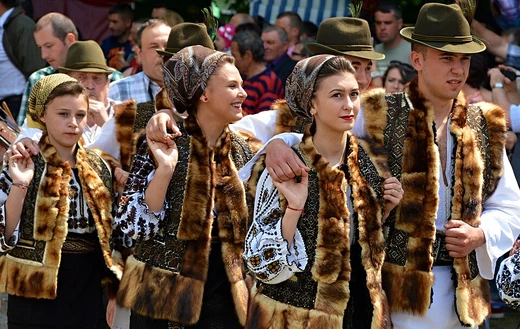
Călușari
Participants in an old Romanian ritual dance with secret society origins.

Costică Axinte · Public domain
The Călușari are participants in an old traditional Romanian dance known as the căluș. They are historically associated with a spring rite, possibly a remnant of tribal warrior societies, and their origins are unknown, with the first widely accepted written attestations dating to the 16th century (e.g., the 1582 account by Stanisław Sarnicki).
Quick Facts
- Genre
- Traditional
- Origin
- Romania
Facts from the source article.
Lore & Background
The Călușari traditionally formed a secret, male-only society. The group leader, usually an older man, recruited young, single adults chosen for physical prowess. Members took an oath of secrecy, underwent an initiation rite, and were taught the dance forms. From the third week after Easter until Pentecost, for around three weeks, they traveled to local communities, dancing accompanied by fiddlers.
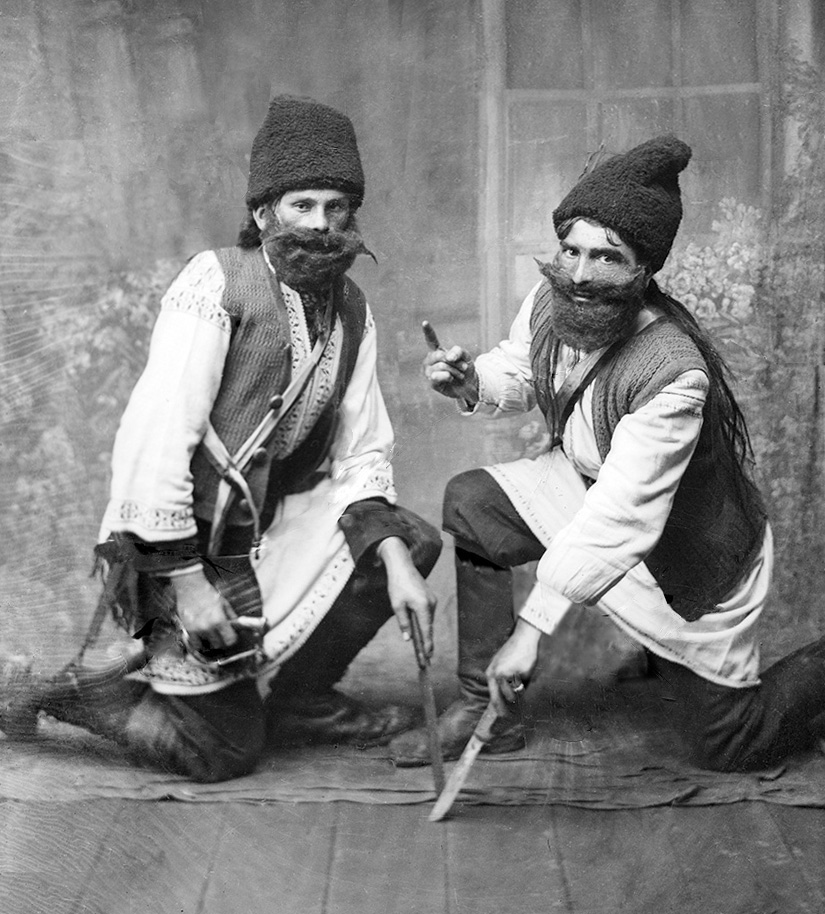
The dance itself is highly acrobatic, with dancers wearing white trousers and tunics, brightly colored ribbons on hats, and bells on their ankles. They use ornate sticks and include a fool figure known as the 'nebun'. The dance includes walking steps in a counterclockwise circle and more complex figures performed in place. Some groups included a mute figure, and ritual silence was observed by the entire group.
According to Romanian historian Mircea Eliade, the Călușari were known for creating the impression of flying, representing both a horse's gallop and the dancing of fairies. Their patron was the 'Queen of the Fairies', also known as Irodiada (and sometimes called Arada in certain traditions). They were believed to cure victims of fairies. The dance also carried military elements: dancers carried clubs, a sword, a flag, and a wooden horsehead, and swore on the flag to treat each other as brothers.
Reader's Guide
The Călușari hold significance as a traditional Romanian ritual practice with deep roots in pre-Christian beliefs, as noted by Mircea Eliade, who observed that despite oaths taken in God's name, the ritual scenario had nothing in common with Christianity. In the 19th century, clerical opposition led to members being excluded from communion for three years in some regions. The etymology of 'Căluș' is disputed, with derivations from Latin 'collusium' (meaning dance group and secret society), from the Romanian word for a small piece of wood placed in the mouth to prevent talking, or as a diminutive of 'cal' (horse). Extensive scholarship has attempted to prove a pure Roman origin, but results are not persuasive. The dance is similar to other male group dances along the Carpathians and in Transylvania, as well as to Bulgarian and Macedonian rusalii and English Morris dance, suggesting a common European folk dance heritage. The Călușari tradition was proclaimed an Oral and Intangible Heritage of Humanity.
Did You Know?
- The first widely accepted written attestations of the Călușari date to the 16th century (e.g., the 1582 account by Stanisław Sarnicki).
- In the 19th century, clerical opposition led to Călușari members being excluded from taking communion for three years in some regions.
- The dance includes a fool figure known as the 'nebun', or 'crazy'.
The Cultural Ecosystem of Romanian Tradition
Romanian folklore—shared by both Romanian and Moldovan communities—occupies a unique position in the broader cultural landscape. Unlike many European traditions where popular and high culture developed in parallel, Romanian society maintained a deeply intertwined relationship between the two. The predominantly rural nature of Romanian communities gave rise to a remarkably vibrant and inventive traditional culture. Before the eighteenth century, folk creations such as the celebrated ballad Miorița served as the principal literary genre, functioning simultaneously as a wellspring of inspiration for educated writers and as a structural template for their compositions. On the other hand, learned culture for centuries operated under the direction of official and social mandates, taking shape in the courts of princes and boyars as well as within monasteries. This dual dynamic meant that the oral, communal traditions never simply existed beneath a separate elite culture; rather, they fed into and shaped the very architecture of Romanian literary and artistic expression, creating a cultural ecosystem in which the village and the court were in constant, generative dialogue.
Cosmological Foundations: God, the Devil, and the World Ocean
The Romanian folk imagination places creation at the edge of a boundless ocean called Apa Sâmbetei, where God and the Devil coexist not as equals but as master and servant. In these narratives, the Devil—known as Nefârtatul, the Uncreated One—is portrayed as God's somewhat foolish brother. When God resolves to fashion the Earth, he dispatches the Devil to retrieve a handful of clay from the ocean floor. The Devil attempts to perform the task in his own name and fails repeatedly until he finally invokes God's name, at which point the clay surfaces and swells into the world. God then lies down to rest upon the new Earth, and the Devil, in a fit of mischief, tries to shove him into the sea from each of the four cardinal directions. Each attempt is thwarted by the ever-expanding land. Finally, the Devil recoils from a cross he himself has scratched into the ground. These creation tales are not uniquely Romanian; parallel versions appear across Aromanian, Slavic Macedonian, and Bulgarian folk traditions, suggesting a shared mythological heritage in the broader Balkan and Danubian world.
The Blajini and the Mirror Earth
Romanian folk cosmology envisions the Earth as a flat disc, and on its underside lives a hidden people called the Blajini—a word derived from the Slavonian blažĕnŭ, meaning a kind and well-minding person. In Bucovina they are alternatively known as Rohmani. These short, anthropomorphic beings, sometimes depicted with the head of a rat, are described in contradictory ways: some accounts paint them as malicious, while others portray them as deeply pious, sinless creatures who fast throughout the entire year, thereby rendering a great service to humanity. They serve as invisible connectors between the Inner and Hollow Earth. The holiday Paștele Blajinilor, observed on the first Monday after St. Thomas Sunday in Banat, Transylvania, Bucovina, and Maramureș, is a ritual of repayment. Because the Blajini live in isolation and cannot perceive when Easter arrives, Romanians eat dyed eggs and release the shells downstream, believing they will travel to Apa Sâmbetei and reach their hidden kin. Some interpret the Blajini as incarnations of unbaptized dead children, while others trace them to the descendants of Seth or to a people Moses drove away by splitting and then releasing the waters.
The Living Earth and the Approach of the End
In Romanian folk eschatology, the Earth is not inert matter but a living entity capable of shuddering, slipping, and responding to divine command. Mountains, in one telling, sprang into existence when God demanded the Earth to nurture all life and the ground trembled in obedience. In another, the planet was simply too vast to fit beneath the firmament, so God compressed it, raising peaks in the process. Beneath these mountains stand the World Pillars, great supports that hold the Earth aloft. The Devil is perpetually gnawing at them, and when the Earth slips, the result is an earthquake. God and his angels rebuild the pillars during periods of fasting, restoring stability. The most prominent symbol of the End Times in Romanian tradition is precisely this earthquake, accompanied by overflowing waters and collapsing mountains. These catastrophic events are attributed primarily to a collective lack of faith, which accelerates the crumbling of the Pillars. The living, responsive Earth thus becomes the central stage upon which the entire moral and spiritual drama of Romanian folk belief plays out, from creation through daily sustenance to the final dissolution.
Gallery
Frequently Asked Questions
What are the Călușari?
The Călușari are a group of male performers who carry out an ancient Romanian ritual dance called the căluș. Rather than being characters in a single narrative, they are best understood as participants in a traditional spring rite passed down through generations.
What do the Călușari actually perform?
They execute a male group dance that weaves in acrobatic movements, making the routine both physically demanding and visually striking. The performance is tied to seasonal spring rituals and carries overtones of old warrior traditions.
When were the Călușari first documented?
The earliest written record pointing to their existence comes from a 1644 document by Miron Costin, though some scholars suspect the tradition may stretch back even further. Their true origins remain unclear and unverified.
What is the secret-society or fairy connection?
Folklore links the Călușari to secret-society customs and to fairy beings, suggesting their rituals once carried esoteric or initiatory meaning beyond mere entertainment. This mystical layer is what sets them apart from ordinary folk dances.
Why are the Călușari important in Romanian folklore?
They represent one of the oldest surviving male ritual traditions in Romanian culture, possibly echoing the practices of ancient tribal warrior groups. Their continued performance into the modern era makes them a living thread connecting present-day Romania to its pre-Christian past.
More in Romanian folklore 1-21
Spotted an error? Know more?
Reader corrections go straight into our review queue. Suggest an edit · How this site is sourced