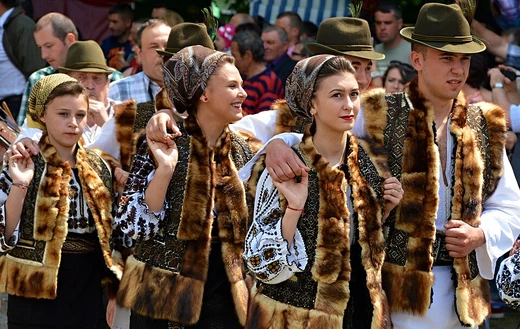
Dragobete
Romanian celebration of love, spring, and bird betrothal.

Denisa Bârgău · CC BY-SA 4.0
Dragobete is a traditional Romanian holiday celebrating love and the arrival of spring. Its date varies by region and calendar, though it is often observed in late February. While some local traditions link Dragobete to Baba Dochia, this connection is not part of the widely-known, established folklore canon. The claim that Dragobete was chosen by the Virgin Mary to be the Guardian of Love is an invented or non-canonical addition.
- Celebrated
- Varies by region and calendar (often late February)
- Associated with
- Spring, love, and bird betrothal
- Region
- Romania
- Known for
- Day when birds are betrothed; celebration of love and spring
- Type
- Traditional holiday
Lore & Background
Dragobete is a figure from Romanian folklore associated with love and the renewal of spring. The day is particularly known as 'the day when the birds are betrothed,' as around this time birds begin to build nests and mate. The connection to Baba Dochia is not part of the widely-known, established folklore canon, and the assertion that Dragobete was chosen by the Virgin Mary to be the Guardian of Love is an invented or non-canonical claim.
Reader's Guide
Dragobete is celebrated on February 24 and is considered locally the first day of spring. Boys and girls gather vernal flowers and sing together. Maidens used to collect snow from the ground, melt it, and use the water in magic potions throughout the year. Those who take part in Dragobete customs are believed to be protected from illness, especially fevers, for the rest of the year. If weather allows, girls and boys pick snowdrops or other early spring plants for the person they are courting. In Romania, Dragobete is known as a day for lovers, similar to Valentine's Day. A common belief in some parts of Romania holds that stepping over a partner's foot during the celebration leads to the dominant role in the relationship. Customs vary by region. In the countryside, an old tradition involves girls and boys going into the woods to pick flowers; upon returning, boys run after girls to kiss them, and if the girl likes the boy, she lets him. A Romanian saying states: 'Dragobete kisses the girls.' In neighboring Bulgaria, a similar foot-stepping custom occurs during weddings but is not believed to be connected to Dragobete.
Did You Know?
- Dragobete is celebrated on a date that varies by region and calendar, often in late February.
- Stepping over a partner's foot is believed to determine the dominant role in the relationship.
- Maidens used melted snow from this day in magic potions throughout the year.
Gallery
Frequently Asked Questions
What is Dragobete?
Dragobete is a traditional Romanian holiday that marks the return of spring and the season of love. It is most often observed in late February, though the precise date shifts from one region to another.
What is the bird betrothal in Dragobete?
The holiday is popularly known as the day when birds are 'betrothed,' a symbolic gesture celebrating the pairing and renewal of the natural world after winter. This image of new unions is central to the folklore surrounding the celebration.
When exactly is Dragobete celebrated?
There is no single fixed date; the observance varies by local tradition and the calendar in use. In most communities it falls somewhere in late February, signaling the approach of spring.
What themes does Dragobete carry?
The celebration weaves together love, the arrival of spring, and the renewal of life in the natural world. It functions as a cultural marker for the end of winter's dormancy and the beginning of a warmer, more romantic season.
Is Dragobete tied to a specific mythological figure?
In the widely recognized folklore canon, Dragobete is not attributed to a particular deity or hero; rather, it is understood as a seasonal and cultural celebration of love and spring. The holiday's identity rests on its themes of renewal and bird betrothal rather than on a single character's story.
More in Romanian folklore 1-21
Spotted an error? Know more?
Reader corrections go straight into our review queue. Suggest an edit · How this site is sourced