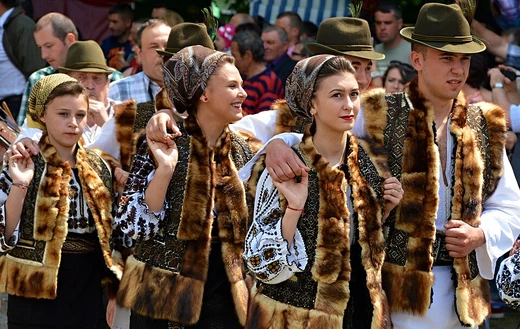
Dodola and Perperuna
Southeast European rainmaking rites invoking pagan deities.

Andrey Shishkin · CC BY 3.0
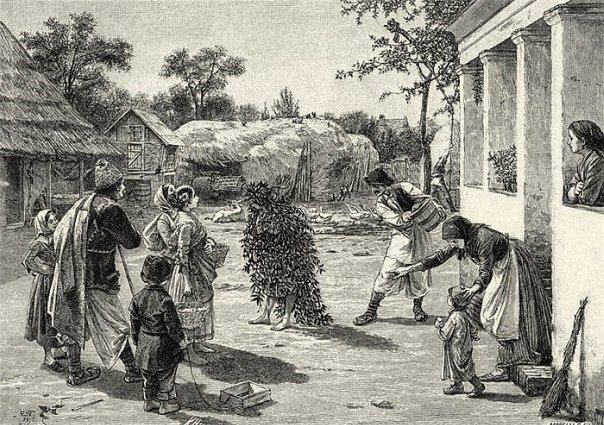
Dodola and Perperuna are names for rainmaking pagan customs widespread among different peoples in Southeast Europe until the 20th century, found in Albania, Bulgaria, Croatia, Greece, Hungary, Kosovo, Moldova, Montenegro, North Macedonia, Romania, and Serbia. The ritual is an analogical-imitative magic rite consisting of singing and dancing by young girls or boys following a main performer dressed with fresh branches, leaves, and herbs, intended to invoke rain during droughts. The custom is still practiced in remote Albanian ethnographic regions, but only in rare events when the summer is dry and without atmospheric precipitation.
- Also known as
- Dodole, Dudola, Perperuna, Peperuda, Preperuda, Prporuša, Papaluga, and many local variants
- Region
- Southeast Europe (Albania, Bulgaria, Croatia, Greece, Hungary, Kosovo, Moldova, Montenegro, North Macedonia, Romania, Serbia)
- Type
- Pagan rainmaking ritual
- Practitioners
- Young girls or boys, with a main performer dressed in branches and herbs
- Purpose
- Invoking rain during droughts to protect crops, pastures, and human life
- Status
- Largely extinct by the 20th century; still practiced rarely in remote Albanian regions
Lore & Background
The customs are generally named after the divine figure invoked in ritual songs, as well as the boy or girl who performs the rite. Names vary widely: Preperuna, Peperuna, Preperuda, Peperuda in Bulgaria and North Macedonia; Prporuša, Parparuša, Preporuša in Croatia; Peperuda, Papaluga, Paparudă in Romania and Moldova; Perperouna, Perperinon in Greece; Perperona, Rona in Albania; Pirpirunã among Aromanians; and Dodola (with variants Dodole, Dudola, Dudula, Dudulica, Doda, Dodočka, Dudulejka, Didjulja, Dordolec) in Serbia and other countries. In Albanian, the ritual is also called riti i ndjelljes së shiut ('Rain-Invoking Ritual'), riti i thirrjes së shiut ('Rain-Calling Ritual'), riti i thatësisë ('Drought Ritual'), and riti i dordolecit ('Dordoleci Ritual').
Reader's Guide
The significance of Dodola and Perperuna lies in their shared presence across multiple Balkan ethnic groups, reflecting a common pre-Christian heritage. Scholars debate their origin: one interpretation suggests a Slavic origin related to the god Perun, with Perperuna as a possible Slavic goddess of rain and wife of Perun. Recent research criticizes the invention of a Slavic female goddess, indicating both Slavic and old-Balkan influences. In Albanian ritual songs, Dielli (the Sun), Perëndi (the Sky or deity of weather), and Ilia (Elijah, who in Christianized Albanian and South Slavic folklore replaced the Sun god and thunder/weather god) are invoked. Etymological analysis is uncertain, with some linking the names to the Indo-European god *Perkʷūnos, while others derive them from words for butterfly, quail, or onomatopoeic roots. The custom has parallels in ancient Mediterranean rainmaking practices documented since Minoan and Mycenaean times, though strong historical evidence for a direct link is lacking. The ritual's persistence into the 20th century and its rare survival in remote Albanian regions highlight its enduring cultural resonance.
Did You Know?
- The name Dodola has been suggested to be a cognate to the Lithuanian Dundulis, a word for 'thunder' and another name of the Baltic thunder-god Perkūnas.
- Similar customs outside the Balkans have been observed in the Caucasus, Middle East, and North Africa.
A Shared Balkan Heritage Across Nations
The rainmaking customs known as Dodola and Perperuna represent one of the most geographically widespread pagan traditions in Southeast Europe. Documented across Albania, Bulgaria, Croatia, Greece, Hungary, Kosovo, Moldova, Montenegro, North Macedonia, Romania, and Serbia, the practice unified diverse peoples—South Slavs, Albanians, Greeks, Hungarians, Moldovans, Romanians, and Aromanian Vlachs including those of Bukovina and Bessarabia—under a common agricultural desperation. Despite this broad distribution, the tradition carried two distinct naming streams: the Slavic-prototype *Perperuna family and the Dodola family, suggesting the customs may have entered different ethnic groups at different historical moments. Scholars have noted that similar rainmaking rites appear beyond the Balkans in the Caucasus, the Middle East, and North Africa, while Jacob Grimm once proposed connections to Bavarian and Austrian spring rituals. The sheer breadth of the phenomenon makes it one of the most striking examples of shared pre-Christian folk religion in the region.
The Ceremony of Rain-Calling
At its core, the Dodola-Perperuna rite is an analogical-imitative magic performance designed to coax precipitation from a sky that has withheld it. Young girls or boys form processions that follow a principal performer adorned with fresh branches, leaves, and herbs. The ensemble sings and dances through the community, their songs invoking specific divine figures. In Albanian tradition, the ritual songs call upon Dielli (the Sun), Perëndi (the Sky or weather deity), and Ilia (Elijah), the latter having absorbed the roles of older thunder and weather gods in Christianized folklore. The timing is dictated by survival: the rite is performed during summer droughts when the absence of rain threatens crops, pastures, and even human life itself. While the practice faded across most of Southeast Europe by the twentieth century, it persists in remote Albanian ethnographic regions, emerging only on rare occasions when an unusually dry summer demands intervention.
A Tangle of Names and Etymologies
The naming of these rainmaking figures presents one of the most tangled etymological puzzles in Balkan folklore studies. The Slavic-prototype *Perperuna spawns a vast family: Preperuna and Peperuda in Bulgaria and North Macedonia; Prporuša and Barburuša in Croatia; Peperuda, Papaluga, and Babaruta in Romania and Moldova; Perperouna and Parparouna in Greece; Perperona and Rona in Albania; and Pirpirunã among Aromanians. The Dodola stream adds its own variants—Dudola, Dudula, Dordolec, Didjulja, and dozens more across Serbia and neighboring areas. Scholars have proposed radically different origins: Roman Jakobson saw reduplication of a root meaning to strike; Dimitar Marinov linked it to the Bulgarian word for butterfly; Petar Skok derived prporuša from the image of water poured on hot ash; Urbańczyk and Łuczyński traced it to a Proto-Slavic quail name. Dodola itself may echo Lithuanian Dundulis for thunder or even Greek Dodona. The multiplicity of theories has prompted calls for a comprehensive comparative study of rainmaking song formulas across all Balkan languages.
Mythological Roots and the Question of Origin
The deepest scholarly question surrounding Dodola and Perperuna concerns their mythological ancestry. The dominant interpretation ties the customs to the Slavic thunder-god Perun, with Perperuna once understood as his rain-bringing consort. This (Balto-)Slavic theory, rooted in Proto-Indo-European heritage, finds parallels in Vedic prayers to the rain-thunder deity Parjanya and in the Baltic thunder-god Perkūnas, a cognate alongside Perun. However, recent research has challenged the very existence of a Slavic female rain goddess, arguing that the figure was a later scholarly invention, and points instead to a blend of Slavic and older Balkan influences. Albanian ritual songs, which invoke Perëndi and the Christianized Elijah, complicate a purely Slavic origin. Ancient Mediterranean rainmaking traditions documented since Minoan and Mycenaean times offer typological parallels, though no strong historical evidence links those ancient practices directly to the customs that survived into the twentieth century. The shared Balkan tradition remains, in essence, a puzzle of mutual borrowing whose direction and timing scholars have not yet resolved.
Gallery
Frequently Asked Questions
What is Dodola and Perperuna?
Dodola and Perperuna are not mythological figures but rather names for a traditional pagan rainmaking rite performed across Southeast European communities, including Romania, to call down rain when droughts threatened crops, pastures, and livelihoods. The practice is classified as a form of analogical-imitative magic rather than a story about deities.
How is the Dodola and Perperuna ritual actually performed?
A lead performer wears an outfit made of fresh branches, leaves, and herbs while a group of young girls or boys follows behind, singing and dancing together. The collective movement and song are intended to symbolically summon rainfall during periods of severe dry weather.
Who carries out the Dodola and Perperuna ceremony?
The rite is led by a single main performer adorned in greenery and herbs, with a group of young girls or boys joining in the singing and dancing. It is a community-oriented performance rather than a solo act by a priest or shaman.
Is Dodola and Perperuna still practiced in Romania today?
The custom largely vanished across most of Southeast Europe by the twentieth century and is no longer an active tradition in Romania. It survives only in a handful of remote Albanian ethnographic areas, and even there it is performed only on rare occasions when an unusually dry summer strikes.
What other names is Dodola and Perperuna known by in different regions?
The rite appears under numerous local variants across the Balkans and beyond, including Dodole, Dudola, Peperuda, Preperuda, Prporuša, and Papaluga, among others. These different spellings reflect the diverse linguistic communities—Albanian, Bulgarian, Croatian, Greek, Hungarian, Romanian, Serbian, and others—that once carried out the practice.
More in Romanian folklore 1-21
Spotted an error? Know more?
Reader corrections go straight into our review queue. Suggest an edit · How this site is sourced