Arcan (dance)
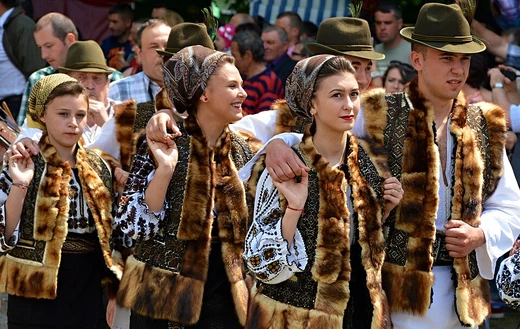
Romanian men's line or circle dance.

Ali Isenkul · CC BY-SA 4.0
The Arcan is a Romanian custom, popular dance, and melody, also known as laț or pripon (meaning 'lasso' or 'aiguillette'). It is typically performed by men in a line or circle and is part of the larger group of circle dances called hora. A slower version, Arcanul bătrânesc, is danced in the Moldavian region of Romania.
- Type
- Folk dance and custom
- Origin
- Romania
- Region
- Moldavia (for Arcanul bătrânesc)
- Also known as
- laț, pripon
- Associated with
- hora circle dances
Lore & Background
The Arcan dance is performed by amateurs, professional ensembles, and other folk dance performers. The step involves the right foot stepping to the side (or double stamping as momentum builds), the left foot crossing behind, the right foot stepping to the side again, and the left foot hopping in front with a bent knee. Men dance with their arms on each other's shoulders. The dance is performed by men of various ages, not restricted to marriageable boys, and is not tied to a rite of passage like the călușari. The name 'Arcan' is sometimes linked to the word for 'lasso,' but the etymology connecting it to conscription methods is speculative and not part of mainstream Romanian folklore scholarship. There is no known historical document called 'Lex Antiqua Valachorum' that relates to this dance.
Reader's Guide
The Arcan holds significance as both a folk dance and a social ritual marking the transition from boyhood to marriageable manhood in Romanian communities. Its name and steps reflect a historical conscription practice, giving the dance a forceful, initiatory character. The dance is accompanied by specific verses, such as those mentioning the 'green belt' that identifies a man as having emerged from adolescence. Precision in performing the dance is crucial, as it determines community acknowledgment of eligibility. The Arcan has been performed internationally: in 1908 in Vienna and in 1937 in London, winning prizes. A fresco at Humor Monastery (built 1530) depicts Arcan dancers with a lăutar. The dance was also brought to southwestern Ukraine by the Hutsuls, where it is called Arkan or Arcan. Ukrainian Eurovision 2004 winner Ruslana Lyzhichko, of Hutsul origin, used traditional Hutsul sounds and moves on her 'Wild Dances' album, which included an arkan song. The Arcan thus represents a living tradition linking folk performance, social structure, and historical memory.
Did You Know?
- The Arcan is also called laț or pripon, meaning 'lasso' or 'aiguillette'.
- The Hutsul Arkan is a distinct Carpathian dance with its own origins, not directly derived from the Romanian Arcan; the direction of influence is debated or reversed in some sources.
- Unlike some folk dances, the Arcan does not require a bonfire and is danced in a line or circle formation.
Rite of Passage and Social Function
The Arcan is not merely a dance but a formalized ritual of transition, marking the moment a boy crosses into the category of marriageable young man. Performed exclusively by males dressed in traditional Romanian costumes, it carries what scholars describe as a rite-of-passage character. The very act of joining the circle is framed in forceful, almost violent language: participants grab or lasso one another into the dance, a terminology that mirrors the conscription practices of Early Modern Wallachia and Moldavia, where authorities would selectively kidnap boys into military service. In the ritual context, established men led by an authority figure ritually compel the younger boys—still regarded as children—into the hora. This violence is entirely symbolic, serving to initiate the boy into the next rung of the social hierarchy. Crucially, completing the Arcan was a prerequisite for later participation in the more elaborate căluşari ritual dance. These layered requirements for organizing groups of young men are tied to the Lex Antiqua Valachorum, the ancient Vlach legal code, underscoring how deeply embedded the dance was in communal governance and social structure.
Choreography and Performance Setting
The Arcan unfolds around a burning bonfire, a setting that lends the circle dance its primal, communal energy. Dancers link arms over one another's shoulders, forming the characteristic ring of the hora family of circle dances. The step pattern is precise and repetitive: the right foot steps to the side—or double-stamps as the tempo builds—the left foot crosses behind, the right foot steps out again, and the left foot hops forward with a bent knee. This sequence is repeated in a driving rhythm that intensifies as the dance progresses. The performance is not limited to a single tempo; in the Moldavian region of Romania, a slower variant known as Arcanul bătrânesc preserves an older, more measured pace, the word bătrân carrying the dual sense of ancient and old and serving as a common honorific for traditional dances across the country. The dance is performed by a wide spectrum of practitioners, from amateur village groups to professional folk ensembles, ensuring that the choreographic vocabulary remains alive in both rural and staged contexts. The bonfire, the linked arms, and the stamping feet together create a sensory tableau that distinguishes the Arcan from other hora variations.
Verses and Symbolic Language
The Arcan is inseparable from its spoken and sung verses, which function simultaneously as lyrical poetry, choreographic instruction, and social commentary. One well-known couplet invokes the green belt (brâul verde), a sash worn by men to signal that they have emerged from adolescence and entered the eligible pool. A man who has completed the dance earns titles like arcănit (arkaned), bun de oi (good for sheep, meaning fit to be a shepherd), or bun de însurat (good to be married). As the rhythm quickens, dancers shout repetitive refrains that codify the steps—counting three beats and calling for a knee forward—turning the choreography into a shared verbal script. A separate set of verses serves as a caution to the young participants: take care, boys, do not disgrace yourselves, for the girls are watching. This layer of social performance, where precision in execution is publicly scrutinized by the opposite sex, reinforces the dance's role as a communal assessment of a boy's readiness for adult life.
Cross-Cultural Legacy and International Recognition
The Arcan's influence extends well beyond Romanian borders. In 1908, a Romanian dance troupe performed the dance in Vienna, and in 1937 they repeated the feat in London, both times receiving prizes from the event organizers for the quality of their presentation. Visual evidence of the dance's antiquity survives in a fresco at Humor Monastery, built in 1530 in northern Moldavia, which depicts arcan dancers accompanied by a lăutar, a traditional stringed-music player. The dance also traveled to southwestern Ukraine, where the Hutsul ethnic subgroup adopted it under the names Arkan or Arcan. This Ukrainian thread found a striking modern echo when Ruslana Lyzhichko, a Hutsul-origin artist, won the Eurovision Song Contest in 2004 and subsequently incorporated traditional Hutsul sounds and movements—including an arkan song—into her Wild Dances album. These threads collectively demonstrate how a localized Romanian rite of passage evolved into a pan-Carpathian cultural marker, recognized on stages from medieval monasteries to the global Eurovision arena.
Gallery

Frequently Asked Questions
What is Arcan in Romanian folklore?
Arcan is a traditional Romanian men's ritual dance and melody, performed in a circle around a bonfire. It is classified as both a folk custom and a dance, and it belongs to the larger family of circle dances called hora.
What do the alternative names laț and pripon mean?
The dance is also referred to as laț or pripon, which translate to 'lasso' and 'aiguillette' respectively. These names are used interchangeably with Arcan across different Romanian-speaking communities.
How is Arcan traditionally performed?
Groups of men dance in a circle around a bonfire, making the event a communal ritual rather than a solo performance. It is tied to rites of passage, so the bonfire setting marks a significant social and spiritual moment.
What is Arcanul bătrânesc and where is it found?
Arcanul bătrânesc is a slower-paced variant of the standard Arcan dance. It is specifically associated with the Moldavian region of Romania.
How does Arcan relate to the hora dance tradition?
Arcan is one member of the broader hora family of Romanian circle dances, sharing the communal, circular structure that defines that genre. Its distinguishing features are the bonfire setting, the exclusively male participants, and its ritual purpose.
More in Romanian folklore 1-21
Spotted an error? Know more?
Reader corrections go straight into our review queue. Suggest an edit · How this site is sourced