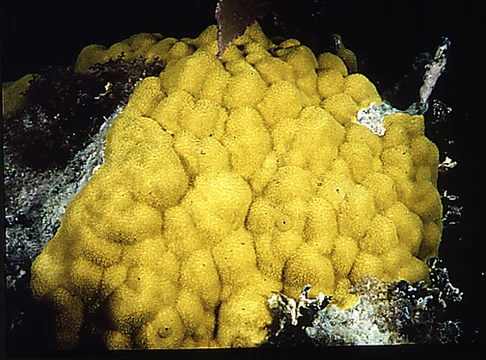
Porites
A stony coral genus with finger-like morphology and paleoclimate utility.

Porites is a genus of stony coral, classified as small polyp stony (SPS) corals, also referred to as finger coral or hump coral. They are notable for their finger-like morphology, widely spaced calices, well-developed wall reticulum, and bilateral symmetry, and are found in reefs throughout the world, serving as hosts for Christmas tree worms and as accurate recorders of past marine surface conditions.
Quick Facts
- Taxon
- Porites
Facts from the source article.
Lore & Background
Porites corals are characterized by a finger-like morphology, widely spaced calices, a well-developed wall reticulum, and bilateral symmetry. Members of this genus, particularly Porites lutea, often form microatolls. They are found in reefs throughout the world and are a dominant taxon on the Pandora platform of the Great Barrier Reef, where Potts et al. (1985) identified seven dominant species: P. lobata, P. solida, P. lutea, P. australiensis, P. mayeri, P. murrayensis, and P. anae. The oldest of six colonies in this reef was approximately 700 years old, growing at 10.3 mm per year. Representatives of this genus are found in both the Indo-Pacific and Caribbean basins.
In the aquarium trade, specimens are sometimes available but difficult to keep due to strict water quality, lighting, and dietary requirements. Many collected Porites have Christmas tree worms (Spirobranchus giganteus) boring into them, and are sold as 'christmas tree worm rocks' or 'christmas tree worm coral.' Ecologically, Meyer and Schultz (1985) demonstrated that P. furcata has a mutualistic relationship with schools of French and white grunts (Haemulon flavolineatum and H. plumierii), which provide ammonium, nitrates, and phosphorus compounds, leading to higher growth rates and nitrogen composition in coral heads with resting grunts.
Reader's Guide
Porites corals hold significance in paleoclimatology as accurate and precise recorders of past marine surface conditions. Measurements of the oxygen isotopic composition of their aragonitic skeleton indicate sea-surface temperature and the oxygen isotopic composition of seawater at the time of growth, which reflects the precipitation/evaporation balance. This relationship is important for reconstructing past climates and large-scale patterns such as the El-Nino Southern Oscillation, the Intertropical Convergence Zone, and the mean state of the climate system.
In physiology, some species demonstrate high halotolerance; in the Gulf of Thailand, P. lutea tolerates daily tidal shifts of 10-30‰ salinity. When salinity declines, symbiotic zooxanthellae decrease photosynthesis as the coral contracts its polyps, and the coral temporarily switches to heterotrophy, consuming brine shrimp and other zooplankton. Growth rates can be determined from annual rings; P. astreoides grows about the central axis at 3.67 mm/year, calcifies at 0.55 g/cm²/year, and increases density at 1.69 g/cm³/year. Growth varies seasonally, with P. furcata's rate peaking between May and August.
Threats include predation, climate change, and anthropogenic pollution. Increased temperatures and copper slow P. cylindrica's production and reduce zooxanthellae photosynthesis. Settled larvae are vulnerable to competition from other corals and predation from sea urchins, and mortality likelihood increases after strong storms.
Did You Know?
- Porites corals often serve as hosts for Christmas tree worms (Spirobranchus giganteus).
- The oldest Porites colony on the Pandora platform of the Great Barrier Reef was approximately 700 years old.
- P. furcata has a mutualistic relationship with French and white grunts, which provide it with ammonium, nitrates, and phosphorus compounds.
- P. lutea in the Gulf of Thailand tolerates daily tidal salinity shifts of 10-30‰.
Frequently Asked Questions
What is Porites?
Porites is a genus of small polyp stony (SPS) coral in the poritid family, commonly nicknamed finger coral or hump coral. It is one of the most recognizable reef-building coral groups found across tropical and subtropical waters worldwide.
How old can a Porites colony get?
The oldest known Porites colonies have survived for roughly 700 years, making them among the longest-living reef organisms. Over that extraordinary timespan, those ancient colonies have maintained a growth pace of about 10.3 millimeters per year.
What makes Porites useful for paleoclimate research?
Porites skeletons serve as exceptionally accurate recorders of past marine surface conditions, allowing scientists to reconstruct historical ocean temperatures and chemistry. Their well-developed wall reticulum and consistent calcification patterns preserve the chemical signatures that make those reconstructions possible.
What does Porites look like?
Porites corals are immediately recognizable by their finger-like branching morphology, widely spaced calices, and a pronounced wall reticulum. They also display bilateral symmetry, a trait that distinguishes them from many other stony coral genera.
How fast does Porites grow?
Growth rates differ among the seven dominant species in the genus; Porites astreoides, for instance, adds roughly 3.67 millimeters per year and calcifies at about 0.55 grams per square centimeter. The oldest colonies in the genus, by contrast, have sustained a pace closer to 10.3 millimeters per year over their centuries-long lives.
More in Porites and Poritid Corals 1-17
Spotted an error? Know more?
Reader corrections go straight into our review queue. Suggest an edit · How this site is sourced