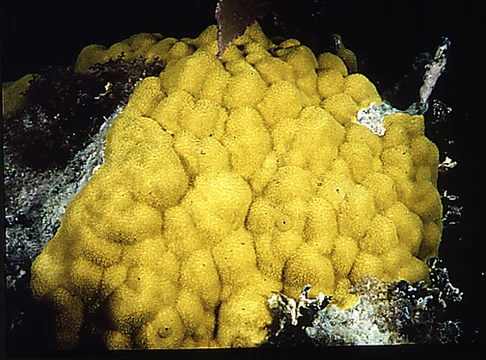
Porites cylindrica
Branching reef-building coral dominant in shallow Indo-Pacific waters.

Porites cylindrica, commonly known as Hump coral, is a stony coral of the subclass Hexacorallia in the class Anthozoa. It is a hermatypic (reef-building) coral that can grow to a few square meters wide and form micro-atolls, typically cream, yellow, blue, pale brown, or green in color. Notable for its branching growth form, it is dominant in both inshore reefs and midshelf reefs and is an ideal species for coral rehabilitation due to its tolerance of environmental extremes and successful dispersal via fragmentation.
Quick Facts
- Taxon
- Porites cylindrica
Facts from the source article.
Lore & Background
Porites cylindrica is a gonochoric coral species with distinct male and female colonies, releasing sperm and eggs separately rather than as bundles. Its buoyant gametes float to the surface to merge, and the brooding coral internally fertilizes eggs that contain zooxanthellae algae evenly distributed, allowing larvae to establish symbiotic relationships before birth. Larvae settle on hard substrate and develop into polyps, which replicate through budding to form colonies. However, P. cylindrica relies primarily on asexual reproduction through fragmentation, where broken pieces settle and grow into genetically identical colonies.
The coral is sessile, capturing suspended food particles, and obtains most nutrients through a mutualistic relationship with zooxanthellae, a photosynthetic dinoflagellate that provides carbohydrates. Additional nutrients like nitrogen come from detritus and waste from higher organisms. Its branching growth form, with numerous branches sometimes bearing secondary branches, allows faster growth and adaptation to favorable microenvironments but makes it more vulnerable to breakage and injury.
Reader's Guide
Porites cylindrica plays a significant ecological role as a reef-building coral, providing key habitats for fish, invertebrates, plants, sea turtles, birds, and marine mammals. Shallow reef ecosystems it helps construct offer coastlines protection against storms and erosion, and are economically important for food, fishing, diving, and snorkeling. The species is notably suited for coral rehabilitation due to its ability to tolerate environmental extremes and disperse via fragmentation. However, it faces threats from rising carbon dioxide levels, which decrease respiration and photosynthesis rates, and from warming seawater above 34 °C, which reduces zooxanthellae densities and causes coral bleaching, increasing susceptibility to disease and death. The IUCN Red List classified P. cylindrica as Near Threatened on January 3, 2008.
Did You Know?
- Porites cylindrica is gonochoric, with separate male and female colonies that release sperm and eggs individually, not as bundles.
- Its larvae contain zooxanthellae evenly distributed, establishing symbiosis before birth.
- The coral primarily reproduces asexually through fragmentation, where broken pieces grow into genetically identical colonies.
- Seawater temperatures above 34 °C pose risks to its zooxanthellae, leading to coral bleaching.
Frequently Asked Questions
What is Porites cylindrica?
Porites cylindrica, widely recognized by its common name Hump coral, is a stony reef-building coral belonging to the Hexacorallia subclass. It is a hermatypic species found across shallow Indo-Pacific waters, noted for its distinctive branching colony structure.
How large can a Porites cylindrica colony grow?
A single colony can spread across several square meters of substrate, and under favorable conditions these corals can even build small micro-atolls. The individual polyps are quite small, typically just one to three millimeters across.
Where does Porites cylindrica typically live?
This species thrives in shallow waters ranging from about one to eleven meters deep, though it has been observed as far down as twenty meters. It is a dominant presence on both inshore and midshelf reefs throughout the Indo-Pacific region.
Why is Porites cylindrica valued in coral rehabilitation?
Its remarkable tolerance of environmental extremes and its ability to propagate successfully through fragmentation make it a go-to species for reef restoration projects. Because it is also a dominant reef-builder, restoring it helps rebuild overall reef structure.
What is the conservation status of Porites cylindrica?
The IUCN listed this species as Near Threatened in January 2008. Water temperatures exceeding 34 °C pose a serious risk to its symbiotic zooxanthellae, making it vulnerable to heat-stress events.
More in Porites and Poritid Corals 1-17
Spotted an error? Know more?
Reader corrections go straight into our review queue. Suggest an edit · How this site is sourced