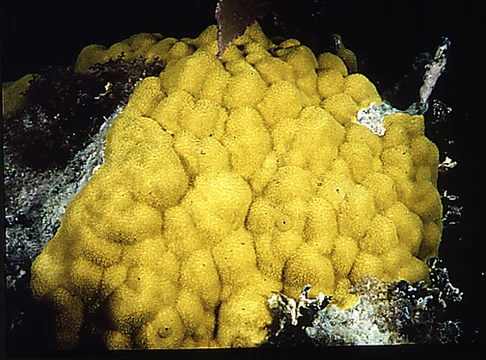
Goniopora columna
A colonial stony coral with columnar mounds and long polyps.

Goniopora columna is a colonial stony coral belonging to the family Poritidae. It forms neat, hemispherical or irregular columnar mounds, often with dead basal sections. The polyps can be yellow, brown, or green, typically with differently colored oral discs. Its small, rounded calices measure about 3 to 5 mm in diameter and have a uniform bundle of tentacles, while the living polyps can extend up to 10 cm in length. The columellae are relatively large and long. This species closely resembles *Goniopora stokesi* and *Goniopora lobata*, but is distinguished by its columnar colony shape and large, light-colored oral disc.
This coral is native to the western and eastern Indian Ocean and the western Pacific Ocean, including the Red Sea, Gulf of Aden, Persian Gulf, Australia, Southeast Asia, Japan, and the East China Sea. Its range extends across many countries, from Australia and Bahrain to Yemen. It is a reef-associated species found in tropical shallow waters, typically in sheltered, sandy, or lagoon environments at depths of 2 to 15 meters, and can also occur in turbid waters. The International Union for Conservation of Nature lists it as "Near Threatened." These corals are moderately susceptible to bleaching, though turbid waters may offer some protection.
Like most corals, *Goniopora columna* reproduces asexually. It usually feeds on plankton. Mature gametes are released through the mouth, and the resulting zygote develops into a planktonic planula larva.
Quick Facts
- Genus
- Goniopora
- Species
- columna
Facts from the source article.
Lore & Background
This species develops hemispherical or irregular columnar mound-shaped colonies with a neat appearance and dead basal parts. The color of the polyps may be yellow, brown or green, usually with different color in the oral discs. The diameter of the small and rounded calices ranges from about 3–5 mm, with a uniform bundle of tentacles. The columellae are rather large and long, and the living polyps can reach a length up to 10 cm.
Goniopora columna is quite similar to Goniopora stokesi and Goniopora lobata, but differs from the other two especially for the columnar shape of the colonies and for the large light-colored oral disc. It is reef-associated and occurs in tropical shallow waters and in sheltered, sandy or lagoon environments, at depths of 2 to 15 m. It may also occur in turbid waters.
The International Union for Conservation of Nature has assessed its conservation status as being 'Near Threatened'. These corals appear moderately susceptible to bleaching, especially in turbid waters, which can help to protect them.
Reader's Guide
Goniopora columna is a colonial stony coral native to the western and eastern Indian Ocean and the western Pacific Ocean, including the Red Sea, the Gulf of Aden, the Persian Gulf, Australia, South-east Asia, Japan and East China Sea. Its distribution spans numerous countries from Australia and Bahrain to Yemen and Vietnam. The species is reef-associated and inhabits tropical shallow waters, sheltered sandy or lagoon environments, and turbid waters at depths of 2 to 15 m. Its conservation status is assessed as 'Near Threatened' by the International Union for Conservation of Nature. The coral appears moderately susceptible to bleaching, though turbid waters may offer some protection. Like most corals, it reproduces asexually and feeds on plankton. Mature gametes are spawned through the mouth, and the zygote develops into a planktonic planula larva. Its hemispherical or irregular columnar mound-shaped colonies, with dead basal parts and polyps colored yellow, brown, or green, distinguish it from similar species such as Goniopora stokesi and Goniopora lobata, particularly by its columnar shape and large light-colored oral disc.
Did You Know?
- The living polyps of Goniopora columna can reach a length up to 10 cm.
- It occurs in turbid waters, which may help protect it from bleaching.
- Goniopora columna is similar to Goniopora stokesi and Goniopora lobata but differs by its columnar colony shape.
Frequently Asked Questions
What is Goniopora columna?
Goniopora columna is a colonial stony coral in the family Poritidae that grows into compact, hemispherical or irregular columnar mounds on shallow reef slopes. Its most eye-catching trait is how far individual polyps can stretch—up to roughly 10 cm—giving the colony a soft, flowing appearance when extended.
How do I tell Goniopora columna apart from G. stokesi or G. lobata?
All three species share small, rounded calices, but G. columna stands out because of its distinctly columnar growth form and its noticeably larger, longer columellae inside each calice. The two look-alikes tend to produce flatter or more lobed colony shapes rather than upright columns.
What do Goniopora columna polyps look like when extended?
The polyps appear in shades of yellow, brown, or green, and the oral disc is usually a contrasting hue from the rest of the body. Each polyp bears a uniform ring of tentacles, and when fully stretched it can reach about 10 cm in length, far exceeding the 3-to-5-mm calice it retracts into.
Where and at what depth does Goniopora columna live?
This species is typically encountered between 2 and 15 meters on reef slopes and shallow flat areas where light is ample. It is moderately susceptible to bleaching, so colonies can show stress during extended warm-water events.
What is the conservation status of Goniopora columna?
Goniopora columna is currently classified as Near Threatened, a designation that reflects ongoing pressure from habitat loss and climate-driven thermal anomalies. Its moderate bleaching susceptibility means it is not yet in immediate danger, but populations are vulnerable without improved reef conditions.
More in Porites and Poritid Corals 1-17
Spotted an error? Know more?
Reader corrections go straight into our review queue. Suggest an edit · How this site is sourced