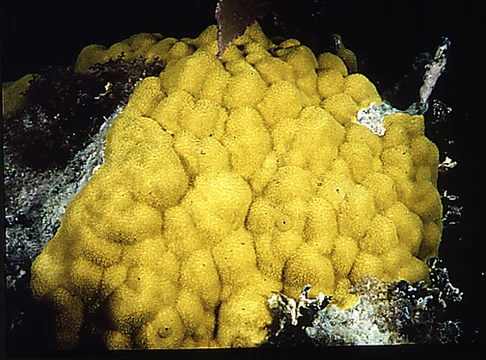
Porites astreoides
A common Caribbean coral lacking finger-like form.

Porites astreoides, called mustard hill coral or yellow porites, is a colonial stony coral from the family Poritidae. It is the only species in its genus that does not grow in a finger-like shape. Its growth form changes with water conditions: in fast-flowing, shallow water it forms encrusting mats; in calmer, medium-depth water it becomes a smooth, mounded, semi-spherical mass up to 60 centimeters across; and in deeper water it grows as plates, which angle toward light under overhangs and in caves. The coral’s small, tightly packed corallites give it a porous look. Its polyps, each with six tentacles, stay retracted during the day. The color—yellow, yellowish-green, pale gray, or pale brown—comes from symbiotic zooxanthellae algae living in its tissue.
This coral is common throughout the Caribbean Sea and the western tropical Atlantic, including North, Central, and South America, as well as the eastern tropical Atlantic off western Africa. It grows on all parts of reefs and in lagoons, usually in water less than 15 meters deep but occasionally down to 50 meters. Sometimes it lives free, attached to loose coral fragments, pebbles, or mollusk shells. Large domed colonies can appear lobed when parts die and the living tissue between them keeps growing.
Polyps feed mostly at night, extending tentacles to catch zooplankton and bacteria, and also get nutrients from photosynthesis by their zooxanthellae during the day. Some colonies are female; others are hermaphroditic. Around the new moon, male gametes are released into the water and drawn into other polyps for fertilization. Larvae are brooded inside the parent colony and released near the full moon. The planula larvae drift with currents before settling and metamorphosing into new polyps, which then form new colonies by secreting a calcium carbonate skeleton and budding—first extratentacular (at the polyp’s side), later intratentacular (within the tentacle ring).
The sponge *Mycale laevis*, with its prominent openings, often grows on the coral’s underside, and fan worms are common associates. The polyps have stinging nematocysts to defend against predators like stoplight parrotfish, other reef fish, snails, worms, and starfish. The coral needs an unshaded spot for its zooxanthellae to work well; sedimentation can limit this, but under good conditions it grows about 3.5 millimeters per year.
Quick Facts
- Taxon
- Porites astreoides
Facts from the source article.
Lore & Background
Porites astreoides exhibits a variety of growth forms depending on its environment. In fast-flowing, shallow water it is encrusting; in calmer water at medium depths it becomes a massive coral with a smooth, mounded, semi-spherical form up to 60 centimetres in diameter. At greater depths it is usually plate-like, and in caves and under overhangs the plates are angled to receive maximum light. The corallites are small and tightly packed, giving the coral a porous appearance. Its color—yellow, yellowish-green, pale grey, or pale brown—comes from symbiotic dinoflagellate zooxanthellae.
The polyps each have six tentacles and are generally retracted during the day, feeding mostly at night on zooplankton and bacteria. Some colonies are female while others are hermaphroditic. Sexual reproduction involves male gametes released near the new moon; sperm is drawn into other polyps for fertilization. Larvae are brooded initially and liberated around the full moon, then drift as planulae before settling and metamorphosing. New colonies grow by budding—first extratentacular, later intratentacular.
This coral often hosts the sponge Mycale laevis on its underside and is associated with fan worms. It uses nematocysts to defend against predators such as stoplight parrotfish, other reef fish, snails, worms, and starfish. It requires unshaded positions for its zooxanthellae to function fully, and sedimentation may limit its growth. Compared to other Porites, it is resistant to disease and bleaching and lives in deeper water, potentially mitigating effects of rising sea temperatures.
Reader's Guide
Porites astreoides is a widespread and common species across the Caribbean Sea, western tropical Atlantic, and eastern tropical Atlantic off western Africa. Its significance lies in its ecological role as a reef-building coral that adapts its growth form to varying water flow, depth, and light conditions—from encrusting in shallow fast-flowing water to plate-like in deeper habitats. It is the only Porites species lacking a finger-like morphology, a distinctive trait within the genus. The coral's symbiotic relationship with zooxanthellae provides much of its nutrition, and its polyps supplement this by nocturnal feeding on zooplankton and bacteria. Its reproductive strategy—with separate female and hermaphroditic colonies, synchronized spawning around the new moon, and brooded larvae released near the full moon—contributes to its successful recruitment. Ecologically, it hosts the sponge Mycale laevis and associates with fan worms, while defending itself with nematocysts against a range of predators. The IUCN lists it as least concern because it is widespread, common, and relatively resistant to disease and bleaching compared to other Porites. Its ability to live in deeper water may offer some resilience to rising sea temperatures, making it a potentially important species for reef persistence under environmental change.
Did You Know?
- Porites astreoides is the only species in the genus Porites that does not have a finger-like form.
- It can grow at a rate of about 3.5 millimetres (0.14 in) per year under good conditions.
- It often has the sponge Mycale laevis growing on its underside.
Frequently Asked Questions
What is Porites astreoides?
Porites astreoides, commonly called mustard hill coral or yellow porites, is a colonial stony coral in the family Poritidae. It is the only member of its genus that never develops the finger-like branching shape seen in its relatives.
How does Porites astreoides change its growth form?
Its shape is dictated by local water conditions: in fast-flowing shallow water it spreads as a flat encrusting mat, in calmer mid-depth zones it builds a smooth semi-spherical dome up to 60 cm wide, and in deeper settings it produces angled plates that tilt toward light beneath overhangs and in caves.
Where does Porites astreoides typically live?
This coral is a common Caribbean reef species, most often found at depths under 15 metres, though records extend to 50 metres. Its small, tightly packed corallites give the colony a distinctly porous surface texture.
How fast does Porites astreoides grow?
Porites astreoides is a slow accretionist, adding roughly 3.5 millimetres of new skeleton per year. Over many decades this steady buildup allows a colony to reach its maximum diameter of about 60 centimetres.
What is the conservation status of Porites astreoides?
The IUCN currently classifies Porites astreoides as Least Concern, reflecting its broad Caribbean distribution and presence across multiple depth zones. Its ability to shift growth form in response to flow and light likely contributes to this stable status.
More in Porites and Poritid Corals 1-17
Spotted an error? Know more?
Reader corrections go straight into our review queue. Suggest an edit · How this site is sourced