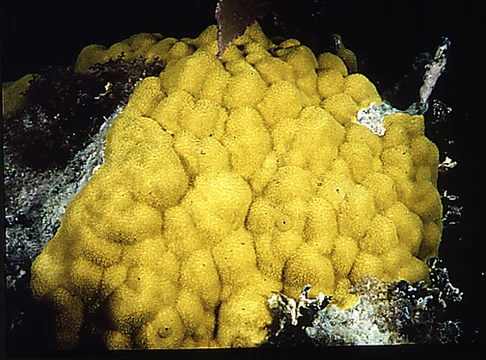
Goniopora stokesi
A near-threatened colonial stony coral with a reputation among aquarists.

Goniopora stokesi is a colonial stony coral, commonly called flowerpot coral or daisy coral, like others in its genus. The IUCN lists it as near threatened.
This coral ranges across the northern Indian Ocean and western Pacific Ocean, from Madagascar and the Gulf of Aden east through the Maldives, southern India, and the East Indies, north to Japan, and south to northern Western Australia and the Great Barrier Reef. It is usually uncommon but conspicuous, though sometimes locally common. It lives at depths of 9–20 meters (30–66 feet), less often from 3–30 meters (10–100 feet). Typically free-living—not attached to a fixed surface—colonies are often hemispherical and found on sandy bottoms in turbid, still waters. They frequently have satellite (daughter) colonies that have not yet separated.
Among aquarists, Goniopora stokesi is known for being both readily available commercially and difficult to keep in captivity. The aquarium trade may contribute to its threatened status.
The species name *stokesi* may honor Charles Stokes (c. 1784–1853), an English amateur malacologist, but confirming this requires consulting the original description, which as of 2018 had not been digitized.
Quick Facts
- Genus
- Goniopora
- Species
- stokesi
Facts from the source article.
Lore & Background
Goniopora stokesi is found widely across the northern Indian Ocean and the western Pacific Ocean. In roughly clockwise order: from Madagascar and the Gulf of Aden in the west, through the Maldives and southern India, through the East Indies, up to Japan, and down to northern parts of Western Australia, and to the Great Barrier Reef in the east. It has been described as usually uncommon but conspicuous, but sometimes locally common. It has been reported at depths of 9–20 m (30–66 ft), less commonly at 3–30 m (10–100 ft). It is usually free-living; that is, not attached to a fixed substrate. Colonies are often found on sandy bottoms, in turbid and relatively still waters. They are usually hemispherical, and often have satellite (daughter) colonies which have not yet budded off.
Goniopora stokesi has a reputation among aquarists both of being readily available commercially, and of being difficult to maintain in captivity. The aquarium trade may be one reason why the species is under threat. The specific epithet stokesi may be in honour of Charles Stokes (c. 1784 - 1853), a respected English amateur malacologist. It would be necessary to consult the original paper describing the species (which as of 2018 does not seem to have been digitised) to settle the matter.
Reader's Guide
Goniopora stokesi is notable for its IUCN status as near threatened, with the aquarium trade cited as a possible reason for its decline. Its reputation among aquarists is twofold: it is readily available commercially, yet difficult to maintain in captivity. This duality highlights a tension between commercial demand and conservation concern. The species is widely distributed across the northern Indian Ocean and western Pacific Ocean, but is described as usually uncommon, though sometimes locally common. Its free-living habit and preference for sandy bottoms in turbid, still waters distinguish it from many reef-building corals. The specific epithet stokesi may honor Charles Stokes, an English amateur malacologist, but the original description has not been digitised as of 2018, leaving the matter unresolved. The species' hemispherical colonies and satellite daughter colonies that have not yet budded off are characteristic features. Its depth range of 3–30 m, with a typical range of 9–20 m, places it in accessible waters, contributing to its availability in the aquarium trade. The combination of commercial interest and conservation vulnerability makes Goniopora stokesi a species of particular interest for marine conservation and aquarium husbandry discussions.
Did You Know?
- Goniopora stokesi is categorised as near threatened by the IUCN.
- It is usually free-living and not attached to a fixed substrate.
- The specific epithet stokesi may honour English amateur malacologist Charles Stokes.
- The aquarium trade may be one reason the species is under threat.
Frequently Asked Questions
What is Goniopora stokesi?
Goniopora stokesi is a colonial stony coral in the genus Goniopora, widely known by the informal names flowerpot coral and daisy coral. The IUCN currently lists the species as near threatened.
Where does Goniopora stokesi live in the wild?
Its range spans the northern Indian Ocean and western Pacific, running from Madagascar and the Gulf of Aden eastward through the Maldives, southern India, and the East Indies, and north to Japan or south to the Great Barrier Reef. It is generally uncommon but can be locally abundant in patches.
At what depth can I expect to find Goniopora stokesi?
Most colonies sit between 9 and 20 meters (about 30–66 feet) below the surface. Less frequently, you may encounter them anywhere from 3 to 30 meters (10–100 feet) deep.
What is the conservation status of Goniopora stokesi?
The IUCN Red List classifies it as near threatened, indicating it is approaching the threshold for a threatened category but does not yet meet the full criteria. Across its broad range it tends to be uncommon, though it is visually conspicuous where present.
Why is Goniopora stokesi nicknamed flowerpot or daisy coral?
Those common names come from the distinctive colonial shape the organism forms as its polyps arrange into a rounded, pot-like or daisy-like structure. The scientific specific epithet 'stokesi' is thought to honor Charles Stokes (c. 1784–1853), an English amateur malacologist.
More in Porites and Poritid Corals 1-17
Spotted an error? Know more?
Reader corrections go straight into our review queue. Suggest an edit · How this site is sourced