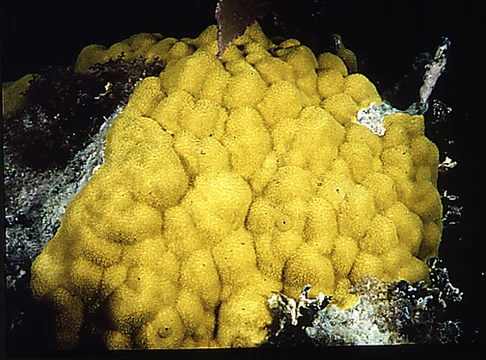
Porites nodifera
A hardy dome coral tolerant of high salinity and disease.

Porites nodifera, commonly called dome coral, is a stony coral belonging to the family Poritidae. German physician and zoologist Carl Benjamin Klunzinger, who worked in the Red Sea region during the 1860s and classified species in the 1870s and 1880s, first described it.
This coral grows on a hard base, forming column-like structures that reach toward the water’s surface. The tops of these columns are fairly flat and circular, and the coral’s surface is relatively smooth. Its color ranges from dark brown to light brown. It resembles Porites harrisoni, another Porites species found in the Persian Gulf, but Porites nodifera tends to produce noticeably thicker columns.
The species is native to the northwestern Indian Ocean, including the Red Sea, Gulf of Aden, and Persian Gulf. It lives in shallow water, usually less than 5 meters deep, but can occur up to 15 meters. It tolerates salinities as high as 4.8 percent, making it very common in areas with high salinity where seagrasses also thrive. Because salinity limits the lower zones of coral reefs, this species can dominate the lowest reef zones, such as those in Egypt’s Dahab Reef, where it forms a large single-species stand. Only one other species, Millepora sp., coexists there in very sparse numbers. In areas of normal Red Sea salinity (4.0–4.2 percent), Porites nodifera does not tend to dominate due to competition from many other coral species. In the Persian Gulf, Porites nodifera and other Porites species are the dominant corals, possibly because coral bleaching has affected Acropora species more heavily, allowing Porites to fill the gaps.
Porites nodifera can contract Arabian Yellow Band Disease (AYBD), a common ailment among several coral species in the Persian Gulf. Infected corals show a yellow band that spreads over healthy tissue, killing it. However, the disease often stops progressing before infecting the entire coral, allowing Porites nodifera to recover by building new skeletons.
The IUCN lists this coral as Least Concern. Its most significant known threat is the widespread loss of coral reef habitat due to climate change and ocean acidification. A 2020 study in the Red Sea indicated that this species has a high tolerance to rising water temperatures and may serve as a refuge for other species because of this ability.
Quick Facts
- Taxon
- Porites nodifera
Facts from the source article.
Lore & Background
Porites nodifera was first described by Carl Benjamin Klunzinger, a German physician and zoologist active in the Red Sea region in the 1860s, classifying its species in the 1870s and 1880s. It has a hard substrate and grows in column-like structures toward the water surface, with each column having a relatively flat, circular top and a fairly smooth surface. Its color ranges from dark brown to light brown, and it resembles Porites harrisoni but forms substantially thicker columns.
This species is native to the northwestern Indian Ocean, including the Red Sea, Gulf of Aden, and Persian Gulf, found in shallow water generally at depths less than 5 metres but up to 15 metres. It tolerates salinities up to 4.8% and is very common in areas of high salinity where sea grasses dominate. Salinity limits the lower zones of coral reefs, allowing Porites nodifera to dominate the lowest zones of the Dahab Reef in Egypt, forming a considerable single species stand; only Millepora sp. co-exists there in very sparse numbers. In normal Red Sea salinities (4.0-4.2%), it does not tend to dominate due to interspecific competition.
In the Persian Gulf, Porites nodifera and other Porites species are the dominant corals, possibly because coral bleaching has affected Acropora species more, allowing Porites to fill gaps. The species can become infected with Arabian Yellow Band Disease (AYBD), which appears as a yellow band that encroaches on healthy tissue. However, Porites nodifera can overcome AYBD, as the disease often halts and becomes inactive before infecting the entire coral, allowing the coral to rejuvenate by building new skeletons.
Reader's Guide
Porites nodifera holds significance as a resilient coral species in harsh environments. Its high tolerance to salinity up to 4.8% enables it to dominate lower reef zones where few other corals survive, such as in the Dahab Reef in Egypt, where it forms a considerable single species stand. In the Persian Gulf, it is among the dominant corals, likely due to its ability to recover from bleaching events that have reduced Acropora populations. The species also demonstrates a notable capacity to recover from Arabian Yellow Band Disease, as the disease often becomes inactive before killing the entire coral, allowing it to regenerate new skeletons. Conservation-wise, it is listed as Least concern by the IUCN Red List, but faces threats from climate change and ocean acidification. A 2020 study in the Red Sea suggested that Porites nodifera has a high tolerance to increasing environmental temperature and may serve as a refuge for other species. Its legacy lies in its adaptability to extreme conditions and its role in maintaining reef structure in areas where other corals struggle.
Did You Know?
- Porites nodifera was first described by German physician and zoologist Carl Benjamin Klunzinger.
- It can tolerate salinities up to 4.8%, allowing it to dominate high-salinity zones.
- The species can recover from Arabian Yellow Band Disease, which often becomes inactive before killing the entire coral.
Frequently Asked Questions
What is Porites nodifera?
Porites nodifera is a stony coral in the family Poritidae, commonly known as dome coral. It builds upright, column-like growths on a hard substrate, with the column tops flattening into broad, circular caps.
Where is Porites nodifera found?
This species is native to the northwestern Indian Ocean, ranging across the Red Sea, Gulf of Aden, and Persian Gulf. It typically inhabits shallow waters from just under 5 metres down to about 15 metres.
What does Porites nodifera look like?
The coral presents a relatively smooth surface and grows in upright, column-like forms with flat, round tops. Its coloration spans from dark brown to lighter brown tones.
Who first described Porites nodifera?
The species was originally described by German physician and zoologist Carl Benjamin Klunzinger, who conducted his fieldwork in the Red Sea area during the 1860s and published his classifications in the 1870s and 1880s.
Why is Porites nodifera considered a hardy coral?
It can tolerate salinity levels as high as 4.8%, making it resilient in fluctuating coastal environments. It is also notably resistant to disease, which sets it apart from many other reef-building corals.
More in Porites and Poritid Corals 1-17
Spotted an error? Know more?
Reader corrections go straight into our review queue. Suggest an edit · How this site is sourced