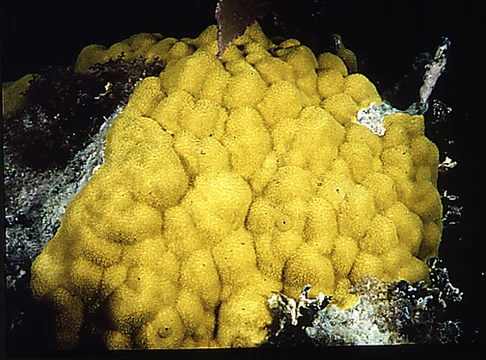
Porites furcata
A common Caribbean stony coral forming dense clumps of slender lobes.

Porites furcata—also called hump coral, thin finger coral, or branched finger coral—belongs to the stony coral genus Porites. Its range includes the Caribbean Sea and the western Atlantic Ocean.
This coral grows in colonies made up of short, slender lobes with rounded tips. The lobes are often packed tightly together and can form patches covering several square meters. The coral is yellow or pale brown, and each lobe is between 1 and 2 centimeters thick. The inner parts of the colony frequently take on a purplish tint and are dead, likely because newer growth above blocks light and cuts off water flow. In size, Porites furcata sits between two related species: Porites porites, whose branches are about 2.5 centimeters wide, and Porites divaricata, whose branches are less than 1 centimeter wide.
The species lives in the Caribbean Sea, the Gulf of Mexico, the Bahamas, and southern Florida, from the low-water mark down to around 20 meters deep. It has not been found in Bermuda. Its preferred habitat is back reefs, though it also appears in other reef zones. Where it is common, the dead, basal parts of the coral contribute most of the rubble on the reef. Grooves sometimes cut across colonies, carved by heavy chunks of massive coral that are dragged across the reef during severe storms. Fossils of this species have been found in Florida and date to the Pleistocene.
Porites furcata is a zooxanthellate coral: its tissues host unicellular green algae that live symbiotically inside the cells. These algae photosynthesize, using the coral’s carbon dioxide and waste while supplying oxygen and organic compounds in return. The polyps often extend during the day. The coral’s nooks and crevices shelter a variety of invertebrates and other organisms, including brittle stars, sea urchins, polychaete worms, chitons, and algae.
The IUCN Red List classifies Porites furcata as Least Concern. It is common across its range, and its population appears stable. The species is fairly adaptable and lives in several different habitats, but it is especially vulnerable to bleaching. Its main threats include loss of reef habitat from mechanical damage, violent storms, rising sea temperatures, ocean acidification, pollution, increased sedimentation, and tourism.
Quick Facts
- Taxon
- Porites furcata
Facts from the source article.
Lore & Background
Porites furcata is a colonial coral that grows in clumps of short, slender lobes with rounded tips, often densely packed. The interior parts of the coral often have a purplish tinge and are dead, possibly killed by increased shading and lack of water circulation from newer growth above. This species is intermediate in appearance between Porites porites, which has branches 2.5 cm wide, and Porites divaricata, whose branches are under 1 cm wide.
It is found in the Caribbean Sea, the Gulf of Mexico, the Bahamas and southern Florida from low water mark down to about 20 metres. Its preferred habitat is back reefs, but it also occurs in other parts of the reef. In areas where this species is common, the dead basal parts of the coral are responsible for most of the coral rubble on the reef. Grooves sometimes cut across colonies, caused by heavy detached chunks of massive coral moved during severe storms. Fossils have been found in Florida dating back to the Pleistocene.
Reader's Guide
Porites furcata is a zooxanthellate coral, hosting symbiotic unicellular green algae within its tissues. These algae photosynthesize, using carbon dioxide and waste products from the coral while supplying oxygen and organic compounds. The polyps are often extended during the day. The niches and crevices in this coral are home to a range of invertebrates including brittle stars, sea urchins, polychaete worms, chitons and algae.
Listed as Least Concern on the IUCN Red List, it is a common species throughout its range with a stable population. It is fairly adaptable, found in a range of habitats, but is particularly susceptible to bleaching. Its chief threats include loss of reef habitat through mechanical damage, violent storms, a rise in sea temperatures, ocean acidification, pollution, increased sedimentation and tourism. The species has not been found in Bermuda.
Did You Know?
- Porites furcata is intermediate in branch width between Porites porites and Porites divaricata.
- The dead basal parts of this coral are responsible for most of the coral rubble on reefs where it is common.
Frequently Asked Questions
What is Porites furcata?
Porites furcata is a stony coral in the genus Porites, going by the common names hump coral, thin finger coral, and branched finger coral. It builds dense colonies out of short, slender lobes with rounded tips that can blanket patches several square meters across.
What does Porites furcata look like?
The coral typically appears yellow or pale brown, with each lobe only 1 to 2 centimeters thick. The lobes are packed tightly together, and the shaded inner regions of the colony often take on a purplish hue where older tissue has died off.
Where can you find Porites furcata?
This species is native to the Caribbean Sea and the western Atlantic Ocean. It occurs from the low water mark down to roughly 20 metres (about 66 feet) in depth.
Why do the inner parts of Porites furcata colonies die?
As fresh growth layers over the top, it shades the deeper lobes and restricts their access to light and nutrients. The buried tissue eventually dies, leaving a purplish tint in the colony's interior.
What is the conservation status of Porites furcata?
The IUCN classifies Porites furcata as Least Concern, indicating it is not currently threatened with extinction. It remains a common and widespread stony coral throughout its Caribbean and western Atlantic range.
More in Porites and Poritid Corals 1-17
Spotted an error? Know more?
Reader corrections go straight into our review queue. Suggest an edit · How this site is sourced