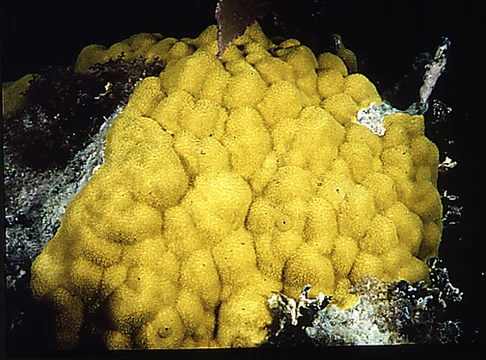
Porites lobata
A resilient, slow-growing reef-building coral of the Indo-Pacific.

Porites lobata, commonly known as lobe coral, is a species of stony coral in the family Poritidae. It is a hermatypic (reef-building) coral found on coral reefs in tropical parts of the Indian and Pacific Oceans. It is notable for being the most common coral species in Hawaii and for its resilience to bleaching compared to many other corals.
Quick Facts
- Taxon
- Porites lobata
Facts from the source article.
Lore & Background
Porites lobata varies greatly in size and shape depending on its environment. On wave-exposed reef slopes it grows as an encrusting form, while in calm water areas it can develop into large helmet-shaped or hemispherical hummocks up to 6 metres high and wide. Its growth rates are very slow, sometimes as little as 1 centimetre per year, meaning large corals are very old. The general colour is greenish, yellow, or tan due to symbiotic zooxanthellae (single-celled microalgae) living within its tissues, which provide organic nutrients through photosynthesis.
The corallites are very small and closely packed, joined directly to one another by fused but porous walls. The septa are also fused, and diagnostic skeletal characteristics are only visible under a microscope. The polyps are 1 millimetre in diameter, and the coenosarc covering the skeleton is thin.
Porites lobata is gonochoristic, meaning individual colonies are either male or female. Gametes are released into the water column, and the developing planula larvae drift with currents as part of the zooplankton. Later they settle, undergo metamorphosis, and develop into polyps that found new colonies. Mortality is very high, and very few recruits are found in the Eastern Pacific. Fragments that become detached from the colony may also develop into new colonies, often due to wave damage or skeletal weakening by boring date mussels (Lithophaga spp.) or feeding activities of fish such as the stone triggerfish (Pseudobalistes naufragium).
Reader's Guide
Porites lobata is a common and ecologically significant species in tropical Indian and Pacific Ocean reefs. Its range extends from East Africa, the Red Sea, and the Gulf of Aden, through Indonesia and Australian waters, to the Pacific coasts of the Gulf of California and Central America. It is the most common coral species in Hawaii and often dominates reef margins, lagoons, and fringing reefs at depths down to 30 metres, occurring in a slightly deeper zone than cauliflower coral.
Several fish species live among its lobes, some sheltering there and others, like the puffer fish (Arothron meleagris), grazing on the polyps. The snapping shrimp (Alpheus deuteropus) is a commensal that lives among the lobes, where it may form grooves and tunnels.
Porites lobata is one of the more resilient coral species. A rise in sea temperature may kill its zooxanthellae and cause bleaching, but it is more resistant to bleaching than many corals, and if bleaching occurs, it often recovers. Tropical reefs in general face threats from El Niño events, ocean acidification (which tends to dissolve the coral skeleton), trawling (causing mechanical damage), and coral diseases that kill polyps. Due to its lack of coloration, this coral is very rarely collected for the aquarium hobby.
Did You Know?
- Its growth rate can be as slow as 1 centimetre per year.
- Fragments detached by wave damage or boring by date mussels can develop into new colonies.
Frequently Asked Questions
Who is Porites lobata?
Lobe coral is a stony coral species in the Poritidae family, native to tropical reefs across the Indian and Pacific Oceans. It is best known as the single most abundant coral species in Hawaiian waters.
What is Porites lobata's role in its reef community?
As a hermatypic reef-builder, it constructs the calcium-carbonate framework that forms the physical structure of tropical reefs. Its tiny one-millimetre polyps work collectively over decades to raise massive colonies.
How does Porites lobata handle bleaching events compared to other corals?
Lobe coral is notably more resilient to thermal stress and bleaching than many of its reef neighbours, allowing it to persist through heat events that devastate more sensitive species. This durability makes it a key survivor in warming-ocean scenarios.
How large can Porites lobata grow, and how fast?
Mature colonies can reach up to six metres (20 ft) in both height and width, yet they accumulate that size extremely slowly at roughly one centimetre per year. A colony that appears enormous today has been growing for centuries.
Where can Porites lobata be found, and how deep does it live?
It inhabits shallow tropical reef environments throughout the Indo-Pacific, typically colonising the upper reef flat and slope. Its depth range extends to about thirty metres (98 ft) below the surface.
More in Porites and Poritid Corals 1-17
Spotted an error? Know more?
Reader corrections go straight into our review queue. Suggest an edit · How this site is sourced