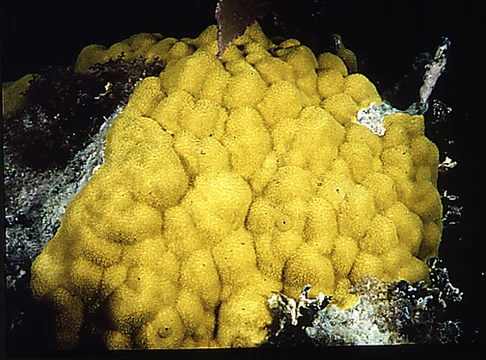
Porites branneri
An encrusting coral with knobbly projections, found in shallow Caribbean waters.

Porites branneri, or blue crust coral, is a stony coral belonging to the family Poritidae. It grows on reefs in the Caribbean Sea and along the northern and eastern shores of South America.
This coral forms encrusting patches up to 15 cm across, with knobbly bumps about 2.5 cm wide. Its corallites are small and pentagonal, giving the surface a pitted look when the polyps are withdrawn. When the polyps extend to feed, the surface appears fuzzy. The color ranges from pale blue to lilac or purple.
The species lives in shallow waters of the southern Caribbean and northern South America, including Jamaica, the Cayman Islands, Colombia, Venezuela, Trinidad and Tobago, and northern and eastern Brazil from Ceará to Cabo Frio. It inhabits reefs, channels, and intertidal pools where water movement is vigorous, at depths no greater than 3 m.
Its main threat is habitat loss from damage to shallow reefs. It is vulnerable to coral diseases but fairly resistant to bleaching. Though generally uncommon, it is more frequent among thickets of Elkhorn coral (Acropora palmata) in the southern Caribbean. No precise population figures or trends exist, but the IUCN lists it as near threatened.
Quick Facts
- Taxon
- Porites branneri
Facts from the source article.
Lore & Background
Porites branneri is an encrusting coral that forms patches up to 15 cm in diameter with knobbly projections about 2.5 cm across. Its corallites are small and pentagonal, giving the surface a pitted appearance when polyps are retracted; when extended to feed, the surface appears fuzzy. The coral is pale blue, lilac or purple in color.
This species is native to shallow water habitats in the southern Caribbean Sea and the northern coasts of South America, including Jamaica, the Cayman Islands, Colombia, Venezuela, Trinidad and Tobago, and northern and eastern Brazil between Ceará and Cabo Frio. It occurs on reefs, in channels and pools in the intertidal zone, in places with vigorous water movement, to a maximum depth of 3 m.
The greatest threat to this coral is loss of habitat due to damage to shallow water reefs. It is susceptible to coral diseases but fairly resistant to coral bleaching. Although generally uncommon, it is more common growing among thickets of Elkhorn coral (Acropora palmata) in the southern Caribbean.
Reader's Guide
Porites branneri is notable as an encrusting coral species that contributes to the structural complexity of shallow reef habitats in the Caribbean and along South American coasts. Its small, pentagonal corallites and knobbly projections distinguish it from other poritids. The species is assessed as near threatened by the International Union for Conservation of Nature, reflecting its vulnerability to habitat loss from reef damage. While no precise population figures or trends are known, its occurrence among Elkhorn coral thickets in the southern Caribbean suggests a localized abundance. The coral's resistance to bleaching offers some resilience, but its susceptibility to disease and dependence on shallow, high-energy environments make it sensitive to environmental changes. Its pale blue, lilac, or purple coloration adds to the visual diversity of reef communities.
Did You Know?
- Porites branneri is commonly called blue crust coral.
- Its corallites are small and pentagonal, giving a pitted surface when polyps are retracted.
- It occurs to a maximum depth of 3 m (10 ft).
- The International Union for Conservation of Nature has assessed its conservation status as near threatened.
Frequently Asked Questions
What is Porites branneri?
Porites branneri is a stony coral in the family Poritidae, widely known by its common name blue crust coral. It grows as an encrusting colony characterized by distinctive knobbly bumps across its surface.
What does Porites branneri look like?
The coral's surface shifts between a pitted texture when polyps are retracted and a fuzzy appearance when they extend to feed. Its coloration spans pale blue, lilac, and purple tones, and the small pentagonal corallites give the colony a uniquely dimpled look.
Where does Porites branneri live in the wild?
This species is restricted to shallow reef habitats in the Caribbean Sea and along the northern and eastern shores of South America. It is generally found at depths no greater than about 3 meters.
How big does a Porites branneri colony get?
Individual encrusting patches can grow to roughly 15 centimeters (about 6 inches) in diameter. The knobbly projections dotting the surface measure around 2.5 centimeters across.
What is the conservation status of Porites branneri?
The species is currently listed as Near Threatened. Its limited distribution across shallow Caribbean and northern South American reefs makes it particularly susceptible to localized habitat loss and environmental stress.
More in Porites and Poritid Corals 1-17
Spotted an error? Know more?
Reader corrections go straight into our review queue. Suggest an edit · How this site is sourced