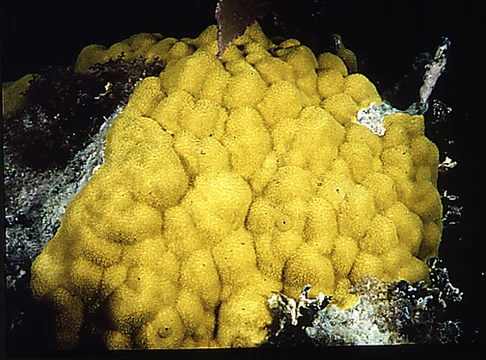
Porites lutea
Massive Indo-Pacific coral that forms microatolls used for sea-level research.

Porites lutea is a species of stony coral in the family Poritidae, found growing in very shallow water on reefs in the Indo-Pacific region. It is notable for forming massive, smooth, hemispherical mounds or helmet-shaped colonies up to 4 meters across, and for its ability to create 'microatolls' in the intertidal zone, which have been used to study trends in sea levels and sea water temperature.
Quick Facts
- Taxon
- Porites lutea
Facts from the source article.
Lore & Background
Porites lutea forms massive, smooth, hemispherical mounds or helmet-shaped colonies up to 4 meters across. Its corallites have thin walls, are closely packed, and are well-filled with skeletal elements including five tall pali near the center. The color is usually cream or yellow, though other bright colors sometimes occur in shallow-water habitats. It is native to the tropical Indo-Pacific, ranging from Madagascar and the east coast of Africa to Malaysia, Indonesia, the Philippines, Japan, and northern and eastern Australia, occurring on back reef margins, in lagoons, and on fringing reefs.
This coral can form 'microatolls' in the intertidal zone—disc-shaped mounds with dead coral material at the top and living material around the perimeter that continues to grow sideways. Sometimes these structures remain as fossil microatolls with no living polyps but retained colony morphology. Fossil microatolls of Porites lutea, combined with precise dating of individual annual growth rings using uranium–thorium dating, have been used to determine past relative changes in sea level. In the South China Sea, this method showed that during 7000–6550 years before 2000, sea level was about 170 to 220 centimeters higher than now, with four or more cycles of fluctuations.
In Yemen, the non-native, invasive, encrusting red sponge Clathria aceratoobtusa grows over the coral's surface at about 1 cm per month, smothering and killing it, with a thin white line of dead tissue separating healthy coral from the advancing sponge. Sometimes fragments of Porites lutea become detached from colonies and may remain alive, moved by currents or waves to new locations where they can form new colonies or reefs in sites unsuitable for larval settlement.
Reader's Guide
Porites lutea is significant primarily for its use in paleoclimatology and sea-level research. Its ability to form microatolls in the intertidal zone, which record past sea levels through their growth morphology, has allowed scientists to reconstruct relative sea-level changes. Using uranium–thorium dating of annual growth rings in fossil microatolls, researchers have determined that in the South China Sea, sea level was 170 to 220 centimeters higher than present between 7000 and 6550 years before 2000, with multiple fluctuation cycles. This provides a precise record of past environmental conditions.
The coral's growth rate is influenced by environmental factors, particularly water temperature and wave action. Studies in Indonesia have correlated growth rates with the El Niño phenomenon, finding higher rates on windward slopes with greater wave action and lower rates on lee slopes. Growth rates peaked in 1992 when sea temperature was about 28°C and were lowest in 1998 at 29.6°C, indicating that higher water temperatures stress the coral and reduce growth. Additionally, exposure to increased iron concentrations causes bleaching through loss of symbiotic zooxanthellae, though prior exposure can lead to tolerance. The invasive sponge Clathria aceratoobtusa in Yemen poses a threat by smothering colonies at a rate of about 1 cm per month. Fragmentation also allows the coral to colonize new areas where larval settlement is not possible.
Did You Know?
- Porites lutea can form microatolls in the intertidal zone, which are disc-shaped mounds with dead coral at the top and living material around the perimeter.
- Fossil microatolls of Porites lutea, dated using uranium–thorium dating, have shown that sea level in the South China Sea was 170 to 220 cm higher than present between 7000 and 6550 years before 2000.
- In Yemen, the invasive red sponge Clathria aceratoobtusa smothers and kills Porites lutea at a rate of about 1 cm per month.
- Growth rates of Porites lutea were highest in 1992 when sea temperature was about 28°C and lowest in 1998 at 29.6°C, correlating with the El Niño phenomenon.
Frequently Asked Questions
What is Porites lutea?
Porites lutea is a stony coral in the family Poritidae that inhabits the shallow reef waters of the Indo-Pacific. It is best known for building enormous, smooth dome- or helmet-shaped colonies that can reach four meters across.
What does a Porites lutea colony look like?
The coral typically presents as a cream or yellow mass with a remarkably smooth outer surface, since its individual corallites are only one to one and a half millimeters wide. Colonies grow into massive hemispherical mounds rather than branching or plate-like shapes.
What are microatolls and why are they special to this species?
In the intertidal zone, Porites lutea can form small dome-shaped structures called microatolls that lay down a visible band of calcium carbonate every year. Those annual rings turn each colony into a natural growth record of local environmental conditions.
How has Porites lutea been used to study past sea levels?
Scientists have read the annual growth bands in P. lutea microatolls to reconstruct ocean heights from roughly 7,000 to 6,550 years before 2000. The results indicate that sea levels during that window stood between 170 and 220 centimeters above present-day heights.
Where in the wild can you find Porites lutea?
This species is restricted to very shallow reef habitats throughout the Indo-Pacific region. It is especially common in the intertidal and near-surface zones, where its smooth mounds are often visible at low tide.
More in Porites and Poritid Corals 1-17
Spotted an error? Know more?
Reader corrections go straight into our review queue. Suggest an edit · How this site is sourced