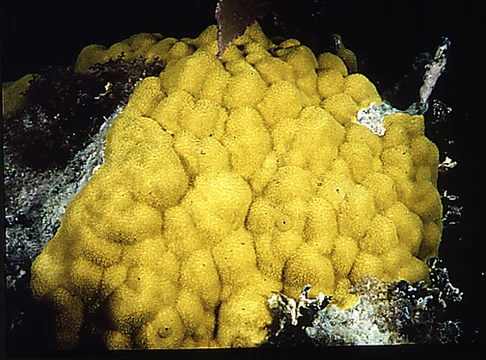
Porites compressa
A slow-growing, long-lived stony coral of Indo-Pacific reefs.

Porites compressa, commonly called Finger coral or Hump coral, is a type of hard coral found in the family Poritidae. It grows on tropical reefs and in shallow lagoons across the Indian and Pacific Oceans. Its color is usually a pale brown or gray. In shallow water, it looks like a bumpy boulder, but in deeper water it takes on a more columnar shape. The branches are cylindrical and often grow fused together. Though it grows slowly, this coral can form very large colonies, some of which may be as old as 1,000 years. It hosts symbiotic zooxanthellae algae in its tissues, which supply it with energy.
This species lives throughout the Indo-Pacific region, the Red Sea, and the East African coast. Around Hawaii, it is especially common, found on reefs and in lagoons down to about 30 meters (98 feet), where the water stays relatively calm. In Kaneohe Bay, it is the dominant coral and sometimes forms stands made up entirely of this species.
Porites compressa is harmed by rising sea temperatures, but it resists bleaching better than many other corals. However, it is more vulnerable to certain coral diseases, and stressed corals are most likely to get sick. Coral reefs overall face many threats, including El Niño events, ocean acidification, trawling and fishing activities, competition from invasive species, and human impacts like pollution and the collection of corals for the aquarium trade.
Quick Facts
- Taxon
- Porites compressa
Facts from the source article.
Lore & Background
Porites compressa is generally pale brown or grey. In shallow water it resembles a knobbly boulder but in deeper water it is more columnar. The branches are cylindrical and often fuse together. The growth rate is slow but it often grows into large colonies which may be up to 1000 years old. It is a zooxanthellate coral, having symbiotic unicellular zooxanthellae in the tissues which provide it with energy.
Porites compressa occurs in the Indo-Pacific region, the Red Sea and East African coast. Around Hawaii it is common and is found on reefs and in lagoons to a depth of 30 metres (98 ft) where the water is relatively undisturbed. In Kaneohe Bay it is the dominant coral species and sometimes forms monospecific stands.
Porites compressa is affected by rising sea temperatures but it is more resistant to bleaching than many other corals. It is more susceptible to coral diseases than some other species however and it is stressed corals that are most likely to succumb to disease.
Reader's Guide
Porites compressa is significant as a dominant coral species in certain habitats, such as Kaneohe Bay, where it sometimes forms monospecific stands. Its slow growth and extreme longevity—colonies may live up to 1000 years—make it a long-term component of reef ecosystems. The coral's resistance to bleaching relative to other species is notable, though it is more susceptible to coral diseases, particularly when stressed. The species faces threats common to coral reefs generally, including El Nino events, ocean acidification, trawling and other fishery activities, competition from invasive species, and human activities such as pollution and collection for the aquarium trade. Its presence across the Indo-Pacific, Red Sea, and East African coast underscores its wide distribution, while its reliance on symbiotic zooxanthellae for energy ties it to the health of shallow, sunlit waters.
Did You Know?
- Porites compressa is also known as Finger coral or Hump coral.
- It may form colonies up to 1000 years old.
- It is more resistant to bleaching than many other corals but more susceptible to coral diseases.
Frequently Asked Questions
What is Porites compressa?
It is a hard stony coral belonging to the family Poritidae, most often called Finger coral or Hump coral by reef enthusiasts. It is one of the slow-growing, long-lived structural builders of Indo-Pacific reefs.
What does Porites compressa look like?
In shallow lagoon water it forms a lumpy, boulder-like mass, while in deeper settings the same species stretches into more upright, columnar shapes. Its cylindrical branches frequently fuse together, and the overall coloration is a muted pale brown or grey.
Where can you find Porites compressa?
This species thrives on tropical reefs and in shallow lagoon settings throughout the Indian and Pacific Oceans. It can be encountered at depths reaching roughly 30 metres (about 98 feet).
How old can a Porites compressa colony get?
Despite its very slow growth rate, individual colonies can persist for up to around 1,000 years, making them among the oldest living organisms on a reef. That extreme longevity is a major reason they serve as foundational structure for so many other marine species.
How does Porites compressa obtain its energy?
It houses symbiotic zooxanthellae algae within its own tissues, and those algae photosynthesize to supply the coral with a steady stream of organic carbon. This mutualism is what fuels the slow but continuous construction of its massive calcium-carbonate skeleton over centuries.
More in Porites and Poritid Corals 1-17
Spotted an error? Know more?
Reader corrections go straight into our review queue. Suggest an edit · How this site is sourced