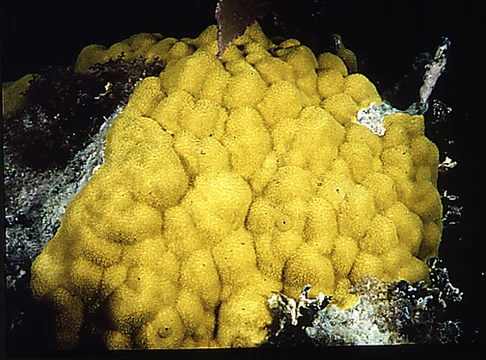
Porites porites
A slow-growing stony coral found in the Caribbean and West Africa.

Porites porites, also called hump coral or finger coral, is a stony coral species within the genus Porites. It grows in irregular patches of short, finger-like lobes with blunt, slightly swollen tips. These lobes can be densely packed or widely spaced, and they measure up to 2.5 cm (1 inch) wide—a feature that sets this species apart from other Porites with narrower lobes. The lobes may be curved or hooked and grow in all directions, typically appearing white or pale blueish-grey.
This coral is among the oldest known life forms due to its extremely slow growth. It forms when tiny polyps attach at the base of their skeletons and branch outward. Scientists estimate some Porites colonies are up to 1,000 years old, reaching heights of eight metres (26 feet) and widths of five metres (16 feet).
Porites porites is found in the Caribbean Sea, western Atlantic Ocean, Gulf of Mexico, Bahamas, southern Florida, and as far south as Venezuela. It also occurs in shallow tropical seas off the west coast of Africa. It lives from the low water mark down to about 20 metres (70 feet) deep, on both fore reefs and back reefs where water is not too turbid. It also grows on mangrove prop roots and among seagrass (Thalassia spp.).
As a zooxanthellate coral, its tissues contain symbiotic unicellular green algae. These algae photosynthesize, using carbon dioxide and waste from the coral, and supply oxygen and organic compounds in return. Unlike most stony corals, Porites porites polyps often extend their tentacles to feed during the day.
The species is listed as least concern on the IUCN Red List because it is common throughout its range and its population appears stable. It is adaptable to a wide range of habitats and is not especially prone to bleaching. However, it is vulnerable to coral diseases, and its main threats include loss of reef habitat from mechanical damage, violent storms, rising sea temperatures, ocean acidification, pollution, increased sedimentation, and tourism.
Quick Facts
- Taxon
- Porites porites
Facts from the source article.
Lore & Background
Porites porites forms irregular patches of short, finger-like lobes with blunt, slightly swollen tips. The lobes, up to 2.5 cm wide, may be curved or hooked and grow in all directions, distinguishing this species from narrower-lobed members of the genus. Its color is usually white or pale blueish-grey. The coral is built from tiny polyps that attach together at the base of their skeletons and branch outward. Due to its slow growth rate, scientists believe some Porites coral are up to 1,000 years old and can reach heights of eight metres and widths of five metres.
This species occurs throughout the Gulf of Mexico, the Caribbean Sea, the Bahamas, southern Florida, and as far south as Venezuela, as well as in shallow tropical seas off the west coast of Africa. It is found from the low water mark down to about 20 metres depth, on both fore reefs and back reefs where water is not too turbid, and also on the prop roots of mangroves and among seagrass.
Porites porites is a zooxanthellate coral, hosting symbiotic unicellular green algae that photosynthesize, supplying oxygen and organic compounds in return for carbon dioxide and waste. Unlike most stony corals, its polyps often extend tentacles to feed during the daytime.
Reader's Guide
Porites porites is listed as Least Concern on the IUCN Red List due to its common status across a wide range and stable population. It is an adaptable species found in diverse habitats and is not particularly susceptible to bleaching. However, it is prone to coral diseases. Its chief threats include loss of reef habitat through mechanical damage, violent storms, a rise in sea temperatures, ocean acidification, pollution, increased sedimentation, and tourism. The species is notable for its extreme longevity, with some colonies believed to be up to 1,000 years old, making it one of the oldest known forms of life on Earth. Its slow growth rate and formation of finger-like lobes up to 2.5 cm wide help distinguish it from other Porites species. The coral's symbiotic relationship with photosynthetic algae and its unusual daytime feeding behavior further characterize its biology.
Did You Know?
- Porites porites is known to be among the oldest forms of life on Earth, with some colonies believed to be up to 1,000 years old.
- Its lobes are up to 2.5 cm wide, distinguishing it from other Porites species with narrower lobes.
- Unlike most stony corals, the polyps of Porites porites often extend their tentacles to feed during the daytime.
- It occurs on both fore reefs and back reefs, as well as on mangrove prop roots and among seagrass.
Frequently Asked Questions
What is Porites porites and what is it commonly called?
Porites porites is a stony coral species within the genus Porites, and hobbyists most often refer to it as hump coral or finger coral. It is recognized by its irregular patches of short, finger-like lobes that end in blunt, slightly swollen tips.
How large can a Porites porites colony get?
A mature colony can stand roughly eight metres (26 ft) tall and spread up to five metres (16 ft) across. Each individual lobe reaches a maximum width of about 2.5 cm (1 inch), a trait that separates it from other Porites species with noticeably narrower lobes.
Where is Porites porites found and at what depths?
This species occurs in Caribbean and West African waters, colonizing reefs from the low water mark down to approximately 20 metres (70 ft). Its IUCN conservation status is currently listed as Least Concern.
How long can Porites porites live?
Because it grows extremely slowly, a single colony can persist for up to 1,000 years, which places it among the oldest continuously living organisms on Earth. That slow, incremental accretion of polyps is what allows the colony to accumulate such extraordinary age.
What does Porites porites look like in the water?
The coral typically presents a white or pale blueish-grey colour, with lobes that may be tightly clustered or spread far apart and grow in every direction. The tips are blunt and slightly swollen, and some lobes curve or hook, giving the colony a distinctive knobby silhouette.
More in Porites and Poritid Corals 1-17
Spotted an error? Know more?
Reader corrections go straight into our review queue. Suggest an edit · How this site is sourced