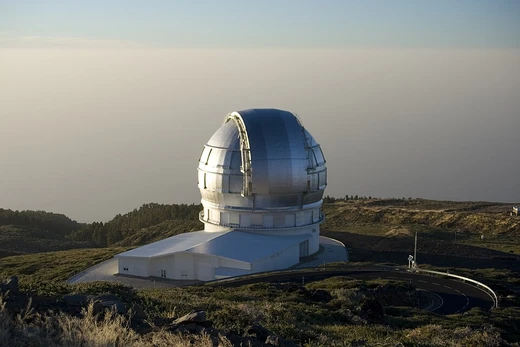
ESO 3.6 m Telescope
Optical reflecting telescope at La Silla, Chile, since 1977.

The ESO 3.6 m Telescope is an optical reflecting telescope operated by the European Southern Observatory at La Silla Observatory, Chile. It has been in use since 1977 and is notable for its clear aperture of about 3.6 metres and its role in exoplanet discovery, particularly through the HARPS instrument.
- Clear aperture
- 3.6 metres (140 in)
- Area
- 8.6 m² (93 sq ft)
- Location
- La Silla Observatory, Chile
- First light
- 1976
- Full operations
- 1977
- Overhaul
- 1999
- New secondary
- 2004
Lore & Background
The ESO 3.6 m Telescope saw first light in 1976 and entered full operations in 1977. When completed, it was one of the world's largest optical telescopes. ESO collaborated with CERN on building the telescope. It received an overhaul in 1999 and a new secondary mirror in 2004. The telescope presented ADONIS, one of the first adaptive optics systems available to the astronomical community in the 1980s. ADONIS was the final version of diverse adaptive optics prototypes named Come-on and Come-on+, offered as an official ESO instrument in October 1996 and decommissioned in 2001. More than 40 peer-reviewed scientific articles were published based on ADONIS data.
Reader's Guide
The ESO 3.6 m Telescope has supported many scientific achievements, particularly through the HARPS instrument. HARPS, a fibre-fed high resolution echelle spectrograph dedicated to extrasolar planet discovery, has enabled the detection of more than 130 exoplanets. Notable discoveries include Gliese 581e, the lightest exoplanet known at the time with only twice the mass of Earth, and the richest planetary system known at the time with up to seven planets orbiting a Sun-like star. In 2012, the telescope discovered Alpha Centauri Bb, a now-disproven possible planet in the Alpha Centauri system. The telescope was also involved in solving a decades-old mystery regarding the mass of Cepheid variable stars, using HARPS to detect a double star where a pulsating Cepheid variable and another star pass in front of one another, allowing mass measurement. By 2009, the telescope was used to discover 75 exoplanet candidates, and another 50 were announced in 2011. Other instruments hosted include CES, EFOSC2, TIMMI-2, and ADONIS.
Did You Know?
- The ESO 3.6 m Telescope has discovered more than 130 exoplanets using the HARPS instrument.
- In 2012, it discovered Alpha Centauri Bb, a now-disproven possible planet 4.4 light-years away.
- ADONIS, one of the first adaptive optics systems, was offered to the astronomical community in the 1980s.
- The telescope was built in collaboration with CERN.
More in Optical Telescopes, Part 2 1-24
Spotted an error? Know more?
Reader corrections go straight into our review queue. Suggest an edit · How this site is sourced