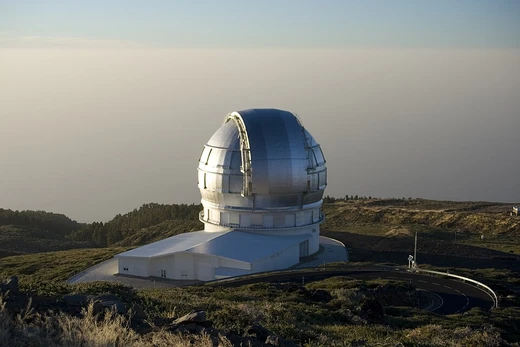
Canada–France–Hawaii Telescope
3.58-meter optical/infrared telescope on Mauna Kea since 1979.

The Canada–France–Hawaii Telescope (CFHT) is a 3.58-meter optical/infrared telescope located near the summit of Mauna Kea on the Big Island of Hawaiʻi at an altitude of 4,204 meters, within the Maunakea Observatories. It has been in operation since 1979 and uses a Prime Focus/Cassegrain configuration. The telescope is notable for its role in the discovery of 128 new moons of Saturn in March 2025, bringing the gas giant's total confirmed satellites to 274.
- Aperture
- 3.58 m (11.7 ft)
- Location
- Mauna Kea, Big Island of Hawaiʻi
- Altitude
- 4,204 m (13,793 ft)
- Configuration
- Prime Focus/Cassegrain
- Year of first light
- 1979
- Number of instruments
- 5
Lore & Background
The Canada–France–Hawaii Telescope is operated by a corporation bound by a tripartite agreement between the University of Hawaii at Manoa, the National Research Council (NRC) in Canada, and the Centre National de la Recherche Scientifique (CNRS) in France. It also has partnerships with the National Astronomical Observatory of China (NAOC), the Academia Sinica Institute of Astronomy and Astrophysics (ASIAA) in Taiwan, the National Laboratory of Astrophysics (LNA) in Brazil, and the Korea Astronomy and Space Science Institute (KASI) in Korea. Observing time is offered to scientists from all seven partner countries, and astronomers from the European Union can submit proposals through the OPTICON access program.
CFHT had proposed redeveloping its summit facility into the Maunakea Spectroscopic Explorer, replacing the existing telescope with an 11.25-meter segmented telescope while reusing much of the existing infrastructure, including the foundation, telescope pier, and portions of the support building. As of 2026, however, the project remains on hold pending review of governance and leasing of observatories at this site. In the interim, the existing telescope will remain operating into the 2030s.
The telescope currently operates five instruments: MegaPrime/MegaCam (a one-square-degree field high-resolution CCD mosaic of 40 CCDs totalling 378 megapixels), WIRCam (a wide-field infrared camera optimized for J, H, and K bands), ESPaDOnS (an echelle spectropolarimeter), SITELLE (a wide-field Fourier transform spectrograph), and SPIRou (a near-infrared spectropolarimeter).
Reader's Guide
The Canada–France–Hawaii Telescope has been a key facility for optical and infrared astronomy since 1979, contributing to a wide range of discoveries. Its most notable recent achievement, as reported in March 2025, is the discovery of 128 new moons of Saturn, which dramatically increased the known satellite count of the gas giant to 274. This discovery underscores the telescope's ongoing observational capabilities. The telescope's significance is also reflected in its international partnership structure, involving seven countries and providing access to astronomers from the European Union through the OPTICON network. The proposed redevelopment into the Maunakea Spectroscopic Explorer, though on hold as of 2026, indicates the site's potential for future large-scale projects. In the meantime, the existing telescope continues to operate, with plans to remain active into the 2030s. Its suite of five instruments, including wide-field imagers and spectropolarimeters, supports diverse scientific programs. The telescope also engages in public outreach through the 'Hawaiian Starlight' website, offering high-quality images and a yearly calendar.
Did You Know?
- The CFHT has a 3.58-meter aperture and has been in operation since 1979.
- In March 2025, astronomers using CFHT discovered 128 new moons of Saturn, bringing its total to 274.
- CFHT is operated by a tripartite agreement among the University of Hawaii at Manoa, the National Research Council of Canada, and the CNRS of France.
- The telescope has five instruments, including MegaPrime/MegaCam with 378 megapixels and WIRCam for infrared observations.
Position in the Aperture Hierarchy
The Canada–France–Hawaii Telescope earns its place among the world's most substantial optical reflecting instruments by meeting the threshold of a 3.0-metre effective aperture, a benchmark that has long served as a practical gauge of a telescope's collecting area, limiting resolution, physical footprint, and construction cost. In this framework, aperture is not simply the physical diameter of a single mirror but the diameter of a hypothetical circle whose collecting area matches the instrument's total light-gathering surface. Telescopes built with multiple or segmented mirrors on a shared mount are ranked by their equivalent combined aperture, while instruments that cannot deploy their full primary at once are listed by their maximum effective aperture. The CFHT, as a single-aperture reflector comfortably above the three-metre line, sits squarely within the cohort of large ground-based optical telescopes whose mirrors may in fact extend beyond the stated aperture figure, and whose performance in resolution and sensitivity is ultimately governed by how effectively that collecting area is harnessed.
The Earth-Based Advantage
Operating from a high-altitude site in Hawaii, the Canada–France–Hawaii Telescope benefits from a suite of Earth-based strengths that space-based rivals cannot easily replicate. First, the comparatively modest expense of swapping out or upgrading detector instruments means the observatory can keep pace with advances in imaging and spectroscopy without the prohibitive cost of a space mission. Second, when paired with active and adaptive optics systems that correct for much of the atmospheric turbulence above the site, large ground-based reflectors can push their effective resolution beyond what the Hubble Space Telescope achieves, despite Hubble's freedom from the atmosphere. Third, the chosen location matters enormously: a site in the northern hemisphere restricts which portions of the sky are accessible, and the local climate determines how many clear, stable nights the telescope can actually observe each year. For a facility on Mauna Kea, those climatic and geographic factors are central to its annual productivity and scientific yield.
Size Is Not Destiny
A common misconception is that the biggest mirror automatically produces the best science, yet the Canada–France–Hawaii Telescope illustrates why overall light-gathering power is an incomplete measure of an instrument's true capability. Interferometric arrays such as the Keck pair, which can be combined into an interferometer spanning up to 85 metres, or the Large Binocular Telescope with its 22.8-metre mirror spacing, achieve resolutions far exceeding any single large reflector, albeit over a narrower range of observations. Conversely, a space telescope like Hubble sidesteps atmospheric distortion entirely and gains longer, uninterrupted exposure times. The CFHT's value therefore rests not on being the largest aperture in the catalogue but on the synergy of its site conditions, its optical design, its instrumentation, and the flexibility to adapt to new scientific questions. In the broader taxonomy of large reflectors, it is one node in a network where aperture, location, and technique each pull the performance envelope in different directions.
A Moving Target: The Future Landscape
The Canada–France–Hawaii Telescope occupies a specific rung in the chronological progression of ever-larger optical reflectors, a lineage that has steadily pushed apertures upward since the early twentieth century. Looking ahead, several projects will dwarf it in scale: the Extremely Large Telescope in Chile, with a 39.5-metre aperture and first light targeted for 2029; the Giant Magellan Telescope, also in Chile, whose seven 8.4-metre segments on a single mount yield an effective aperture equivalent to 21.4 metres; and the Thirty Metre Telescope, whose construction in Hawaii began in 2014 but was halted the following year and, as of 2025, has not resumed. Smaller but still significant successors include the 6.5-metre San Pedro Martir Telescope in Mexico and the 3.8-metre Timau National Observatory in Indonesia. For the CFHT, this cascade of larger instruments underscores that its historical role as a frontier-class observatory will gradually give way to a supporting position in an increasingly crowded field of giant reflectors.
Frequently Asked Questions
What is the Canada–France–Hawaii Telescope?
The CFHT is a 3.58-meter optical and infrared telescope that has been observing the night sky from Mauna Kea on Hawaiʻi's Big Island since 1979. It is a joint project between Canadian and French institutions, operating at an altitude of 4,204 meters within the Maunakea Observatories complex.
What are the CFHT's key specifications?
The telescope features a 3.58-meter (11.7-foot) primary mirror and currently carries five instruments for optical and infrared observations. It sits at 4,204 meters (13,793 feet) near the summit of Mauna Kea, and it uses a Prime Focus/Cassegrain optical configuration.
When did the CFHT achieve first light?
The CFHT reached first light in 1979, making it one of the earlier large-aperture optical telescopes to begin operations at the Mauna Kea site.
What was the CFHT's role in the March 2025 Saturn moon discovery?
In March 2025, the CFHT played a key role in identifying 128 previously unknown moons orbiting Saturn. That single finding brought the gas giant's confirmed satellite total to 274.
How does the CFHT's optical design work?
The CFHT uses a Prime Focus/Cassegrain configuration, meaning light can be collected either at the primary focal point or redirected to a secondary Cassegrain focus. This dual-path design lets the five installed instruments be positioned to suit different observational needs.
More in Optical Telescopes, Part 2 1-24
Spotted an error? Know more?
Reader corrections go straight into our review queue. Suggest an edit · How this site is sourced