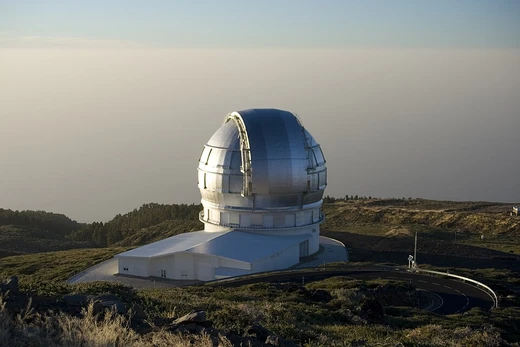
William Herschel Telescope
Third largest optical telescope at its 1987 completion.

The William Herschel Telescope (WHT) is a 4.20-metre optical and near-infrared reflecting telescope located at the Roque de los Muchachos Observatory on the island of La Palma in the Canary Islands, Spain. Named after William Herschel, the discoverer of the planet Uranus, it is part of the Isaac Newton Group of Telescopes and is funded by research councils from the United Kingdom, the Netherlands and Spain. At the time of its construction in 1987, it was the third largest single optical telescope in the world, and it is currently the second largest in Europe.
- Aperture
- 4.20 metres (165 inches)
- Location
- Roque de los Muchachos Observatory, La Palma, Canary Islands, Spain
- First light
- 1 June 1987
- Builder
- Grubb Parsons
- Mount
- Alt-azimuth
- Total moving mass
- 186,250 kg (183.31 long tons) plus instruments
- Clear nights
- 75%
- Median seeing
- 0.7 arcseconds
Lore & Background
The WHT was first conceived in the late 1960s, when the British astronomical community saw the need for a northern-hemisphere telescope comparable to the 3.9-metre Anglo-Australian Telescope. Planning by the British Science and Engineering Research Council led to the Isaac Newton Group of Telescopes, which included a 4-metre-class telescope initially planned as 4.5 metres. By 1979, the project was nearly scrapped due to budget overruns, but a cost-saving redesign by a panel known as the Tiger Team reduced the price by 45%, primarily by shortening the focal length and using a smaller dome. In 1981, the Netherlands Organization for Scientific Research bought a 20% stake, allowing the telescope to proceed; it was named in honour of William Herschel on the 200th anniversary of his discovery of Uranus. Construction by Grubb Parsons began in 1983, and the telescope was shipped to La Palma in 1985, achieving first light on 1 June 1987. It was the last telescope built by Grubb Parsons in their 150-year history.
Reader's Guide
The William Herschel Telescope is notable for its role in astronomical discoveries, including the first evidence for a supermassive black hole (Sgr A*) at the centre of the Milky Way and the first optical observation of a gamma-ray burst. Its design features an alt-azimuth mount, which reduced weight and cost compared to equatorial mounts, though it requires continuous computer control and creates a small blind spot at the zenith. The telescope's primary mirror is a solid Cervit blank, supported by 60 pneumatic cylinders, and it can operate in Ritchey-Chrétien Cassegrain, Nasmyth, or prime focus configurations. The dome, designed to minimise wind stresses, sits on separate foundations from the telescope to prevent vibration. The WHT's realuminising plant is used by all other telescopes at the observatory except the Gran Telescopio Canarias. With 75% clear nights and a median seeing of 0.7 arcseconds, the telescope continues to serve professional astronomers across optical and near-infrared wavelengths.
Did You Know?
- The WHT was the last telescope constructed by Grubb Parsons in their 150-year history.
- Its primary mirror blank was produced in 1969 as one of a set of four, along with those for the AAT, CFHT, and Blanco telescopes.
- Before the drive motors were installed, the 160-long-ton mount assembly could be moved by hand.
- The telescope's realuminising plant has a vacuum vessel large enough to accommodate mirrors from any other telescope at the Roque de los Muchachos Observatory.
From Near-Scrapping to First Light
The WHT was first conceived in the late 1960s while the Anglo-Australian Telescope was still in design. British astronomers identified a critical gap: radio surveys at Jodrell Bank and Mullard required optical follow-up from the Northern Hemisphere, a task the Southern Hemisphere AAT simply could not perform. Once the AAT was completed in 1974, the British SERC planned a trio of northern telescopes. The 4-metre-class instrument was originally envisioned at 4.5 metres, yet by 1979 it teetered on the edge of cancellation as the budget spiralled. A panel dubbed the Tiger Team slashed the price by 45 percent, primarily by shortening the focal length to permit a smaller dome and relocating non-essential functions into a cheaper rectangular annexe. The aperture settled at 4.2 metres. In 1981 the Dutch NWO purchased a 20 percent stake, unlocking the remaining funding. That year also marked the bicentennial of Uranus's discovery, inspiring the telescope's name. Grubb Parsons began fabrication in Newcastle in 1983, and the finished instrument was shipped to La Palma in 1985. First light arrived on 1 June 1987.
Mirror, Mount, and Multiple Foci
At the core of the WHT sits a 4.20-metre primary mirror cast from Cervit, a zero-expansion glass-ceramic produced by Owens-Illinois. The blank was actually manufactured in 1969 as one of four in a batch (the others destined for the AAT, CFHT, and Blanco telescopes) and was not acquired for the WHT until 1979. Weighing 16.5 tonnes, the solid, unthinned primary needs no active optics; it rests on 60 pneumatic cylinders, and even at the most extreme vertical pointing the surface deforms by only 50 nanometres. In its standard configuration a 1.00-metre Zerodur hyperbolic secondary forms a Ritchey-Chretien Cassegrain system at f/11 with a 15-arcminute field. A flat fold mirror routes light to two Nasmyth platforms or two folded Cassegrain stations, each offering 5 arcminutes. For wide-field work the secondary is swapped for a three-element field corrector, yielding an f/2.8 prime focus spanning 60 arcminutes. Switching between Cassegrain and Nasmyth takes mere seconds; changing to prime focus requires a 30-minute daytime mirror exchange.
Two Firsts and a Prime Site
The WHT has been the stage for two genuinely first-of-their-kind observations. Astronomers working with its instruments gathered the first evidence for a supermassive black hole, Sgr A*, at the centre of the Milky Way. In a separate landmark, the telescope recorded the first optical observation of a gamma-ray burst, opening a new observational window onto the universe's most violent transients. These achievements rest on exceptional site conditions: Roque de los Muchachos Observatory, perched at 2,344 metres on La Palma, delivers 75 percent clear nights and a median seeing of 0.7 arcseconds, placing it among the finest optical observing locations on Earth. The telescope's versatile instrument suite spans the optical and near-infrared, supporting a broad portfolio of professional research. Funded jointly by research councils in the United Kingdom, the Netherlands, and Spain, the WHT operates within the Isaac Newton Group of Telescopes, a collaborative framework that has sustained its scientific productivity for decades.
The Last of Grubb Parsons and a Living Legacy
The WHT occupies a singular place in the history of telescope manufacturing. It was the final instrument ever built by Grubb Parsons, a firm that had been constructing telescopes for 150 years before ceasing production. Fabrication began at their Newcastle upon Tyne factory in 1983, and the completed telescope was shipped to La Palma in 1985. At its 1987 first light the WHT ranked as the third-largest single optical telescope in the world; it now holds the position of second-largest in Europe. Governance of the project evolved alongside British astronomy itself: the Royal Greenwich Observatory led the build and operated the telescope until its closure in 1998, after which control passed to the independent Isaac Newton Group. The total project cost—dome, instruments, and structure—came to 15 million pounds in 1984 money, roughly 49 million in 2025 terms, landing within budget once inflation was accounted for. The telescope stands as both a monument to a specific era of international collaboration and a living instrument still producing frontier science.
Frequently Asked Questions
What is the William Herschel Telescope?
It is a 4.20-metre reflecting telescope built for optical and near-infrared astronomical research, achieving first light on 1 June 1987. It operates at the Roque de los Muchachos Observatory on La Palma in the Canary Islands, Spain.
Where is the William Herschel Telescope located?
The WHT sits at the Roque de los Muchachos Observatory on the island of La Palma, part of Spain's Canary Islands in the mid-Atlantic. The high-altitude site is favoured by astronomers for its exceptionally dark and steady atmospheric conditions.
Who is the William Herschel Telescope named after?
It honours William Herschel, the 18th-century astronomer who discovered the planet Uranus in 1781. His groundbreaking contributions to telescopic observation made him a fitting namesake for a major research instrument.
How large is the William Herschel Telescope relative to other telescopes?
With a 4.20-metre (165-inch) primary mirror, it was the third-largest single optical telescope in the world when completed in 1987. It currently holds the position of the second-largest optical telescope in Europe.
Who funds and operates the William Herschel Telescope?
The WHT belongs to the Isaac Newton Group of Telescopes and is supported by research councils from the United Kingdom, the Netherlands, and Spain. It was constructed by Grubb Parsons and rides on an alt-azimuth mount whose total moving mass is approximately 186 tonnes.
More in Optical Telescopes, Part 2 1-24
Spotted an error? Know more?
Reader corrections go straight into our review queue. Suggest an edit · How this site is sourced