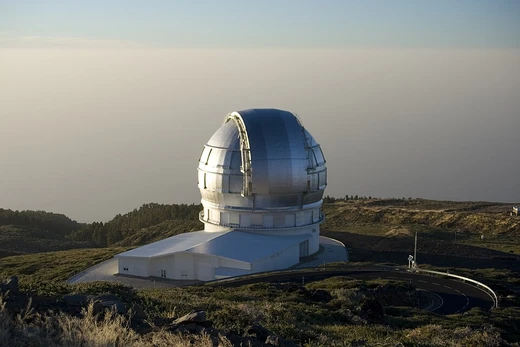
C. Donald Shane telescope
Second-largest optical telescope in the world at its 1959 commissioning.

The C. Donald Shane telescope, a 120-inch (3.05-meter) reflecting telescope, sits at the Lick Observatory on Mount Hamilton, California. It received its name in 1978 in honor of astronomer C. Donald Shane, who spearheaded the fundraising from the California Legislature and supervised its construction. As the largest and most powerful instrument at Lick, it ranked as the world’s second-largest optical telescope when it debuted in 1959.
The telescope’s mirror began as a 10,000-pound glass test blank from Corning Labs, originally intended for the Palomar Observatory’s 200-inch Hale Telescope in San Diego County. Caltech sold it to Lick below cost for $50,000, and it was transported to Mount Hamilton, where the observatory ground and polished it. The Shane is notable for its three focal stations: prime focus, Cassegrain focus, and coudé focus. After decades of use, it was later equipped with an early adaptive optics system.
In the Shane dome, a laser—sometimes visible to the naked eye—is beamed into the night sky as part of the Lick Adaptive Optics (LAO) program, a collaboration between Lick Observatory and Lawrence Livermore National Laboratory. LAO corrects for atmospheric turbulence by using a natural guide star or creating a sodium laser guide star, adjusting a deformable mirror hundreds of times per second based on the guide star’s motion. This yields images nearly as sharp as those from space telescopes. Adaptive optics with natural guide stars has been in development since 1996, and with laser guide stars since 2001. Similar systems based on LAO have been installed on the University of California’s two Keck telescopes in Hawaii.
The Kast Double Spectrograph began operation in 1992 and was upgraded in the 2010s. It detects spectra from near-infrared to near-ultraviolet and includes two sub-instruments. Current instrumentation at the Shane includes the Kast Double Spectrograph for visible-light observations of stars, supernovae, galaxies, and active galactic nuclei; the Hamilton Spectrograph, an echelle spectrograph for stellar spectroscopy and exoplanet detection; and the Shane Adaptive optics infra-Red Camera Spectrograph (ShARCS), an infrared camera used with the adaptive optics system.
After World War II, plans for a large reflecting telescope at Lick were realized with state funding in 1946.
- Aperture
- 120 inches (3.05 meters)
- Location
- Mount Hamilton, California (Lick Observatory)
- Commissioned
- 1959
- Named after
- C. Donald Shane (1978)
- Mirror origin
- 10,000-pound Corning Labs glass test blank for the Palomar 200-inch Hale Telescope
- Mirror cost
- $50,000 (sold below cost by Caltech)
- Foci
- Prime focus, Cassegrain focus, coudé focus
Lore & Background
After World War II, plans for a large reflecting telescope for Lick Observatory were realized with funding from the State of California in 1946. A 120-inch glass blank leftover from the Hale Telescope was acquired and ground to its figure at optical shops on the mountain. The telescope took 15 years to complete, becoming operational in 1959 as the second-largest telescope in the world, behind Palomar's 200-inch Hale Telescope.
The telescope is noted for having three foci: wide field prime focus, coudé focus for high precision spectroscopy, and the intermediate Cassegrain focus. An adaptive optics system was developed for the Shane, utilizing an artificial star made by a laser and a deformable mirror with actuators, mounted at the f/17 Cassegrain focus. The system could send light to a visible-light CCD or an infrared sensor (NICMOS III camera). The Shane telescope was tested in 1995 with a sodium laser to create an artificial light for the adaptive optics system.
In 2009, Lick Observatory celebrated the fiftieth anniversary of the Shane telescope with a ticketed dinner and a lecture on exoplanets. In 2014, the observatory received a grant to upgrade the Kast instrument. In 2015, Google donated 1 million USD to the observatory over two years.
Reader's Guide
The C. Donald Shane telescope holds significance as the largest and most powerful telescope at Lick Observatory and as the second-largest optical telescope in the world at its 1959 commissioning. Its mirror, originally a test blank for the Palomar 200-inch Hale Telescope, was acquired at a reduced cost and ground on site, reflecting the resourcefulness of post-war astronomy. The telescope's three focal stations—prime, Cassegrain, and coudé—enabled diverse scientific observations, from wide-field imaging to high-precision spectroscopy. Its legacy includes early adaptive optics development, with a sodium laser guide star system tested in 1995 and later integrated into the Lick Adaptive Optics program, a joint project with Lawrence Livermore National Laboratory. This system, using natural guide stars since 1996 and laser guide stars since 2001, produced images nearly equivalent to space-based telescopes and influenced similar systems on the Keck telescopes in Hawaii. Instruments like the Kast Double Spectrograph (operational since 1992, upgraded in the 2010s) and the Hamilton Spectrograph have supported studies of stars, supernovae, galaxies, active galactic nuclei, and exoplanets. The telescope's continued operation and upgrades, supported by grants and donations, underscore its enduring role in astronomical research.
Did You Know?
- The Shane telescope's mirror was originally a 10,000-pound glass test blank for the Palomar 200-inch Hale Telescope, sold below cost ($50,000) by Caltech to Lick Observatory.
- The telescope was the second-largest optical telescope in the world when commissioned in 1959.
- Its adaptive optics system uses a sodium laser to create an artificial guide star, tested in 1995.
- Google donated 1 million USD to the observatory in 2015 over two years.
From a Surplus Blank to a Giant of the Sky
When World War II ended, the astronomers at Lick Observatory faced an uncomfortable reality: for fifty-five years they had depended on two nineteenth-century instruments that had long since fallen behind the international competition. The solution arrived in 1946, when the State of California committed funding for a major new reflector. The project's driving force was C. Donald Shane, who shepherded the necessary money through the California Legislature and then supervised the build itself. The mirror's origin story is particularly remarkable. What became the Shane's primary reflector began life as a ten-thousand-pound Corning Labs glass test blank intended for the 200-inch Hale Telescope at Palomar Observatory in north San Diego County. Caltech sold the surplus blank to Lick for just fifty thousand dollars—well below cost—and the massive disc was hauled up to Mount Hamilton, where observatory staff ground and polished it to its final figure. Fifteen years from conception to completion, the 120-inch (3.05-meter) reflector achieved first light in 1959, making it the second-largest optical telescope on Earth at the time, trailing only the Hale. The instrument was formally named in Shane's honor in 1978.
Three Windows into the Universe
The Shane telescope's optical architecture is distinguished by its three focal stations, a design choice that gives observers far more flexibility than a single-focus instrument could offer. At the prime focus, the wide-field station captures broad swaths of sky, ideal for surveys and imaging large regions. The intermediate Cassegrain focus, positioned at f/17, serves as the mounting point for the adaptive optics system and can route light to either a visible-light CCD detector or an infrared sensor such as the NICMOS III camera. The third station, the coudé focus, is purpose-built for high-precision spectroscopy, allowing detailed wavelength analysis without the mechanical constraints of the other two positions. This tripartite arrangement means a single night's observations can shift from wide-area imaging to narrow spectral work without swapping the entire optical train. The versatility of these three foci has kept the Shane a productive research platform for decades, accommodating everything from supernova monitoring to exoplanet detection through its various instruments.
Beating the Atmosphere: The Laser and the Deformable Mirror
Inside the Shane dome sits a laser whose beam is occasionally visible to the naked eye, shooting up into the night sky. This is no decorative feature; it is the heart of the Lick Adaptive Optics program, a collaboration between Lick Observatory and Lawrence Livermore National Laboratory. The laser excites a high-altitude sodium layer in the atmosphere, creating an artificial guide star. A sensor tracks the apparent wobble of that star, and the resulting data drives a deformable mirror that reshapes itself hundreds of times every second to cancel out atmospheric turbulence. Natural guide-star adaptive optics entered development on the Shane in 1996, and the laser-guide-star variant followed in 2001, with a sodium laser test conducted as early as 1995. The payoff is striking: corrected images rival those from space-based telescopes. The success of this approach was so compelling that similar laser adaptive optics systems derived from the LAO design were subsequently installed on the University of California's two Keck telescopes in Hawaii, extending the Shane's influence well beyond Mount Hamilton.
Instruments, Milestones, and a Living Legacy
The Shane's scientific output depends heavily on the instruments mounted at its focal stations. The Kast Double Spectrograph, operational since 1992 and upgraded in the 2010s, covers a broad band from near-infrared to near-ultraviolet and includes two sub-instruments for studying stars, supernovae, galaxies, and active galactic nuclei. The Hamilton Spectrograph, an echelle design, specializes in stellar spectroscopy and the detection of exoplanets. For infrared work, the Shane Adaptive optics infra-Red Camera Spectrograph (ShARCS) pairs with the adaptive optics system to capture detailed thermal emissions. The telescope's milestones extend beyond hardware. In 2009, Lick marked the Shane's fiftieth anniversary with a ticketed evening of dinner and a lecture on exoplanets. In 2014, a grant funded the Kast upgrade, and in 2015 Google pledged one million dollars over two years to support the observatory's ongoing work. These gestures underscore that the Shane remains not a relic but an active, evolving instrument at the front of ground-based astronomy.
Frequently Asked Questions
Who is C. Donald Shane telescope?
The C. Donald Shane telescope is a 120-inch reflecting telescope stationed at Lick Observatory on Mount Hamilton, California. It was commissioned in 1959 and officially received its namesake in 1978 to honor the astronomer who championed its legislative funding and oversaw construction.
What are C. Donald Shane telescope's powers/role?
With a 3.05-meter aperture, it serves as the largest and most powerful instrument at Lick Observatory. At its 1959 debut it ranked as the second-largest optical telescope on the planet, making it a heavyweight in early space-age astronomy.
Why is C. Donald Shane telescope important?
It held the title of the world's second-largest optical telescope when it first saw light in 1959, placing it among the most significant instruments of its era. It also carries the legacy of C. Donald Shane, who secured California legislative funding and supervised the build.
What is C. Donald Shane telescope's origin story?
Its mirror began as a 10,000-pound glass test blank from Corning Labs originally intended for Palomar's 200-inch Hale Telescope. Caltech sold the surplus blank to Lick for just $50,000, well below its production cost, giving the new telescope a second life from a rejected prototype.
More in Optical Telescopes, Part 2 1-24
Spotted an error? Know more?
Reader corrections go straight into our review queue. Suggest an edit · How this site is sourced