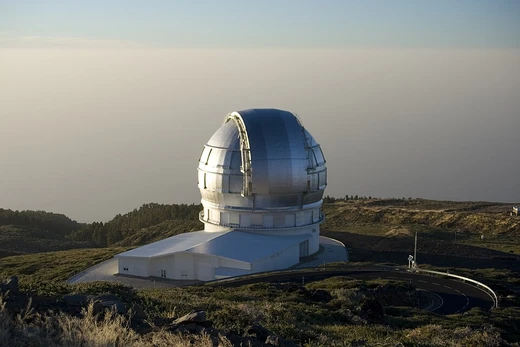
BTA-6
World's largest telescope from 1975 to 1990, pioneering altazimuth mount.

The BTA-6, whose name stands for "Large Altazimuth Telescope" in Russian, is a 6-meter optical telescope located at the Special Astrophysical Observatory in southern Russia, on the northern side of the Caucasus Mountains in the Zelenchuksky District of Karachay-Cherkessia. It first saw light in late 1975 and held the title of the world's largest telescope until 1990, when the partially built Keck 1 overtook it. The telescope was a pioneer in using an altazimuth mount paired with a computer-controlled derotator, a technique now standard in large astronomical instruments.
For various reasons, the BTA-6 has never come close to its theoretical performance. Early issues with a poorly made mirror were addressed in 1978, which improved but did not fully solve the most critical problem. Its location downwind of many large mountain peaks means astronomical seeing is rarely good. The telescope also struggles with thermal expansion due to the large thermal mass of its mirror and the unnecessarily oversized dome. Upgrades have been made throughout its history and continue today.
**History**
**Background** For years, the Soviet Union's main world-class observatory was Pulkovo Observatory, built in 1839 outside Saint Petersburg. Like many observatories of that time, it focused on timekeeping, weather, and navigation, with scientific research as a secondary role. Around its 50th anniversary, a 76 cm telescope was added for deep-space observation. Further upgrades were limited by various factors, while larger instruments were built elsewhere over the following decades.
In the 1950s, the Soviet Academy of Sciences decided to build a new telescope capable of top-tier deep-space observation. Design work began at Pulkovo in 1959 under Bagrat K. Ioannisiani, who would later win the Lenin Prize. Aiming to surpass the 200-inch Hale Telescope at Palomar Observatory—long the world's largest—the team settled on a 6-meter design. This is roughly the maximum size a solid mirror can be without significant distortion when tilted.
A telescope's theoretical resolution depends on its aperture; for the BTA's 6 meters, that's about 0.021 arcseconds. Atmospheric effects overwhelm this, so high-resolution instruments need high altitudes to avoid as much atmosphere as possible. Pulkovo, at just 75 meters above sea level, was unsuitable.
- Aperture
- 6 metres (20 ft)
- First light
- late 1975
- Location
- Zelenchuksky District, Karachay-Cherkessia, north side of Caucasus Mountains, southern Russia
- Altitude
- 2,070 m
- Primary mirror diameter
- 605 cm
- Primary focal ratio
- f/4
- Dome height
- 53 m at peak, 48 m from cylindrical base
Lore & Background
The BTA-6 was conceived in the 1950s by the Soviet Academy of Sciences to build the world's largest telescope, surpassing the 200-inch Hale Telescope. Design work began at Pulkovo Observatory in 1959 under Bagrat K. Ioannisiani. The site was selected after sixteen expeditions, settling on the North Caucasus Mountains near Zelenchukskaya at 2,070 m elevation, co-located with the RATAN-600 radio telescope. The Special Astrophysical Observatory was formed in 1966 to host both instruments.
The first primary mirror, fabricated by the Lytkarino Optical Glass Plant, was flawed due to rapid annealing causing cracks and bubbles. A second mirror was installed in 1975, and first images were obtained on 28/29 December 1975. The telescope was declared fully operational in January 1977, but the mirror had major imperfections, directing only 61% of light into a 0.5-arcsecond circle. A third mirror, with improved figure and no cracks, was installed in 1978, but the telescope has never operated near its theoretical limits due to poor seeing from downwind mountain peaks, thermal expansion problems from the large mirror and dome, and other issues.
Reader's Guide
The BTA-6's significance lies in its pioneering altazimuth mount with computer-controlled derotator, a technique now standard for large telescopes. However, the article notes it has never been able to operate near its theoretical limits. Early mirror fabrication problems were partially addressed in 1978, but the site's astronomical seeing is rarely good, with resolution rarely better than one arcsecond and under 2 arcseconds considered good. Thermal expansion from the large mirror mass and oversized dome further degrade performance. Despite these challenges, speckle interferometry techniques since 2007 have allowed diffraction-limited resolution of 0.02 arcseconds for 15th magnitude objects under good conditions. The telescope's legacy includes its role as the world's largest until 1990, and ongoing upgrades continue to this day. A planned upgrade to a Sitall mirror was not recorded as having taken place, and a 2018 mirror replacement proved inadequate, leading to reinstallation of the previous mirror.
Did You Know?
- The BTA-6 was the largest telescope in the world from 1975 until 1990, when it was surpassed by the partially constructed Keck 1.
- It pioneered the altazimuth mount with a computer-controlled derotator, now standard in large telescopes.
- The primary mirror's first two attempts at fabrication were flawed; the third mirror, installed in 1978, improved but did not eliminate major issues.
- The site's astronomical seeing is rarely better than one arcsecond, and under 2 arcseconds is considered good.
Conception and the Search for the Perfect Sky
In the 1950s, Soviet deep-space astronomy was anchored at Pulkovo Observatory outside Saint Petersburg, a facility dating to 1839 whose original mission centered on timekeeping, navigation, and weather. Though a 76-centimeter instrument had been added around its fiftieth anniversary for research, the site sat merely 75 meters above sea level, making it fundamentally unsuited to the high-altitude, low-atmosphere observing a modern large telescope demands. In 1959, design work began under Bagrat K. Ioannisiani, a future Lenin Prize recipient, with the explicit ambition to surpass the 200-inch Hale Telescope at Palomar. The team settled on a six-meter aperture, roughly the practical ceiling for a single solid mirror before distortion becomes unmanageable when the tube tilts. To house both this new optical instrument and the concurrently designed RATAN-600 radio telescope, sixteen scouting expeditions crisscrossed the Soviet Union. The chosen location, perched at 2,070 meters in the North Caucasus near Zelenchukskaya, became home to the Special Astrophysical Observatory, formally established in 1966.
First Light and a Mount That Changed the Field
On the night of 28–29 December 1975, BTA-6 captured its first images, and after a break-in period it was declared fully operational in January 1977. At that moment it stood as the largest optical telescope on Earth, a title it held until 1990, when the still-partly-constructed Keck 1 at Mauna Kea edged past it. Beyond raw aperture, the instrument's most enduring technical contribution was its mounting architecture. BTA-6 pioneered the pairing of an altazimuth mount with a computer-controlled derotator, a combination that corrected for field rotation as the sky turned. That design philosophy, once novel, has since become standard practice in large astronomical telescopes worldwide. The six-meter aperture, in principle, grants a diffraction-limited angular resolution of roughly 0.021 arcseconds, an enormous figure by any standard. Yet atmospheric turbulence swamps that theoretical edge, which is precisely why the observatory was sited at such altitude. The telescope's Russian name, Bolshoi Teleskop Alt-azimutalnyi, translates literally to 'Large Altazimuth Telescope,' a nod to the very mounting scheme that would go on to define the next generation of astronomical instruments.
Three Mirrors and a Reputation to Defend
The road to a usable primary mirror was anything but smooth. The first casting, produced by the Lytkarino Optical Glass Plant near Moscow, was ruined when the annealing process ran too fast, leaving the glass riddled with cracks and bubbles. The replacement, installed in 1975, proved only marginally superior; observers resorted to draping large sheets of black cloth over the roughest zones of the surface. Ioannisiani himself reported that the mirror directed just 61 percent of incoming photons within a half-arcsecond circle and 91 percent within a one-arcsecond circle, far short of the aperture's potential. Western skepticism followed quickly. By the mid-1980s the instrument was widely dismissed as a Soviet white elephant, a topic even featured in James Oberg's 1988 volume on Soviet scientific failures. A third mirror, free of cracks and with a significantly improved figure, arrived in 1978 and resolved the worst optical defects. Yet the site itself remained a persistent adversary: sitting downwind of several massive Caucasus peaks, seeing rarely beats one arcsecond, and under two arcseconds is considered good. On average, fewer than half of all nights in a year are suitable for observation.
Thermal Wars and the Long Game of Upgrades
Even with a sound mirror in place, BTA-6 has never operated close to its theoretical ceiling, largely because of thermal physics. The enormous mass of the primary, the telescope structure, and the oversized dome all store heat and release it slowly. The mirror can tolerate only a two-degree Celsius daily temperature swing before its figure degrades beyond usefulness, and if the gap between the mirror and ambient air reaches ten degrees, observations become entirely impossible. The dome's generous interior volume creates its own thermal gradients that compound the problem, though internal refrigeration helps offset some of the worst effects. Despite these constraints, the instrument has continued to evolve. Since 2007, an EMCCD-based speckle interferometer using the PhotonMAX-512B camera has allowed researchers to extract the telescope's full 0.02-arcsecond diffraction-limited resolution on fifteenth-magnitude objects under favorable conditions. Unlike adaptive optics, which today works primarily in the infrared and demands the best seeing, speckle interferometry functions in the visible and near-ultraviolet and can operate even under mediocre atmospheric conditions. Plans to replace the primary with a mirror of ultra-low-expansion Sitall glass-ceramic have been discussed, though no completion is on record. Upgrades, in other words, remain an ongoing story.
Frequently Asked Questions
What is BTA-6?
BTA-6 is a 6-meter optical research telescope whose name is the Russian abbreviation for "Large Altazimuth Telescope." It is operated at the Special Astrophysical Observatory in southern Russia.
Where exactly is BTA-6 situated?
The telescope sits at roughly 2,070 meters elevation on the northern slopes of the Caucasus Mountains, in the Zelenchuksky District of Karachay-Cherkessia, Russia.
How long did BTA-6 hold the record as the world's largest telescope?
After achieving first light in late 1975, BTA-6 was the biggest optical telescope on Earth until 1990, when the still-under-construction Keck 1 surpassed its aperture.
What was BTA-6's key technological first?
It was the first major instrument to combine an altazimuth mount with a computer-driven derotator, a design approach that has since become standard for large astronomical telescopes.
What are BTA-6's primary optical specifications?
The primary mirror measures 605 cm in diameter, giving a 6-meter (about 20-foot) aperture, and the system operates at an f/4 focal ratio.
More in Optical Telescopes, Part 2 1-24
Spotted an error? Know more?
Reader corrections go straight into our review queue. Suggest an edit · How this site is sourced