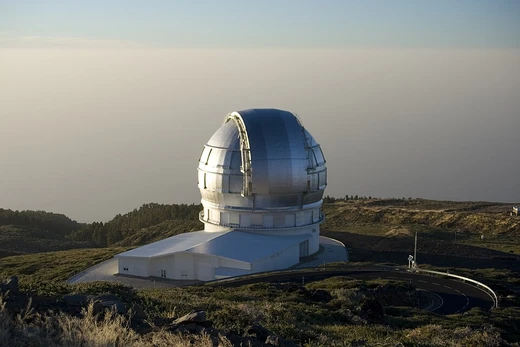
3.67 m Advanced Electro Optical System Telescope
Largest U.S. optical telescope for satellite tracking.

The United States' largest optical telescope built specifically for tracking satellites is a 75-ton Department of Defense instrument at Haleakala Observatory. Called the Advanced Electro-Optical System (AEOS), it belongs to the Maui Space Surveillance Complex, which is part of the Air Force Maui Optical and Supercomputing Site. Despite its size, the telescope can pivot at nearly 20 degrees per second, allowing it to follow both low-Earth satellites and ballistic missiles with high precision. Its optical design gives it an f/200 focal ratio and an extremely narrow field of view. Light from the telescope can be directed through a series of mirrors into seven separate Coudé focus rooms below, enabling multiple research groups to use it simultaneously. The telescope carries an adaptive optics system built around a 941-actuator deformable mirror that corrects for atmospheric distortion, along with sensors such as a radiometer, spectrograph, and long-wave infrared imager. These tools allow AEOS to track man-made objects in deep space and collect data for space object identification, with scientists expecting near-diffraction-limited images.
- Aperture
- 3.67 m
- Type
- Optical telescope for satellite tracking
- Focal ratio
- f/200
- Mass
- 75 tons
- Slew rate
- Nearly 20 degrees per second
- Adaptive optics actuators
- 941
- Owner
- Department of Defense
Lore & Background
The 3.67-meter Advanced Electro Optical System Telescope, known as AEOS, is owned by the Department of Defense and is the largest optical telescope in the United States designed for tracking satellites. The 75-ton telescope points and tracks very accurately, yet is fast enough to track both low-Earth satellites and ballistic missiles, slewing at nearly 20 degrees per second. It is an f/200 instrument with an extremely narrow field of view.
AEOS can be used simultaneously by many groups or institutions because its light can be channeled through a series of mirrors to seven independent Coudé focus rooms below the telescope. It employs sophisticated sensors including an adaptive optics system, radiometer, spectrograph, and long-wave infrared imager, and tracks man-made objects in deep space while performing space object identification data collection.
The telescope is equipped with an adaptive optics system, the heart of which is a 941-actuator deformable mirror that can change its shape to remove the atmosphere's distorting effects. Scientists are expected to get near-diffraction-limited images of space objects.
Reader's Guide
The 3.67 m Advanced Electro Optical System Telescope is notable as the United States' largest optical telescope designed specifically for tracking satellites, a role that distinguishes it from astronomical observatories. Its ability to slew at nearly 20 degrees per second and track both low-Earth satellites and ballistic missiles highlights its military and surveillance applications. The telescope's design allows simultaneous use by multiple groups through seven independent Coudé focus rooms, enabling diverse sensor operations including adaptive optics, radiometry, spectrography, and long-wave infrared imaging. The adaptive optics system, featuring a 941-actuator deformable mirror, is central to its capability to produce near-diffraction-limited images by correcting atmospheric distortion. As part of the Maui Space Surveillance Complex and the Air Force Maui Optical and Supercomputing Site, AEOS performs space object identification data collection on man-made objects in deep space, underscoring its role in space situational awareness.
Did You Know?
- AEOS is the United States' largest optical telescope designed for tracking satellites.
- The telescope can slew at nearly 20 degrees per second.
- Its adaptive optics system uses a 941-actuator deformable mirror.
- Light from AEOS can be channeled to seven independent Coudé focus rooms.
Operational Role Within the Maui Space Surveillance Complex
The AEOS is a 3.67-meter electro-optical telescope that forms one of three principal assets at the Maui Space Surveillance Complex. It operates alongside the Maui Space Surveillance System and the Ground-based Electro-Optical Deep Space Surveillance system, each bringing its own suite of instruments to the surveillance mission. The MSSS employs a 1.6-meter telescope, two 1.2-meter telescopes sharing a common mount, a 0.8-meter beam director and tracker, and a 0.6-meter laser beam director. The GEODSS contributes two 1.0-meter telescopes and a single 0.38-meter telescope. Together these systems represent a layered, multi-aperture approach to tracking objects in space, with the AEOS providing the largest optical aperture in the complex. The entire complex is administered by the Air Force Office of Scientific Research under the Air Force Research Laboratory and forms a component of the broader Air Force Maui Optical and Supercomputing Site.
Strategic Elevation and Atmospheric Advantage
The AEOS draws significant benefit from its position atop Haleakalā at over 3,050 meters elevation, a height that places the instrument above roughly one-third of Earth's troposphere. This altitude yields excellent seeing conditions, a factor of considerable importance for electro-optical surveillance work that demands sharp, stable imagery. The Haleakalā site holds the distinction of being Hawaii's first astronomical research observatory, and its summit is so visually prominent that, under exceptionally clear atmospheric conditions, the entire complex can be discerned from Makakilo on the island of Oahu, a separation exceeding 200 kilometers. The property is owned by the Institute for Astronomy at the University of Hawaiʻi, which manages the site and leases portions to tenant organizations, including the Air Force Research Laboratory that fields the AEOS. This arrangement embeds a military surveillance asset within a broader academic and multi-tenant research landscape on the island of Maui.
Institutional Framework and Multi-Tenant Ecosystem
The AEOS does not operate in isolation. The Haleakalā observatory site hosts a diverse assemblage of scientific and military instruments under the stewardship of the University of Hawaiʻi's Institute for Astronomy. Tenants on the property range from the Air Force Research Laboratory to the Las Cumbres Observatory Global Telescope Network, which operates the 2.0-meter Faulkes Telescope North to provide remote research access primarily to students in the United Kingdom. Other facilities sharing the high-altitude platform include the Pan-STARRS survey telescopes, the Mees Solar Observatory, the Daniel K. Inouye Solar Telescope, and the Zodiacal Light Observatory with its coronagraph and atmospheric monitoring instruments. The AEOS building sits within this constellation of instruments, coexisting with solar physics, asteroid detection, and atmospheric perturbation monitoring equipment. This multi-tenant model creates a distinctive convergence of defense operations and academic research on a single volcanic summit.
Planned Infrastructure and Long-Term Stewardship
The AEOS is not a static installation. The Air Force Research Laboratory has outlined plans to construct a mirror re-coating facility in the immediate vicinity of the AEOS building, signaling a sustained commitment to preserving the telescope's optical performance over time. This planned addition highlights the long-term operational horizon envisioned for the system. The broader site has a well-established pattern of evolving infrastructure: the older TLRS-4 laser ranging facility was superseded, and the vacated space was repurposed to house the Pan-STARRS telescopes. Likewise, the LURE observatory domes, decommissioned in 2004, now shelter the PS1 and PS2 instruments. The AEOS building's adjacency to a future re-coating facility suggests that the Air Force intends to sustain the telescope's capabilities for years to come, integrating critical maintenance directly into the operational footprint rather than depending on off-site services.
Frequently Asked Questions
What is the 3.67 m Advanced Electro Optical System Telescope?
It is a 75-ton Department of Defense optical instrument at Haleakala Observatory, recognized as the largest U.S. telescope built specifically for tracking satellites. It operates as part of the Maui Space Surveillance Complex under the Air Force Maui Optical and Supercomputing Site.
What are the AEOS telescope's key capabilities?
Despite its massive 75-ton frame, the AEOS can slew at nearly 20 degrees per second, letting it lock onto and follow low-Earth orbit satellites and ballistic missiles with high precision. Its f/200 optical design produces an extremely narrow field of view, and 941 adaptive optics actuators keep the tracked image sharp.
How does the AEOS telescope track fast-moving objects?
The telescope's high slew rate lets it pivot rapidly to keep fast targets—ranging from LEO satellites to ballistic missiles—centered in its narrow field of view. Meanwhile, the 941 adaptive optics actuators continuously correct for atmospheric distortion so the object stays in sharp focus during pursuit.
Why is the AEOS telescope important to U.S. defense?
As the largest dedicated satellite-tracking optical telescope in the United States, it serves as a critical sensor for monitoring objects in low-Earth orbit and detecting ballistic missile activity. Its combination of a 3.67-meter aperture, high-speed tracking, and adaptive optics makes it a cornerstone of the Maui Space Surveillance Complex.
Where is the 3.67 m AEOS telescope located?
The instrument sits at Haleakala Observatory on the island of Maui, Hawaii, as part of the Maui Space Surveillance Complex. That complex falls under the Air Force Maui Optical and Supercomputing Site, a Department of Defense installation.
More in Optical Telescopes, Part 2 1-24
Spotted an error? Know more?
Reader corrections go straight into our review queue. Suggest an edit · How this site is sourced