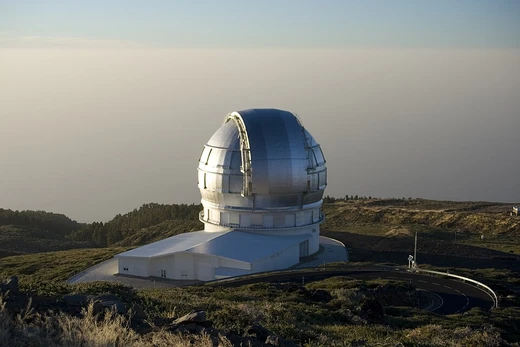
3.6m Devasthal Optical Telescope
Asia's largest reflecting telescope, activated in 2016.

The Devasthal Optical Telescope, or DOT, is a 3.6-meter reflecting telescope with a clear aperture, built using a Ritchey–Chrétien design. It belongs to the Aryabhatta Research Institute of Observational Sciences (ARIES) and sits at the Devasthal Observatory near Nainital in the Kumaon region of India. ARIES also runs a separate 1.3-meter telescope at the same site. The telescope was first activated remotely on 31 March 2016, with Indian Prime Minister Narendra Modi and Belgian Prime Minister Charles Michel jointly initiating the operation from Brussels. Its optics were developed in partnership with AMOS, a Belgian company specializing in advanced mechanical and optical systems. Currently the largest reflecting telescope in Asia, the DOT aims to address a significant gap in longitude for 4-meter-class telescopes across the region. It is equipped with an optical spectrograph, a CCD imager, and a near-infrared spectrograph. Notably, it is the first telescope in India to incorporate an active optics system, which uses a wavefront sensor and pneumatic actuators to correct minor distortions in the 4.3-tonne mirror caused by gravity or atmospheric effects.
- Aperture
- 3.6 meters
- Type
- Clear-aperture Ritchey–Chrétien
- Location
- Devasthal Observatory site, near Nainital, Kumaon, India
- Operator
- Aryabhatta Research Institute of Observational Sciences (ARIES)
- Activation date
- 31 March 2016
- Activated by
- Indian Prime Minister Narendra Modi and Belgian Prime Minister Charles Michel from Brussels
- Mirror mass
- 4.3 tonnes
- Optics collaborator
- Belgian firm Advanced Mechanical and Optical System (AMOS)
Lore & Background
The 3.6m Devasthal Optical Telescope was built by the Aryabhatta Research Institute of Observational Sciences (ARIES) and is located at the Devasthal Observatory site near Nainital, Kumaon, India. ARIES also operates a 1.3m telescope at the same location. The telescope was activated remotely on 31 March 2016 by Indian Prime Minister Narendra Modi and Belgian Prime Minister Charles Michel from Brussels. The telescope optics were built in collaboration with the Belgian firm Advanced Mechanical and Optical System (AMOS).
The telescope is currently the largest reflecting telescope in Asia and intends to fill a large longitudinal gap in the 4m class of telescopes in the Asia region. It features an optical spectrograph, a CCD imager, and a near-infrared spectrograph. The telescope is also the first of its kind in India that features an active optics system, which includes a wavefront sensor and pneumatic actuators that compensate for small distortions in the shape of the 4.3 tonne mirror due to gravity or atmospheric aberrations.
Reader's Guide
The 3.6m Devasthal Optical Telescope is significant as the largest reflecting telescope in Asia, addressing a longitudinal gap in 4m-class telescopes in the region. Its activation on 31 March 2016 by the Indian and Belgian prime ministers underscores international collaboration, with optics built by the Belgian firm AMOS. The telescope's active optics system—the first in India—uses a wavefront sensor and pneumatic actuators to correct mirror distortions from gravity and atmospheric effects, enhancing image quality. Equipped with an optical spectrograph, CCD imager, and near-infrared spectrograph, it supports diverse astronomical observations. Its legacy lies in advancing Indian observational astronomy and providing a key facility for Asian researchers, though the article does not detail specific discoveries or ongoing projects.
Did You Know?
- The 3.6m DOT is the largest reflecting telescope in Asia.
- The telescope features an active optics system, the first of its kind in India.
- Its 4.3 tonne mirror is corrected for distortions using a wavefront sensor and pneumatic actuators.
A Place Among the Giants
The 3.6m Devasthal Optical Telescope occupies a defined position within the broader family of large optical reflecting instruments whose primary mirrors exceed three metres in effective aperture. In this hierarchy, aperture serves as the traditional yardstick for comparing collecting area, theoretical resolution, physical scale, and construction cost. A 3.6-metre collecting surface places the Devasthal instrument comfortably above the minimum threshold that qualifies it for inclusion alongside the world's most substantial ground-based reflectors. Unlike segmented or multi-mirror systems that are ranked by their combined equivalent aperture, a single-aperture design of this class is listed straightforwardly by its own mirror diameter. The telescope also sits well below the frontier instruments currently under construction—telescopes approaching thirty to forty metres—but above the smaller survey and spectroscopic platforms that operate in the sub-three-metre range. Its effective optical aperture, defined as the diameter of a circle with equivalent light-collecting area, is the metric by which it is measured against peers.
Performance Beyond Diameter
A mirror's diameter, while historically the most intuitive measure of a telescope's capability, tells only part of the story. The 3.6m Devasthal Optical Telescope, like all ground-based instruments of its class, must contend with atmospheric turbulence, site climate, and hemisphere-based sky access before its full resolving potential is realized. A larger aperture does not automatically translate into superior observational output; overall light-gathering efficiency of the complete optical system can be a misleading indicator of real-world performance. What elevates a telescope like Devasthal is the combination of a carefully chosen site with stable atmospheric conditions, active optics that maintain mirror figure, and adaptive optics systems that correct for the bulk of atmospheric distortion in real time. Together, these technologies allow even a 3.6-metre instrument to push its effective resolution well beyond what its raw aperture alone would suggest, and in some observing regimes to rival or exceed the angular detail achieved by space-based platforms.
The Ground-Based Edge
One of the most practical advantages enjoyed by the 3.6m Devasthal Optical Telescope, shared by all comparable Earth-based reflectors, is the relative affordability of keeping its instrumentation current. Space-based observatories, once deployed, are locked into the detector and spectrograph technology available at launch; upgrading them would require a costly new mission. By contrast, a ground-based telescope can swap out cameras, spectrographs, and adaptive-optics modules as new sensors and algorithms become available, extending its scientific relevance across decades. Additionally, when active and adaptive optics are employed to compensate for atmospheric seeing, the largest Earth-based telescopes can achieve angular resolution that surpasses that of the Hubble Space Telescope in certain wavelength bands. The 3.6-metre aperture of Devasthal, paired with modern correction systems, therefore represents a flexible and economically sustainable platform for long-term optical and near-infrared research.
Shadow of the Next Generation
The 3.6m Devasthal Optical Telescope operates in a rapidly evolving landscape. Several instruments currently under construction will dwarf it in scale: the Extremely Large Telescope in Chile, with a 39.5-metre aperture and first light targeted for 2029; the Thirty Metre Telescope in Hawaii, whose construction has been stalled since 2015; and the Giant Magellan Telescope, also in Chile, combining seven 8.4-metre mirrors into an effective 21.4-metre aperture. Even the San Pedro Martir Telescope in Mexico, at 6.5 metres, will roughly double Devasthal's collecting area. Yet these future giants will not render existing 3.6-metre-class instruments obsolete. Smaller telescopes remain essential for wide-field surveys, time-domain monitoring, and educational use, and their lower operating costs allow sustained access for a broader community of researchers. The Devasthal telescope thus occupies a vital middle tier in a field that is simultaneously scaling upward and diversifying in purpose.
Frequently Asked Questions
Who is the 3.6m Devasthal Optical Telescope?
The DOT is a 3.6-meter clear-aperture reflecting telescope built on a Ritchey–Chrétien optical design. It is operated by the Aryabhatta Research Institute of Observational Sciences (ARIES) and is recognized as the largest reflecting telescope in Asia.
What are the 3.6m Devasthal Optical Telescope's powers/role?
The DOT functions as a ground-based optical observatory instrument, using its 3.6-meter primary mirror to collect and focus light from distant celestial objects. It supports a broad portfolio of astronomical research programs run by ARIES at the Devasthal Observatory site.
Why is the 3.6m Devasthal Optical Telescope important?
As the largest reflecting telescope in Asia, the DOT gives Indian astronomers a powerful domestic instrument for optical observations without depending on foreign facilities. Its Ritchey–Chrétien design and 3.6-meter aperture make it a cornerstone of ARIES's observational capabilities.
Who activated the 3.6m Devasthal Optical Telescope and how?
The telescope's first remote activation was carried out on 31 March 2016 by Indian Prime Minister Narendra Modi and Belgian Prime Minister Charles Michel, who initiated the operation together from Brussels. The joint ceremony underscored the international collaboration behind the project's optics development.
More in Optical Telescopes, Part 2 1-24
Spotted an error? Know more?
Reader corrections go straight into our review queue. Suggest an edit · How this site is sourced