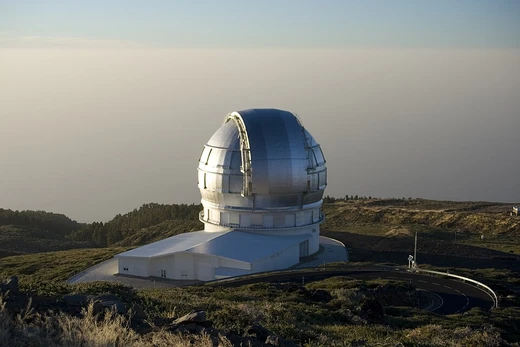
Aristarchos 2.3 m Telescope
Largest telescope in Greece and the Balkans.

The Aristarchos 2.3 m Telescope is a Ritchey-Chrétien telescope located at the Chelmos Observatory on Mount Chelmos, Greece. It is the largest telescope in Greece and the largest in the Balkans, as well as the second largest in mainland Europe. It had its first light test in 2005 and became fully operational in 2007.
- Aperture
- 2.3 m
- Optical design
- Ritchey-Chrétien
- Mount
- Altazimuth
- Location
- Chelmos Observatory, Mount Chelmos, Greece
- First light
- 2005
- Fully operational
- 2007
- Operator
- Institute for Astronomy, Astrophysics, Space Applications and Remote Sensing (IAASARS) of the National Observatory of Athens
Lore & Background
The Aristarchos telescope was built by Carl Zeiss AG and is housed in a tower 35 meters away from the control building to isolate it from heat and vibrations. It has a primary mirror diameter of 2.3 m and an f/8 Cassegrain focus with a corrected field of view of approximately one degree and a plate scale of 1.17 arcsec/mm. The telescope was designed to support remote observation.
The telescope was funded by the European Commission and the General Secretariat for Research and Technology of the Hellenic Ministry of Development as part of the New Greek Telescope project of the National Observatory of Athens. It had its first light test in 2005 and became fully operational at the Chelmos Observatory site in 2007.
The Aristarchos telescope is a full member of the OPTICON-RadioNet Pilot project since January 1, 2016, and has made observations under awarded time, including a stellar occultation of Neptune's moon Triton and a transit of exoplanet WASP-12b. It was also selected in August 2020 as the first ground-based station of the ScyLight program of ESA, and on 23 July 2021 successfully communicated with the Alphasat satellite.
Reader's Guide
The Aristarchos 2.3 m Telescope is notable as the largest telescope in Greece and the Balkans, and the second largest in mainland Europe. Its significance extends beyond its size: it has been selected for major space communications projects, including the ScyLight program of ESA and the Deep Space Optical Communications demonstration of NASA. In July 2025, it achieved laser communication with the Psyche spacecraft, receiving the spacecraft's response after a high-powered laser was fired from the nearby Kryoneri Observatory. The telescope has also contributed to exoplanet discoveries, including WASP-113b and WASP-114b in 2013, and in 2022 it helped prove that 55 asteroids share a common origin as a collisional family. Additionally, it provided a measurement of the distance to the planetary nebula KjPn 8. Its membership in the OPTICON-RadioNet Pilot project since 2016 further underscores its role in European astronomical collaboration.
Optical Architecture: The Hyperbolic Advantage
The Aristarchos 2.3 m Telescope belongs to a family of instruments defined by a precise optical philosophy: the Ritchey–Chrétien configuration. Rather than relying on a single curved surface, this design pairs a hyperbolic primary mirror with a hyperbolic secondary, both shaped to cancel out off-axis optical errors that plague more traditional reflectors. The most notable of these errors is coma, a distortion that smears star images toward the edge of the field. By engineering the two hyperbolic surfaces to work in concert, the system delivers a substantially wider region of sharp, aberration-free imagery than a conventional Cassegrain would allow. This advantage has made the RCT the dominant architecture for large professional research telescopes since the mid-twentieth century. Iconic instruments such as the Hubble Space Telescope, the twin Keck telescopes, and the ESO Very Large Telescope all share this fundamental optical recipe, underscoring how central the hyperbolic two-mirror approach has become to modern astronomy.
A Lineage of Pioneers
The optical concept behind the Aristarchos 2.3 m Telescope traces back to the early 1910s, when American astronomer George Willis Ritchey and French astronomer Henri Chrétien independently developed the principle of using two hyperbolic surfaces to suppress coma. Ritchey brought the idea to life in 1927 with a 60-centimeter instrument that became the first successful RCT ever built. His next effort, a 102-centimeter reflector commissioned for the United States Naval Observatory, proved equally enduring; that telescope continues to operate at the Naval Observatory Flagstaff Station decades later. The design's longevity and scalability are perhaps its most striking attributes. From Ritchey's modest two-foot prototype to the Hubble Space Telescope, the Keck pair, and the ESO Very Large Telescope, the same two-mirror hyperbolic logic has carried astronomy from the ground into orbit and back again, spanning more than a century of observational progress.
The Two-Mirror Foundation and Its Limits
Understanding why the Ritchey–Chrétien design works requires appreciating what a single mirror cannot do. A Newtonian telescope with a spherical primary suffers from spherical aberration, while a parabolic primary fixes that particular flaw but leaves coma and astigmatism untouched, because no additional free parameters remain to adjust. The RCT solves this by introducing a second non-spherical surface: the two mirrors are shaped so that their individual contributions to coma cancel each other out, opening up a larger useful field of view. The basic two-surface RCT is free of third-order coma and spherical aberration, a major achievement. Yet the design is not without residual imperfections. Fifth-order coma persists, large-angle astigmatism remains significant, and field curvature is comparatively severe. When the focal plane is set midway between the sagittal and tangential planes, star images do appear as circles, making the configuration well suited to wide-field and photographic work, but the remaining aberrations still demand careful management.
Engineering Trade-offs: Compactness, Obstruction, and Correction
One of the RCT's practical virtues is its compactness: for a given focal length, the optical tube assembly is remarkably short, a direct benefit of the Cassegrain-style light path folded between two mirrors. However, this elegance carries costs. The secondary mirror necessarily blocks a central portion of the aperture, creating a ring-shaped entrance pupil that depresses the modulation transfer function at low spatial frequencies and reduces contrast when imaging broad, extended features. The spider vanes holding the secondary in place can also introduce diffraction spikes. Moreover, the hyperbolic surfaces demand sophisticated manufacturing and testing techniques, which is why the RCT is most often found on high-performance professional instruments rather than amateur setups. To address residual astigmatism and field curvature, designers may add a third curved mirror to create a three-mirror anastigmat, or insert low-power field-corrector lenses near the focal plane, as in the SDSS and VISTA telescopes, extending the usable field to roughly three degrees. A Schmidt camera can push the field to about seven degrees, but its full-aperture corrector plate limits it to apertures below 1.2 meters, whereas the RCT scales to much larger sizes.
Frequently Asked Questions
What is the Aristarchos 2.3 m Telescope?
It is a 2.3-meter Ritchey-Chrétien reflecting telescope installed at the Chelmos Observatory on Mount Chelmos, Greece. The instrument rides on an altazimuth mount that lets it sweep across the sky in altitude and azimuth.
Where is the Aristarchos 2.3 m Telescope located?
The telescope is housed at the Chelmos Observatory, perched on Mount Chelmos in Greece. Its elevated site provides a clear, low-light-pollution environment ideal for optical astronomy.
When did the Aristarchos 2.3 m Telescope become operational?
The system completed its first-light test in 2005 and was declared fully operational two years later, in 2007.
Why is the Aristarchos 2.3 m Telescope considered important?
It is the largest optical telescope in Greece and in the entire Balkans region. It also stands as the second-largest research-grade optical instrument in mainland Europe.
What optical design does the Aristarchos 2.3 m Telescope use?
The telescope employs a Ritchey-Chrétien configuration, pairing a parabolic primary mirror with a hyperbolic secondary to produce a wide, flat field of sharp images. This two-mirror layout is a staple of modern research telescopes that need high contrast over a broad viewing area.
More in Optical Telescopes, Part 2 1-24
Spotted an error? Know more?
Reader corrections go straight into our review queue. Suggest an edit · How this site is sourced