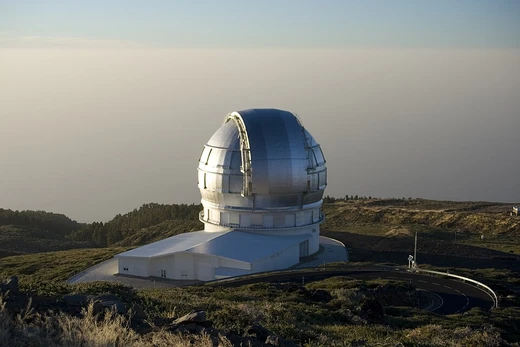
Wisconsin H-Alpha Mapper
A 0.6 m telescope mapping hydrogen-alpha in the warm ionized medium.

The Wisconsin H-Alpha Mapper (WHAM) is a specialized 0.6-meter telescope built and operated by the University of Wisconsin–Madison. Its purpose is to observe the hydrogen-alpha emissions from the warm ionized medium. The telescope currently operates as a tenant at the Cerro Tololo Inter-American Observatory in northern Chile.
The project grew out of interest in ionized hydrogen in interstellar space, which began in the late 1970s when astronomer Ron Reynolds pointed a spectrometer through a makeshift window in a university office. Reynolds, along with senior scientist Matt Haffner and others, later developed WHAM. The instrument first became operational at Kitt Peak National Observatory in November 1996. There, it used flat mirrors on a two-axis, all-sky siderostat to direct light horizontally through a 0.6-meter objective lens with an 8.6-meter focal length. The light entered a trailer housing a spectrometer with two 15-centimeter Fabry-Perot etalons and a low-noise, high-efficiency CCD camera as a multichannel detector. The entire facility was automated, allowing it to be controlled from a campus office in Madison, Wisconsin. WHAM operated at Kitt Peak from 1996 to 2008, then moved to Cerro Tololo in 2009.
With its wide field of view, WHAM can complete a full sky survey in about two years. It mapped the details of the Reynolds Layer.
- Aperture
- 0.6 metres (24 in)
- Focal length
- 8.6 m
- Location
- Cerro Tololo Inter-American Observatory (CTIO), Coquimbo Region, northern Chile
- Operator
- University of Wisconsin–Madison
- First light at kitt peak
- November 1996
- Move to ctio
- 2009
- Key people
- Ron Reynolds, Matt Haffner
Lore & Background
First interest in the ionised hydrogen of the interstellar medium came when Ron Reynolds pointed a spectrometer through a makeshift observing portal in an office of the University of Wisconsin-Madison's Physical Sciences Laboratory during the late 1970s. Reynolds and colleagues, including Matt Haffner, a senior scientist in UW-M's astronomy department, later developed WHAM. WHAM formally began life at Kitt Peak National Observatory (KPNO) in November 1996, using the flat mirrors of a two axis, all-sky siderostat passing light horizontally through a 0.6 m diameter, 8.6 m focal length objective lens into a 2.5 m x 2.5 m x 6 m trailer that contained the spectrometer, that used a low noise, high efficiency CCD camera as a multichannel detector behind a pair of 15 centimetres (5.9 in) diameter Fabry-Perot etalons/spectrometers. The system was automated, so that the entire WHAM facility, including opening and closing at the beginning and end of the observing night, was operated from a campus office at the University of Wisconsin in Madison. It operated there from 1996 to 2008. In 2009, WHAM was moved from KPNO to CTIO.
Reader's Guide
WHAM's field of view allows a whole sky survey in about 2 years. WHAM mapped the details of the Reynolds Layer. The telescope's design, using a siderostat and a trailer-mounted spectrometer with Fabry-Perot etalons, enabled automated remote operation from a campus office in Madison. Its move from Kitt Peak to Cerro Tololo in 2009 extended its survey to the southern sky, complementing its earlier northern survey. The instrument's primary legacy is the comprehensive mapping of the warm ionized medium, particularly the Reynolds Layer, providing a detailed view of ionized hydrogen across the entire sky.
Did You Know?
- WHAM operated at Kitt Peak National Observatory from 1996 to 2008.
- The telescope uses a pair of 15 cm diameter Fabry-Perot etalons as spectrometers.
- WHAM was moved to Cerro Tololo Inter-American Observatory in 2009.
- The entire facility could be operated remotely from a campus office at the University of Wisconsin in Madison.
The Quantum Architecture of H-Alpha
In the Bohr model of the atom, electrons are confined to discrete energy levels labeled by the principal quantum number, running from n = 1 upward. They cannot occupy intermediate states, nor can they drift freely between levels; every transition is strictly quantized. The Balmer series encompasses every transition that terminates at n = 2, and its members are designated by Greek letters in order of the starting level. The very first of these, a drop from n = 3 to n = 2, is called Balmer-alpha, or simply H-alpha. It produces a photon in the deep-red portion of the visible spectrum, with a wavelength of 656.28 nanometers measured in air and 656.46 nanometers in vacuum. Because hydrogen is the primary constituent of nebulae, this particular transition is not a rare curiosity but a fundamental signature of atomic physics. The Rydberg formula governs the precise energy spacing, and the fact that the n = 3 to n = 2 gap requires roughly 12.1 electron-volts to excite—nearly the 13.6 electron-volts needed for full ionization—makes H-alpha a natural byproduct of the most common processes occurring in interstellar gas.
Mapping Ionized Hydrogen Across the Cosmos
H-alpha stands as the most accessible tool astronomers possess for charting the distribution of ionized hydrogen in emission nebulae and other gas clouds. The reason is rooted in the energetics of the hydrogen atom: exciting an electron from the ground state to the n = 3 level demands approximately 12.1 electron-volts, which is almost as much as the 13.6 electron-volts required to strip the electron entirely. In practice, ionization therefore outcompetes direct excitation to n = 3. Once a free electron and proton recombine into a fresh hydrogen atom, the electron can land in any energy level before cascading down toward the ground state, emitting a photon at each step. Roughly half of all such cascades will pass through the n = 3 to n = 2 transition, releasing the characteristic H-alpha photon. This means the line is a reliable marker of active ionization zones. However, because hydrogen dominates nebular composition, the line saturates and self-absorbs with relative ease. Astronomers can thus trace the shape and outer boundaries of a cloud, but they turn to molecular tracers such as carbon monoxide, carbon dioxide, formaldehyde, ammonia, or acetonitrile when they need to estimate the cloud's true mass.
The Engineering Behind H-Alpha Filters
Capturing H-alpha light in isolation requires optical filters that transmit a tightly controlled bandwidth centered on the 656-nanometer line. The most common approach uses dichroic interference filters, built from roughly fifty vacuum-deposited layers whose thicknesses are engineered so that constructive and destructive interference cancel every wavelength except the desired band. On their own, these filters serve astrophotographers well and help suppress the broad glow of urban light pollution. For solar work, however, the bandwidth must be far narrower. A three-stage assembly is typical: a red-glass energy rejection filter absorbs the bulk of unwanted radiation, a Fabry-Pérot etalon—two parallel reflective surfaces separated by an air gap—transmits several closely spaced wavelengths including one at H-alpha, and a final dichroic blocking filter strips away the etalon's extra passbands. The result passes less than 0.1 nanometer of light. Though the etalon and the dichroic filter share the same underlying interference physics, their mechanical implementations differ: the etalon relies on an air gap, while the dichroic depends on internal reflections within its layered stack.
Watching the Sun's Atmosphere in Motion
The Sun's chromosphere and prominences are among the most dramatic structures visible in H-alpha light, and the line's sensitivity to Doppler shifts makes it especially valuable for tracking high-velocity phenomena such as fast-moving prominences and ejections. Because these features can shift the observed wavelength, solar-grade etalons are often designed to be tunable—by tilting the glass, adjusting its temperature, or varying the air density in the gap—so the transmitted band can be nudged to match the shifted line. Commercially available H-alpha filters for amateur solar observers typically specify a bandwidth of 0.7 Ångströms, equivalent to 0.07 nanometers. Stacking a second etalon in the optical path can tighten this to 0.5 Å, yielding noticeably improved contrast in the fine details across the solar disc. For those demanding even finer spectral resolution, a Lyot filter offers an additional narrowing stage. Together, these instruments allow observers to isolate the H-alpha emission from the Sun's atmosphere with a precision that reveals the dynamic, ever-shifting architecture of solar activity.
Frequently Asked Questions
What is the Wisconsin H-Alpha Mapper?
The Wisconsin H-Alpha Mapper, commonly called WHAM, is a 0.6-meter (24-inch) research telescope with an 8.6-meter focal length. It is built and run by the University of Wisconsin–Madison specifically to study hydrogen-alpha light from the warm ionized medium in our galaxy.
Where is the Wisconsin H-Alpha Mapper located?
WHAM currently operates as a tenant instrument at the Cerro Tololo Inter-American Observatory in the Coquimbo Region of northern Chile. It originally saw first light at Kitt Peak in November 1996 before being relocated to CTIO in 2009.
What does the Wisconsin H-Alpha Mapper observe?
The telescope is purpose-built to map hydrogen-alpha emissions, which trace the warm ionized hydrogen gas distributed throughout the interstellar medium. This lets astronomers chart the structure and distribution of ionized gas in our galaxy.
Who operates the Wisconsin H-Alpha Mapper?
The University of Wisconsin–Madison both built and operates WHAM. The project was driven by astronomer Ron Reynolds together with senior scientist Matt Haffner and other collaborators.
How did the Wisconsin H-Alpha Mapper project begin?
The idea traces back to the late 1970s, when astronomer Ron Reynolds simply pointed a spectrometer out through a makeshift window in a university office to study ionized hydrogen in interstellar space. That informal curiosity eventually grew into a dedicated 0.6-meter telescope project.
More in Optical Telescopes, Part 2 1-24
Spotted an error? Know more?
Reader corrections go straight into our review queue. Suggest an edit · How this site is sourced