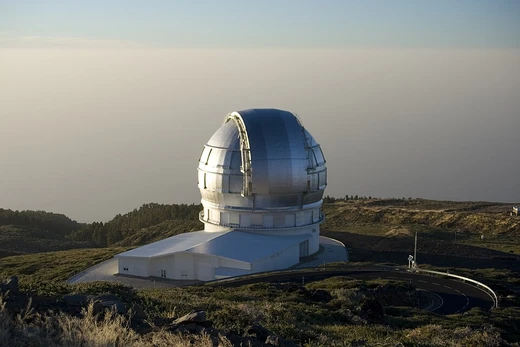
ANU 2.3 m Telescope
Optical telescope with thin mirror, altazimuth mount, and co-rotating building.

The ANU 2.3 m Telescope, an optical instrument at Siding Spring Observatory, is run by the Australian National University's Research School of Astronomy and Astrophysics (RSAA). Built in the early 1980s, it incorporated several daring features for its era: a very thin mirror, an altazimuth mount, and a building that rotates with the telescope.
Don Mathewson, then the observatory’s director, championed the project. Prime Minister Bob Hawke officially opened the telescope on 16 May 1984, and it was hailed as a high-tech achievement for Australia. In 1985, it earned an award from the Institution of Engineers. The telescope was automated in early 2023, allowing it to quickly react to alerts from other facilities. This automation makes it particularly effective for studying objects that change over time, such as supernovae, gamma-ray bursts, and gravitational wave sources.
The mirror is notably thin, with a diameter-to-thickness ratio around 20:1. This lightweight design, combined with the rotating mount, lets the telescope move rapidly during observations.
Currently, the telescope uses the Wide-Field Spectrograph (WiFeS), an integral field spectrograph built at the RSAA and installed in 2009. Earlier instruments included the Cryogenic Array Spectrometer/Imager (CASPIR), the Dual-Beam Spectrograph (DBS), an echelle spectrograph, and an imaging camera. Students from ANU and other universities regularly use the telescope to gain hands-on experience with large scientific instruments. It also frequently follows up on objects flagged by other detectors. The telescope has contributed to major surveys, such as the Dark Energy Bedrock All Sky Survey (DEBass), which studied over 500 type Ia supernovae.
- Location
- Siding Spring Observatory
- Operator
- Australian National University's Research School of Astronomy and Astrophysics (RSAA)
- Construction period
- early 1980s
- Inauguration date
- 16 May 1984
- Inaugurated by
- Prime Minister Bob Hawke
- Mirror diameter-to-thickness ratio
- about 20:1
- Current instrument
- Wide-Field Spectrograph (WiFeS), installed in 2009
Lore & Background
The telescope was the initiative of Don Mathewson, then-director of the observatory. It was inaugurated by Prime Minister Bob Hawke on 16 May 1984 and was regarded as an achievement in high technology for Australia. In 1985, it won an award from the Institution of Engineers. In early 2023 the telescope was automated, enabling it to instantly respond to alerts from other facilities, making it well suited for studying time-varying sources such as supernovae, gamma-ray bursts, and gravitational wave sources.
The telescope's mirror is unusually thin, with a diameter-to-thickness ratio of about 20:1. The light mirror and rotating design allow the telescope to be rapidly moved as observations are made. The telescope's current instrument is the Wide-Field Spectrograph (WiFeS), an integral field spectrograph designed and built at the RSAA and installed in 2009. Previous instruments have included the Cryogenic Array Spectrometer/Imager (CASPIR), the Dual-Beam Spectrograph (DBS), an echelle spectrograph, and an imaging camera.
The 2.3m telescope is regularly used by students from ANU and other universities, enabling them to gain experience working with large scientific telescopes. It also regularly performs follow-up observations on objects of interest identified by other detectors. The telescope has been involved in a number of large survey programs, including the Dark Energy Bedrock All Sky Survey (DEBass), a survey of over 500 type Ia supernovae.
Reader's Guide
The ANU 2.3 metre telescope is notable for its innovative design at the time of construction, including an unusually thin mirror, an altazimuth mount, and a co-rotating building. These features allowed rapid movement during observations. Its inauguration by Prime Minister Bob Hawke in 1984 and an award from the Institution of Engineers in 1985 underscore its recognition as a high-technology achievement for Australia. The telescope's automation in early 2023 enhanced its ability to respond quickly to alerts, making it particularly valuable for studying transient astronomical phenomena such as supernovae, gamma-ray bursts, and gravitational wave sources. Its current instrument, the Wide-Field Spectrograph (WiFeS), installed in 2009, supports integral field spectroscopy. The telescope serves an educational role, regularly used by students from ANU and other universities, and contributes to major surveys like the Dark Energy Bedrock All Sky Survey (DEBass), which surveyed over 500 type Ia supernovae. Its legacy includes a history of supporting follow-up observations and training the next generation of astronomers.
Optical Architecture & Design Philosophy
The Giant Magellan Telescope achieves its extraordinary optical performance through a Gregorian architecture that relies on just two light-collecting surfaces to deliver the highest possible image resolution across the broadest field of view in the thirty-meter class. Its seven primary mirrors, each weighing eighteen tons, together span a collecting area of 368 square meters beneath a 25.4-meter effective aperture. The instrument is tuned to capture light from 320 nanometers in the visible through 25,000 nanometers in the mid-infrared, a range that grants roughly ten times the resolving power of Hubble and four times that of James Webb, though it cannot reach the longer infrared bands accessible only from space. A defining engineering choice is the mirror support: rather than an internal load-bearing frame, each cell draws its rigidity from a sculpted external shell, keeping the structure compact and resistant to wind-induced vibration. Pneumatic actuators embedded in the support push against the rear faces of the mirrors, continuously correcting their shape to preserve image fidelity.
The Atacama Perch
Perched at 2,516 meters above sea level, Las Campanas Observatory sits roughly 115 kilometers north-northeast of La Serena and 180 kilometers south of Copiapó in Chile's Atacama Desert. The Carnegie Institution for Science has held the land since 1960, and the site already hosts the Magellan Telescopes. The GMT was drawn to this particular peak because of its consistently exceptional seeing and long stretches of clear sky, compounded by the near-total absence of nearby populations that would introduce light or atmospheric interference. Being in the southern hemisphere, the observatory opens a window onto targets invisible from the north: the Milky Way's galactic center, the supermassive black hole Sagittarius A*, Proxima Centauri as the Sun's closest stellar neighbor, the Magellanic Clouds, and a dense field of nearby galaxies and exoplanet systems. For a telescope whose stated mission includes hunting for biosignatures on distant worlds, that southern vantage is not a convenience—it is a necessity.
From Furnace to Frictionless Glide
The physical realization of the GMT has unfolded over nearly two decades. The first primary mirror was cast in a rotating furnace on November 3, 2005, and its polishing was finished by November 2012. Subsequent segments followed at irregular intervals: the third in August 2013, the fourth in September 2015, the fifth in 2017, the sixth in 2021, and the seventh and final one in 2023. On the ground, the first blast to level the mountain summit occurred in March 2012, and a formal ground-breaking ceremony marked the start of site construction in November 2015. The telescope mount, a 39-meter-tall alt-azimuth structure standing on a 22-meter-diameter pier, will weigh 2,100 tons once mirrors and instruments are installed. It will glide on a 50-micron film of oil supported by hydrostatic bearings, granting frictionless motion in three degrees of freedom. Ingersoll Machine Tools completed its 40,000-square-foot fabrication facility in Rockford, Illinois, in December 2021, and the mount is slated for delivery to Chile by the end of 2025. The 65-meter-tall, 4,800-ton enclosure, capable of a full rotation in just over three minutes, incorporates a closed-cycle forced-air system to keep thermal gradients across the mirrors minimal and a seismic isolation system rated for the strongest quakes expected over a fifty-year operational life.
Seven Nations, One Vision
Behind the GMT stands the GMTO Corporation, a consortium that unites research institutions from seven nations: Australia, Brazil, Chile, Israel, South Korea, Taiwan, and the United States. The project carries an estimated price tag of two billion US dollars, a sum that reflects both the sheer scale of the hardware and the complexity of coordinating engineering across multiple time zones and regulatory frameworks. By 2023, the consortium had achieved a major milestone: all seven primary mirrors were cast, the first of seven adaptive secondary mirrors was under construction, the telescope mount was in its manufacturing phase, and the remaining subsystems were entering their final design stages. Commissioning is anticipated in the early 2030s. The science case that justifies this collective investment is broad and ambitious—spanning the search for chemical signatures of life on exoplanets to tracing the cosmic origins of the elements that make up stars, planets, and living tissue. No single nation or institution could have shouldered the cost or the technical risk alone; the seven-country model distributes both the burden and the discovery.
Frequently Asked Questions
What is the ANU 2.3 m Telescope?
It is an optical research telescope based at Siding Spring Observatory in New South Wales, Australia, and is operated by the Australian National University's Research School of Astronomy and Astrophysics (RSAA). Built during the early 1980s, it was officially inaugurated on 16 May 1984.
What made the ANU 2.3 m Telescope technically daring for its era?
The instrument featured an exceptionally thin primary mirror with a diameter-to-thickness ratio of roughly 20 to 1, an altazimuth mounting system, and an observatory rotunda that turns in tandem with the telescope. All three design choices were considered bold engineering decisions in the early 1980s.
Who officially opened the ANU 2.3 m Telescope and who championed the project?
Australian Prime Minister Bob Hawke presided over the opening ceremony on 16 May 1984. The build had been strongly advocated by Don Mathewson, who was serving as the observatory's director at the time.
Where is the ANU 2.3 m Telescope located and who runs it day to day?
The telescope is sited at Siding Spring Observatory in rural New South Wales. Operational responsibility rests with the Australian National University's Research School of Astronomy and Astrophysics (RSAA).
Why is the ANU 2.3 m Telescope regarded as a milestone for Australian astronomy?
When it was unveiled in 1984 it was widely celebrated as a landmark in Australian high-technology infrastructure, and it went on to receive an engineering award from the Institution of Engineers in 1985. Its combination of a lightweight mirror, altazimuth drive, and co-rotating building set a new benchmark for domestically built observatory instruments.
More in Optical Telescopes, Part 2 1-24
Spotted an error? Know more?
Reader corrections go straight into our review queue. Suggest an edit · How this site is sourced