Anglo-Australian Telescope
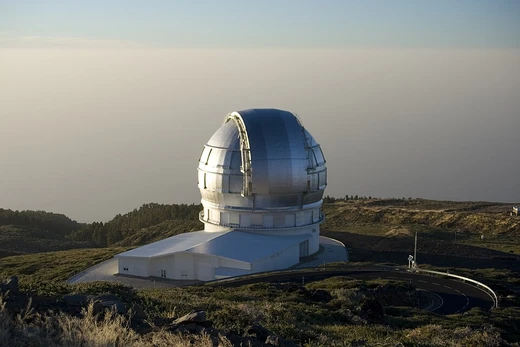
A 3.9-metre equatorial telescope at Siding Spring Observatory.

The Anglo-Australian Telescope (AAT) is a 3.9-metre equatorially mounted optical telescope operated by the Australian Astronomical Observatory at Siding Spring Observatory, Australia, at an altitude of a little over 1,100 m. Commissioned in 1974, it was built by the United Kingdom in partnership with Australia to allow high-quality observations of the sky from the Southern Hemisphere, which had been poorly observed due to most major telescopes being located in the Northern Hemisphere. It was the largest telescope in the Southern Hemisphere from 1974 to 1976 and was credited with stimulating a resurgence in British optical astronomy.
- Aperture
- 3.9 metres
- Mount type
- equatorial
- Location
- Siding Spring Observatory, Australia
- Altitude
- a little over 1,100 m
- First light
- 27 April 1974
- Total moving mass
- 260 tonnes
- Dome diameter
- 36 m
Lore & Background
British astronomer Richard van der Riet Woolley pushed for a large optical telescope for the Southern Hemisphere in 1959. In 1965, Macfarlane Burnet, president of the Australian Academy of Science, wrote to federal education minister John Gorton inviting support for a joint British-Australian project. Gorton was supportive and nominated the Australian National University and CSIRO as Australia's representatives; he was unsuccessful in attempts to induce NASA to join. Gorton brought the proposal before cabinet in April 1967, which endorsed the scheme and agreed to contribute half the capital and running costs. An agreement with the British was finalised a few weeks later, and a Joint Policy Committee started work on construction planning in August 1967. Plans were finalised in September 1969. The agreement initially committed to a telescope design based on the American Kitt Peak telescope until its deficiencies were known; both the horseshoe mount and gearing system needed improvements. The revised gear system was considerably more expensive but significantly more accurate.
The mirror blank was made by Owens-Illinois in Toledo, Ohio, then transported to Newcastle, England, where Sir Howard Grubb, Parsons and Co took two years to grind and polish the mirror's surface. Mitsubishi Electric built the mount, which was constructed by August 1973. First light occurred on 27 April 1974, and the telescope was officially opened by Prince Charles on 16 October 1974. The telescope is housed within a seven-story, circular, concrete building topped with a 36 m diameter rotating steel dome, designed to withstand high winds. The slit is narrow, and the dome moves with the telescope to avoid obstruction. The top of the dome is 50 m above ground level. The telescope tube structure is supported inside a massive 12 m diameter horseshoe rotating around the polar axis; the total moving mass is 260 tonnes.
The AAT was one of the last large telescopes built with an equatorial mount; more recent large telescopes have adopted the more compact and mechanically stable altazimuth mount. However, it was one of the first telescopes to be fully computer-controlled and set new standards for pointing and tracking accuracy. The telescope has various foci for flexible instrumentation: originally three top-end rings exchangeable using the dome crane during the daytime—one for f/3.3 prime-focus with corrector lenses and a cage for a human observer (rarely used after the 1980s); one with a large secondary mirror for f/8 Cassegrain focus; and a third with smaller f/15 and f/36 secondary mirrors. A fourth top-end was built in the 1990s to give a 2-degree field of view at prime focus, with 400 optical fibres feeding the 2dF instrument and its later enhancements AAOmega and HERMES.
Reader's Guide
The Anglo-Australian Telescope was commissioned in 1974 with a view to allowing high-quality observations of the sky from the Southern Hemisphere, which had been poorly observed because most major telescopes were located in the Northern Hemisphere. It was the largest telescope in the Southern Hemisphere from 1974 to 1976, then a close second to the Víctor M. Blanco Telescope from 1976 until 1998, when the first ESO Very Large Telescope (VLT) was opened. The AAT was credited with stimulating a resurgence in British optical astronomy. In 2001–2003, it was considered the most scientifically productive 4-metre-class optical telescope in the world based on scientific publications using data from the telescope. In 2009, it was ranked as having the fifth-highest-impact of the world's optical telescopes. The telescope has been entirely funded by Australia since 2010, and observing time is available to astronomers worldwide. Its instruments include the Two Degree Field facility (2dF), a robotic optical fibre positioner for obtaining spectroscopy of up to 400 objects over a 2° field of view simultaneously; the University College London Échelle Spectrograph (UCLES), used to discover many extrasolar planets; IRIS2, a wide-field infrared camera and spectrograph; HERMES, a high-resolution spectrograph commissioned in 2015 mainly used for the GALAH survey; and TAIPAN, a multispectral positioner and spectrograph using starbugs. The AAT was one of the last large telescopes built with an equatorial mount but was one of the first to be fully computer-controlled, setting new standards for pointing and tracking accuracy.
Origins and the Push for Southern-Sky Observations
The idea for a major optical telescope in the Southern Hemisphere was championed by British astronomer Richard van der Riet Woolley as early as 1959. The project gained serious political momentum in 1965 when Macfarlane Burnet, then president of the Australian Academy of Science, wrote directly to federal education minister John Gorton, urging the government to back a joint British-Australian telescope. Gorton embraced the proposal, designating the Australian National University and CSIRO as Australia's partners, though his bid to draw NASA into the arrangement fell through. Cabinet endorsed the scheme in April 1967, committing to share half the capital and operating costs, and a formal agreement with Britain was sealed weeks later. A Joint Policy Committee began construction planning in August 1967, but finalised plans did not emerge until September 1969. The original specification was modelled on the American Kitt Peak telescope, yet both the horseshoe mount and the gearing system proved inadequate. A revised, far more expensive gear system was ultimately adopted for its superior accuracy, a decision that would serve the telescope well into its future.
Engineering Marvel and Structural Design
The AAT's construction drew on an international supply chain. The mirror blank was cast by Owens-Illinois in Toledo, Ohio, before being shipped to Newcastle, England, where Sir Howard Grubb, Parsons and Co spent two years grinding and polishing its surface. Mitsubishi Electric built the equatorial mount, completed by August 1973. The telescope sits inside a seven-story circular concrete building crowned by a 36-metre-diameter rotating steel dome, engineered to resist the strong winds at the site. The dome's top reaches 50 metres above ground, and its narrow slit must track with the telescope to prevent obstruction. The tube structure rests within a massive 12-metre-diameter horseshoe that rotates around the polar axis, with a total moving mass of 260 tonnes. The AAT was among the last large telescopes to use an equatorial mount, as newer instruments favour the more compact altazimuth design. Yet it was one of the first to be fully computer-controlled, establishing new benchmarks for pointing and tracking precision.
Scientific Productivity and Instrumentation
The AAT has consistently ranked among the world's most productive optical telescopes. In 2009 it was rated the fifth-highest-impact optical telescope globally, and between 2001 and 2003 it was deemed the most scientifically productive four-metre-class instrument based on published research. Its versatility comes from multiple foci: a prime-focus cage rarely used after the 1980s, an f/8 Cassegrain, and smaller f/15 and f/36 secondaries, with a fourth top-end added in the 1990s for a two-degree field of view. Key instruments include the 2dF robotic fibre positioner, capable of spectroscopy of up to 400 objects simultaneously; UCLES, a high-resolution spectrograph credited with discovering numerous exoplanets; HERMES, commissioned in 2015 for the GALAH Survey's goal of deriving multi-element abundances from roughly one million stars; and TAIPAN, its successor, which uses vibrating micro-robots called starbugs to position fibres. The OzDES program, running for six years, obtained redshifts for tens of thousands of galaxies within Dark Energy Survey fields.
Legacy, Funding, and Global Access
Commissioned in 1974, the AAT filled a critical gap: at the time, most major telescopes were concentrated in the Northern Hemisphere, leaving southern skies largely unobserved. It held the title of largest telescope in the Southern Hemisphere from 1974 to 1976, then remained a close second to the Víctor M. Blanco Telescope until the first ESO Very Large Telescope opened in 1998. The project was originally a British-Australian partnership, with the United Kingdom contributing to construction, but since 2010 Australia has borne the entire funding burden. Despite this shift, the telescope remains open to astronomers from around the world for observing time. The AAT is also credited with stimulating a resurgence in British optical astronomy, a notable outcome given that the instrument is physically located in Australia. Its official opening on 16 October 1974 was performed by Prince Charles, underscoring the prestige of the joint venture, after first light had been achieved on 27 April of that same year.
Frequently Asked Questions
What is the Anglo-Australian Telescope?
The AAT is a 3.9-metre equatorially mounted optical telescope operated by the Australian Astronomical Observatory. It was built as a joint venture between the United Kingdom and Australia and commissioned in 1974.
Where is the Anglo-Australian Telescope located?
It is installed at Siding Spring Observatory in Australia, perched at an elevation just above 1,100 metres above sea level.
When did the Anglo-Australian Telescope achieve first light?
The AAT recorded its first light on 27 April 1974. Its total moving mass is 260 tonnes.
Why was the Anglo-Australian Telescope built?
Most of the world's large telescopes were sited in the Northern Hemisphere, leaving the Southern sky poorly covered. The AAT was created as a UK–Australia partnership to close that gap and deliver high-quality optical observations of southern objects.
Why is the Anglo-Australian Telescope important to astronomy?
Between 1974 and 1976 it held the title of the largest telescope in the Southern Hemisphere, and its arrival is widely credited with spurring further investment in southern-sky facilities. It continues to serve as a major optical instrument for the Australian Astronomical Observatory.
More in Optical Telescopes, Part 2 1-24
Spotted an error? Know more?
Reader corrections go straight into our review queue. Suggest an edit · How this site is sourced