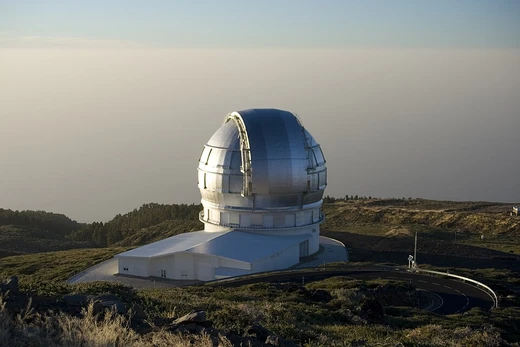
Alfred Jensch Telescope
Largest telescope in Germany and largest Schmidt camera worldwide.

The Alfred Jensch Telescope is a Schmidt camera located at the Karl Schwarzschild Observatory (Thuringia State Observatory Tautenburg) in Tautenburg, Germany. It is notable for being the largest telescope in Germany and the largest Schmidt camera in the world.
- Type
- Schmidt camera
- Mirror diameter
- 2 metres
- Aperture
- 1.34 m
- Location
- Tautenburg, Thuringia, Germany
- Manufacturer
- VEB Zeiss Jena
- Observatory
- Karl Schwarzschild Observatory (Thuringia State Observatory Tautenburg)
Lore & Background
The Alfred Jensch Telescope was made by VEB Zeiss Jena, the branch of Carl Zeiss located in Jena in what was then East Germany. Though its mirror is 2 metres in diameter, the telescope's aperture is 1.34 m. The telescope is named after Alfred Jensch. It is housed at the Karl Schwarzschild Observatory, which was founded in 1960 as an affiliated institute of the former German Academy of Sciences at Berlin in the GDR and named in honour of the astronomer and physicist Karl Schwarzschild. In 1992, the institute was re-established as Thuringian State Observatory.
Reader's Guide
The Alfred Jensch Telescope is significant as the largest telescope located in Germany and the largest Schmidt camera in the world. Its design as a Schmidt camera allows wide-field astronomical imaging. The observatory has used this instrument to observe several exoplanets and brown dwarfs, including around the stars HD 8673, 30 Arietis, 4 Ursae Majoris, and HD 13189 on 5 April 2005. The telescope's legacy is tied to its role in exoplanet discovery and its status as a major instrument of the Thuringia State Observatory, which also hosts an international station for the interferometric radio telescope LOFAR.
Did You Know?
- The Alfred Jensch Telescope is the largest telescope in Germany.
- Its mirror is 2 metres in diameter, but its aperture is 1.34 m.
Optical Architecture and Design Philosophy
The Schmidt camera is a catadioptric astrophotographic instrument that pairs a spherical primary mirror with an aspherical correcting lens positioned at the mirror's center of curvature. Conceived by Estonian-German optician Bernhard Schmidt in 1930, the configuration was engineered to deliver exceptionally wide fields of view while keeping aberrations tightly controlled. The recording medium—photographic film or a modern detector—sits inside the tube at the prime focus, and because the focal plane curves strongly, the medium must be shaped to match: either through purpose-made curved plates, mechanical conforming with retaining clips and bolts, or the application of vacuum pressure. The design excels at achieving very fast focal ratios while taming coma and astigmatism. A notable trade-off is the long tube length demanded by wide-field work, since the corrector plate occupies the center of curvature. Additionally, the detector holder at the mid-tube focus introduces a small obstruction that slightly reduces image contrast through diffraction effects from the support structure.
The Corrector Plate: Function and Fabrication
The Schmidt corrector plate is an aspheric lens whose spherical aberration is precisely equal and opposite to that of the spherical primary mirror it precedes. Thicker at center and edge, it bends light paths from the outer and inner mirror zones to a common focus without altering the system's overall focal length. Three principal manufacturing approaches have been developed. The classical method grinds and polishes the aspheric surface directly onto a flat glass blank, demanding exceptional skill from the optical engineer. Schmidt himself devised a vacuum-based technique: a thin glass disk sealed to a metal pan with a precisely beveled edge was warped under negative pressure, its exposed surface ground spherical, then released to spring back flat on one side while retaining the aspheric figure on the other. A 1970 Celestron innovation by Tom Johnson and John O'rourke pre-shaped the curve into a master block, allowing flat polishing and mass production. The technical difficulty of these processes prompted designers like Maksutov and Bouwers to explore meniscus corrector alternatives.
Survey Instrumentation and Historical Impact
Because of its inherently wide field of view, the Schmidt camera has served as a premier survey instrument for programs requiring coverage of vast sky areas. From 1950 until roughly 2000, instruments of this type—including the Samuel Oschin telescope at Palomar, the UK Schmidt Telescope, and the ESO Schmidt—constituted the principal source of all-sky photographic imaging. Their roles spanned astronomical surveys, comet and asteroid searches, and nova patrols. Beyond deep-sky work, Schmidt cameras and derivative designs have been regularly employed for tracking artificial Earth satellites. The first relatively large examples were constructed at Hamburg Observatory and Palomar Observatory in the years immediately preceding World War II, and between 1945 and 1980 approximately eight additional large Schmidt telescopes were built. The era of photographic Schmidt surveys eventually yielded to electronic detectors, though the design's influence persists in modern instruments such as the Kepler space telescope, which applies related optical principles in its exoplanet-detection mission.
Design Trade-offs and Related Optical Schemes
The Schmidt camera's elegance carries practical compromises. The strongly curved focal plane means flat detectors must be mechanically conformed or vacuum-sealed into shape, adding complexity to the imaging train. A field flattener—often simply a planoconvex lens placed in front of the detector—can mitigate curvature but introduces its own optical considerations. The detector holder, mounted at the prime focus halfway up the tube, obstructs a small fraction of the light path and produces diffraction patterns that slightly degrade image contrast. The long tube length, a consequence of positioning the corrector at the center of curvature, makes these instruments physically substantial. Related designs such as the Wright camera and the Lurie–Houghton telescope explore variations on the catadioptric theme, while the Schmidt–Cassegrain configuration places the corrector just behind the prime focus rather than at the center of curvature. Finnish astronomer Yrjö Väisälä may have independently conceived the corrector plate as early as 1924, lending the design its occasional alternate name, the Schmidt–Väisälä camera.
Frequently Asked Questions
What is the Alfred Jensch Telescope?
It is a Schmidt camera with a 2-metre primary mirror and a 1.34-metre effective aperture, housed at the Karl Schwarzschild Observatory in Tautenburg, Thuringia. It is recognized as both the largest telescope in Germany and the largest Schmidt camera in the world.
Where is the Alfred Jensch Telescope located?
The instrument is stationed at the Karl Schwarzschild Observatory, which operates under the Thuringia State Observatory (Tautenburg) in the town of Tautenburg, in the German state of Thuringia.
Why is the Alfred Jensch Telescope considered significant?
It simultaneously holds the title of Germany's largest telescope and the world's largest Schmidt camera, making it a landmark in both national and global astronomical instrumentation. Its 2-metre mirror set a benchmark for Schmidt-cameral design at the time of its construction.
Who built the Alfred Jensch Telescope?
The telescope was manufactured by VEB Zeiss Jena, the prominent East German optics firm based in Jena. Zeiss Jena had a long track record of producing high-precision astronomical and optical instruments for observatories across the former East Germany.
What are the key specifications of the Alfred Jensch Telescope?
It is a Schmidt camera with a 2-metre diameter primary mirror and a 1.34-metre aperture, built by VEB Zeiss Jena. The instrument is permanently installed at the Karl Schwarzschild Observatory in Tautenburg, Thuringia, Germany.
More in Optical Telescopes, Part 2 1-24
Spotted an error? Know more?
Reader corrections go straight into our review queue. Suggest an edit · How this site is sourced