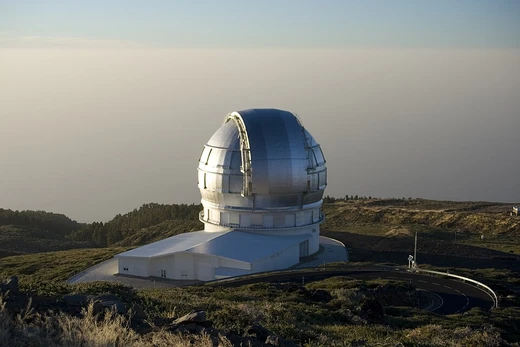
Daniel K. Inouye Solar Telescope
World's largest solar telescope, observing the Sun in visible to near-infrared.

The world’s largest solar telescope sits atop the Haleakalā volcano on Maui, Hawaii. Originally called the Advanced Technology Solar Telescope (ATST), it was renamed in 2013 for Daniel K. Inouye, a former U.S. Senator from Hawaii. The facility, known as the Daniel K. Inouye Solar Telescope (DKIST), has a 4-meter aperture and is designed to study the Sun across visible and near-infrared wavelengths. Funding comes from the National Science Foundation, with management by the National Solar Observatory. Total project costs reached $344.13 million, and the telescope is a joint effort among many research institutions. Test images were released in January 2020, and construction wrapped up in November 2021, when the telescope transitioned into scientific operations. Its first science observations began on February 23, 2022, kicking off a year-long commissioning phase. Since 2018, there have been repeated calls to rename the telescope after allegations of sexual misconduct by Senator Inouye came to light.
The telescope’s primary mirror measures 4.24 meters across but only a 4-meter off-axis section is used, with the outer 12 centimeters masked. This off-axis Gregorian design eliminates a central obstruction, cutting down on scattered light and making adaptive optics and digital image reconstruction—like speckle imaging—easier to run. The 75-millimeter-thick f/2 mirror was cast from Zerodur by Schott, polished at the University of Arizona’s Richard F. Caris Mirror Laboratory, and aluminized at the AMOS facility. A 0.65-meter secondary mirror, made of silicon carbide and mounted on a hexapod, adjusts for thermal expansion and structural bending to stay in optimal position. Adaptive optics correct for atmospheric blurring, letting the telescope resolve features as small as 20 kilometers on the Sun. A deformable mirror and wavefront sensor work together in real time to fix distortions, while an active optics system keeps the mirrors aligned and focused using sensors and actuators.
The site on Haleakalā was chosen for its clear daytime weather and good atmospheric seeing. Construction began in January 2013 after a contract was awarded in 2010, with an original completion target of 2017. The telescope housing was finished by September 2013, and the primary mirror arrived on site in early August 2017.
- Aperture
- 4 meters
- Primary mirror diameter
- 4.24 meters
- Total project cost
- $344.13 million
- Location
- Haleakala Observatory, Maui, Hawaii
- First science observations
- February 23, 2022
- Construction start
- January 2013
- Completion announced
- November 22, 2021
Lore & Background
Known as the Advanced Technology Solar Telescope (ATST) until 2013, it was named after Daniel K. Inouye, a US Senator for Hawaii. The contract to build the telescope was awarded in 2010, with a then-planned completion date of 2017. Physical construction at the DKIST site began in January 2013, and work on the telescope housing was completed in September 2013. The primary mirror was delivered to the site the night of 1–2 August 2017 and the completed telescope provided images of the sun in unprecedented detail in December 2019. Completion of construction and transition into operational phase with the first scientific observations was announced on November 22, 2021. At the time, the telescope had been over 25 years in the making.
The DKIST has a 4.24-meter primary mirror in an off-axis Gregorian configuration that provides a 4-meter clear, unobstructed aperture. The off-axis, clear aperture design avoids a central obstruction, minimizing scattered light. Adaptive optics correct for atmospheric distortions and blurring of the solar image, which enables high-resolution observations of features on the Sun as small as 20 km. The site on the Haleakalā volcano was selected for its clear daytime weather and favourable atmospheric seeing conditions. Since 2018, there have been numerous calls to rename the telescope due to the discovery of Senator Inouye's alleged sexual misconduct.
Reader's Guide
The DKIST is notable as the world's largest solar telescope, with a 4-meter aperture that allows it to observe the Sun in visible to near-infrared wavelengths. Its off-axis Gregorian design minimizes scattered light, and its adaptive optics system corrects for atmospheric distortions, enabling observations of features as small as 20 km. The telescope commenced its first science observations on February 23, 2022, signaling the start of its year-long operations commissioning phase. It is a collaboration of numerous research institutions, with five first-generation instruments including the Visible Broadband Imager, Visible Spectro-Polarimeter, Visible Tunable Filter, and two near-infrared spectro-polarimeters. The first coordinated observations with the Solar Orbiter spacecraft occurred between 18 and 24 October 2022, demonstrating how joint observations can help address important scientific questions in solar physics, such as coronal loop physics and coronal rain dynamics.
Did You Know?
- The DKIST has a 4.24-meter primary mirror but a clear, unobstructed aperture of 4 meters due to an off-axis design.
- The telescope can resolve features on the Sun as small as 20 km (12 miles).
- The primary mirror was cast from Zerodur by Schott and polished at the Richard F. Caris Mirror Laboratory of the University of Arizona.
- The total project cost is $344.13 million.
Frequently Asked Questions
Who is Daniel K. Inouye Solar Telescope?
DKIST is the world's largest dedicated solar telescope, originally developed as the Advanced Technology Solar Telescope before being renamed in 2013 to honor the late U.S. Senator Daniel K. Inouye of Hawaii. It is funded by the National Science Foundation and managed by the National Solar Observatory.
What are Daniel K. Inouye Solar Telescope's powers/role?
Armed with a 4-meter aperture and a 4.24-meter primary mirror, DKIST observes the Sun across visible and near-infrared wavelengths to investigate magnetic fields, flares, and coronal dynamics. It is the most powerful solar observatory ever constructed.
Why is Daniel K. Inouye Solar Telescope important?
At a total project cost of $344.13 million, DKIST stands as the only telescope of its scale devoted entirely to solar research and represents a broad international collaboration. Its data helps scientists better predict solar weather, which directly impacts satellites, power grids, and astronauts in orbit.
Where does Daniel K. Inouye Solar Telescope call home?
The telescope is situated at Haleakalā Observatory atop the Haleakalā volcano in Maui, Hawaii, where the high elevation and thin atmosphere provide exceptionally stable viewing conditions. This makes it one of the best solar-observation sites on Earth.
More in Optical Telescopes, Part 2 1-24
Spotted an error? Know more?
Reader corrections go straight into our review queue. Suggest an edit · How this site is sourced