Vigorón
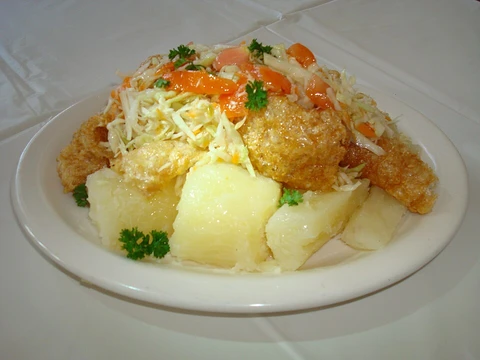
Traditional Nicaraguan dish of yuca, curtido, and chicharrones.

Vigorón is a traditional Nicaraguan dish consisting of a cabbage salad (curtido), boiled yuca, and chicharrones served on a banana leaf. It is often eaten without utensils and is frequently served to visiting family and guests due to its ease and speed of preparation.
- Origin
- Nicaragua
- Creator
- María Luisa Cisneros Lacayo, 'La Loca'
- Year created
- 1914
- Place created
- Granada, Nicaragua
- Type
- Traditional dish
- Main ingredients
- Cabbage salad, boiled yuca, chicharrones, banana leaf
Lore & Background
According to Dr. Alejandro Barberena Pérez's 1971 book Granada, María Luisa Cisneros Lacayo, known as 'La Loca', developed the recipe for vigorón in 1914 in Granada, Nicaragua. She named the dish after a local expression or its 'vigorous' nature, not after a specific tonic advertisement.
The dish is built around curtido—chopped cabbage, tomatoes, onions, and chili pepper marinated in vinegar and salt—along with boiled yuca and chicharrones (fried pork belly or fried pork rinds), all served on a banana leaf. It is typically eaten without utensils.
Many familial and cultural variants have arisen, especially in the preparation of curtido. Variants of vigorón also exist in surrounding countries, notably Costa Rica, where the dish is very common. A similar Nicaraguan dish, vaho, is distinguished by being pressure-cooked (usually with brisket) and containing green and ripe plantains, whereas vigorón is not pressure-cooked and does not include plantains.
Reader's Guide
Vigorón holds significance as a traditional Nicaraguan dish that reflects local culinary practices and social customs. Its creation is attributed to María Luisa Cisneros Lacayo in 1914 in Granada, with the name derived from a medicinal tonic advertisement. The dish's simplicity—requiring no utensils and being quickly prepared—makes it a common offering to visiting family and guests, underscoring its role in hospitality. The core components of curtido, yuca, and chicharrones on a banana leaf have inspired numerous familial and regional variations, particularly in the curtido recipe. Its spread to neighboring countries, especially Costa Rica, demonstrates its cultural resonance beyond Nicaragua. The distinction from the similar dish vaho, which involves pressure cooking and plantains, highlights the specific cooking methods and ingredient choices that define vigorón. As a documented example of a named dish with a known origin story, vigorón provides insight into Nicaraguan food history and the adaptation of local ingredients into a lasting culinary tradition.
Did You Know?
- Vigorón was created in 1914 by María Luisa Cisneros Lacayo, known as 'La Loca', in Granada, Nicaragua.
- The dish's name is traditionally attributed to a local expression or its 'vigorous' nature, not to a tonic advertisement.
- Vigorón is typically eaten without utensils and is served on a banana leaf.
- A similar dish, vaho, is pressure-cooked and includes plantains, unlike vigorón.
More in Nicaraguan cuisine 1-24
Spotted an error? Know more?
Reader corrections go straight into our review queue. Suggest an edit · How this site is sourced