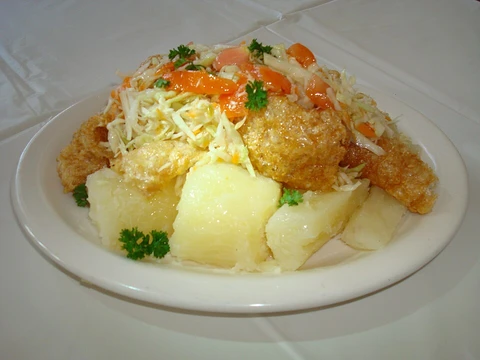
Nicaraguan cuisine
Nicaraguan cuisine blends indigenous, Spanish, African, and Caribbean influences.

MiguelRamirez77 · CC BY-SA 4.0
Nicaraguan food draws from Mesoamerican, Chibcha, Spanish, Caribbean, and African influences. However, the country’s western and eastern regions have distinct culinary traditions. In the west, the diet is rooted in the Mesoamerican staples of the Chorotega and Nicarao people—maize, tomatoes, avocados, turkey, squash, beans, chili, and chocolate—along with potatoes from the Chibcha and introduced meats like pork and chicken. Eastern Nicaragua, by contrast, relies mainly on seafood and coconut. The national dish is gallo pinto.
Corn is a central ingredient, appearing in dishes such as nacatamal and indio viejo, as well as in drinks like pinolillo and chicha, and in sweets. Rice and beans are also fundamental; rice is used when corn is not, and beans provide an affordable protein. Rice and beans often appear together at breakfast, and gallo pinto is commonly eaten at lunch, sometimes with eggs. Many Nicaraguans also grow small gardens with vegetables and occasionally incorporate flowers into meals.
Common ingredients include peanuts, cabbage (shredded in vinegar and served as “ensalada,” sometimes with carrots and beets), carrots, beets, butternut squash, plantains, bananas, fresh ginger, onion, potato, peppers, jocote, grosella, mimbro, mango, papaya, tamarind, pipian, apples, avocado, yuca, and quequisque. Herbs like culantro, oregano, and achiote are also used.
Fruits, some unique to the region, are made into drinks called frescos—similar to aguas frescas elsewhere. Popular flavors include melon, tamarind, papaya, guayaba, guanábana, coconut, pineapple, and pitahaya. Pinolillo is especially popular, and Nicaraguans sometimes call themselves “pinoleros,” or pinolillo drinkers. Another traditional beverage is cacao mixed with maize or corn. Many drinks are also made from grains and seeds, blended with milk, water, sugar, and ice.
Alcoholic beverages include rums like Flor de Caña and Ron Plata, both produced by Compañía Licorera de Nicaragua, S.A. These are widely consumed and key exports. Popular rum cocktails include the “Nica libre” (a local name for the Cuba libre) and the “Macuá,” made with orange, guava, and lime juices. The Macuá originated in 2006, winning a Flor de Caña competition to create a national cocktail; it was invented by a pediatrician from Granada.
- Field
- Cuisine
- Nationality
- Nicaraguan
- Known for
- Gallo pinto, nacatamal, indio viejo, pinolillo, chicha
- Staples
- Corn, rice, beans
- Common ingredients
- Peanuts, cabbage, carrots, beets, butternut squash, plantains, bananas, ginger, onion, potato, peppers, jocote, grosella, mimbro, mango, papaya, tamarind, pipian, apples, avocado, yuca, quequisque, cu
- National dish
- Gallo pinto
Lore & Background
The national dish of Nicaragua is gallo pinto, often served as lunch, sometimes with eggs. Corn is a staple used in dishes such as nacatamal and indio viejo, and in drinks like pinolillo and chicha. Rice and beans are also staples, commonly eaten as a breakfast dish. Many Nicaraguans have small gardens of their own full of vegetables and sometimes incorporate flowers into their meals.
Reader's Guide
Nicaraguan cuisine reflects the country's diverse cultural heritage, combining pre-Columbian, Spanish, and African elements. Western Nicaragua's diet is based on the Mesoamerican staples of the Chorotega and Nicarao people, including maize, tomatoes, avocados, turkey, squash, beans, chili, and chocolate, along with potatoes from the Chibcha and introduced meats like pork and chicken. Eastern Nicaragua's cuisine features seafood and coconut. Common ingredients include peanuts, cabbage (shredded in vinegar as 'ensalada'), carrots, beets, butternut squash, plantains, bananas, ginger, onion, potato, peppers, and various fruits. Herbs such as culantro, oregano, and achiote are used. Beverages include frescos made from fruits like melon, tamarind, papaya, guayaba, guanábana, coconut, pineapple, and pitahaya, as well as pinolillo and a traditional drink of cacao mixed with maize. Alcoholic drinks include rums such as Flor de Caña and Ron Plata, rum-based cocktails like the Nica libre and Macuá (created in 2006 by a pediatrician from Granada), and beers like Toña and Victoria.
Did You Know?
- Western Nicaraguan cuisine revolves around the Mesoamerican diet of the Chorotega and Nicarao people.
- Eastern Nicaraguan cuisine consists mostly of seafood and coconut.
- Pinolillo is so popular that Nicaraguans sometimes refer to themselves as 'pinoleros'.
The Breadbasket of Central America
Nicaragua's claim to the title "breadbasket of Central America" rests on a foundation of extraordinary agricultural potential. Spanning 130,370 square kilometers, the country possesses the most fertile soil and the greatest expanse of arable land of any nation in the region. This bounty is amplified by a warm tropical climate, active volcanoes that enrich the earth, and remarkable biological diversity that stretches from the Bosawás Biosphere Reserve—the second-largest tropical rainforest in the Americas—down to the shores of Lake Nicaragua and Lake Xolotlán. The nation's position between the Pacific Ocean and the Caribbean Sea, threaded with rivers and lagoons, has long supported a wide range of food production. Even before European contact, these natural conditions sustained communities whose sustenance drew on hunting, gathering, fishing, and slash-and-burn cultivation. The combination of volcanic richness, abundant waterways, and tropical warmth gives Nicaragua a culinary landscape rooted in geography itself, where the land's generosity shapes what appears on the table.
A Mosaic of Culinary Traditions
Nicaraguan cuisine cannot be understood as a single, monolithic tradition. The country's population weaves together mestizo, indigenous, European, and African lineages, and this cultural intermingling has produced what observers describe as substantial diversity across folklore, cuisine, music, and literature. On the Caribbean coast, the Mosquitia region preserves its own linguistic traditions alongside Spanish, and the Macro-Chibchan peoples—Miskito, Rama, Mayangna, and Matagalpas—carry food customs that trace back to migrations between Central America and northern Colombia. In the western highlands, the legacy of the Chorotega, Nicarao, and Subtiaba groups, all of whom originated in Mexican valleys and migrated southward over centuries, layers additional flavors and techniques onto the culinary palette. The result is a food culture that is genuinely plural: a tapestry where indigenous foraging and fishing meet colonial-era agriculture, where coastal and highland traditions coexist, and where the sheer variety of ancestral contributions ensures that no single narrative can capture the full richness of what Nicaraguans cook and share.
Indigenous Roots and Ancient Foodways
The story of Nicaraguan food begins far before any European ship appeared on the Mosquito Coast. Paleo-Indians had already inhabited the territory by 12,000 BCE, and over millennia, successive waves of peoples shaped the region's relationship with the land. The Macro-Chibchan groups of the Caribbean lowlands sustained themselves through hunting, gathering, fishing, and slash-and-burn agriculture, their foodways linked to the broader Isthmo-Colombian cultural sphere. In western Nicaragua, the Chorotega people arrived from the Chiapas region around 800 CE, followed by the Nicarao, a Nahuatl-speaking branch connected to the Toltec tradition, around 1200 CE. The Subtiabas, an Oto-Manguean group from Guerrero, added yet another strand. By the fourteenth century, Aztec trade colonies had established a presence, introducing new patterns of exchange. These layered migrations meant that even before the Spanish arrived in the sixteenth century, the land already supported a complex, multi-origin food culture whose ingredients, techniques, and communal practices were the product of thousands of years of adaptation.
Colonial Crossroads and Divergent Paths
The arrival of the Spanish in the sixteenth century set in motion a transformation that would reshape Nicaraguan food culture for centuries. Columbus's 1502 sighting of the Mosquito Coast marked the first European contact, but it was the southwestern interior that became the focus of colonial settlement from 1523 onward. Crucially, the Caribbean coast followed an entirely different trajectory: it remained under British protection as an independent kingdom from the seventeenth century until the Treaty of Managua in 1860 formally united it with the rest of the nation. This divergence meant that while the western highlands absorbed Spanish agricultural practices, livestock traditions, and colonial foodways, the eastern lowlands retained and developed their own distinct culinary customs rooted in indigenous and African influences. Independence from Spain in 1821 did not erase these parallel histories. Instead, the coexistence of two colonial legacies—Spanish and British—within a single nation created a uniquely layered food landscape, one in which the borders between highland and coast, between European and indigenous tradition, remain as visible on the plate as they are on the map.
Gallery
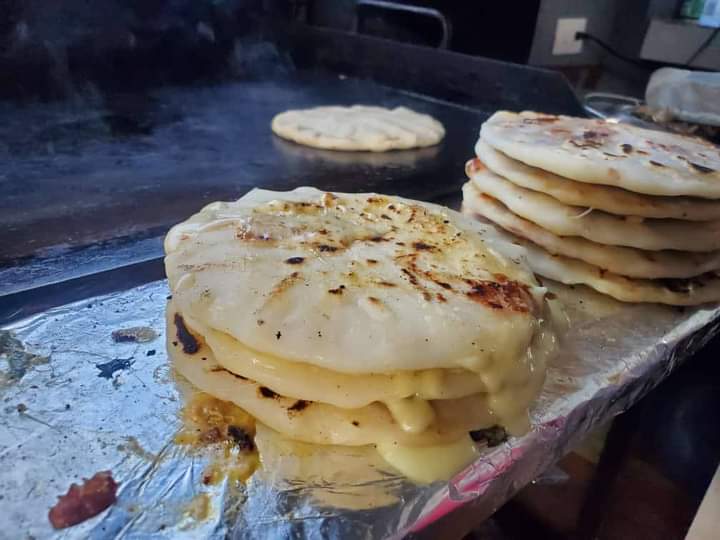
More in Nicaraguan cuisine 1-24
Spotted an error? Know more?
Reader corrections go straight into our review queue. Suggest an edit · How this site is sourced