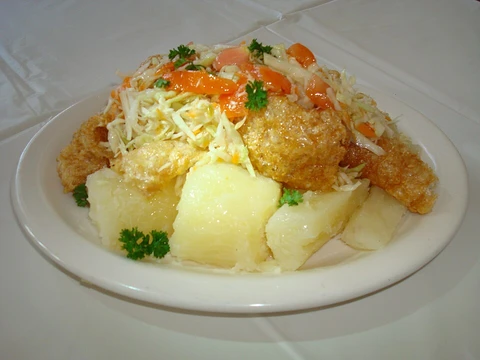
Chilate
A cold Mexican drink of cocoa, rice, and cinnamon.

AlejandroLinaresGarcia · CC BY-SA 3.0
Chilate is a traditional Mexican drink prepared with cocoa, rice, cinnamon, and sugar. Its name derives from the Nahuatl word 'chilliatl,' meaning 'chili water,' and it originates from Ayutla de los Libres, Guerrero, Mexico. Served cold and often accompanied by buñuelos, chilate is widely consumed among the Amuzgos, Mixtec, Tlapanec, and Afro-Mexican communities in Guerrero, as well as in Acapulco. It is distinct from the chilate of Guatemala, El Salvador, Honduras, and Nicaragua, which has a different preparation.
- Origin
- Ayutla de los Libres, Guerrero, Mexico
- Etymology
- From Nahuatl 'chilliatl' (ˈt͡ʃilliat͡ɬ), meaning 'chili water'
- Base
- Atolli (maize drink in Nahuatl)
- Serving temperature
- Cold
- Common accompaniment
- Buñuelos
- Key ingredients
- Cocoa, rice, cinnamon, sugar
Lore & Background
Chilate has its roots in the Nahuatl-speaking cultures of Guerrero, Mexico, where the name 'chilliatl' originally referred to a chili-infused water. Over time, the drink evolved into a sweetened beverage based on atolli, a traditional maize drink. It is now a staple in the regions of Amuzgos, Mixtec, Tlapanec, and Afro-Mexican communities, as well as in Acapulco, where it is served cold alongside buñuelos.
Reader's Guide
Chilate holds cultural significance as a traditional beverage in Guerrero, Mexico, particularly among indigenous and Afro-Mexican communities. Its preparation and consumption reflect a blend of pre-Hispanic and colonial influences, with cocoa and rice as key ingredients. The drink is distinct from Central American versions: in El Salvador and Honduras, chilate is a hot drink made with corn dough and black pepper, lacking cocoa; in Nicaragua, it uses Pujagua corn and includes cocoa, cinnamon, sugar, and milk. In Oaxaca, Mexico, chilate refers to a chicken broth. Understanding these variations is essential to appreciating the regional diversity of the name 'chilate.' The drink's enduring presence in Guerrero highlights its role in local identity and culinary tradition.
Did You Know?
- Chilate's name comes from the Nahuatl word 'chilliatl,' meaning 'chili water.'
- It is originally from Ayutla de los Libres, Guerrero, Mexico.
- Chilate is served cold and usually accompanied by buñuelos.
- In El Salvador and Honduras, chilate is a hot drink with black pepper and no cocoa.
Origins and Cultural Heritage
The story of chilate begins in Guerrero, Mexico, specifically in the town of Ayutla de los Libres, where this beloved beverage first took shape. Its very name carries the weight of indigenous language: chilliatl, a Nahuatl word translating to 'chili water,' a linguistic thread that links the drink to the pre-Hispanic peoples of the region. What makes chilate culturally significant is the breadth of communities that have adopted it as their own. Across Guerrero, the Amuzgo, Mixtec, and Tlapanec peoples all claim chilate as part of their culinary identity. Afro-Mexican communities in the same state have woven it into their traditions, and in the port city of Acapulco, it remains a staple refreshment. The drink's foundation is atolli, the Nahuatl term for a maize-based preparation, which serves as the structural base upon which all other flavors are layered. This shared root in indigenous foodways connects chilate to a deep tradition of Mexican sustenance and communal gathering, making it far more than a simple beverage.
Preparation and the Art of Serving
Chilate in its Mexican form is a study in simplicity and balance. The core ingredients are cocoa, rice, cinnamon, and sugar, all built upon the foundation of atolli, the traditional maize drink that gives the beverage its body and texture. The result is a cold drink, a refreshing counterpoint to the warm climate of southern Mexico where it thrives. The serving ritual matters as much as the recipe itself. Chilate is customarily paired with buñuelos, those golden fried dough pieces that soak up the drink's flavor and add a satisfying crunch. Together, the cold, spiced liquid and the warm, sweet pastry create a pairing that feels both deliberate and timeless. What distinguishes the Mexican chilate from its namesakes elsewhere is precisely this combination: the presence of cocoa, the cold temperature, and the rice that lends a subtle graininess to the texture. It is a drink that asks for nothing more than a glass, a spoon, and a plate of buñuelos to become a complete moment of pleasure.
The Central American Chilate
Cross the border and the word chilate transforms into something almost unrecognizable. In El Salvador and Honduras, chilate is a hot drink built on corn dough and water, spiced with black pepper and ginger. The signature trait is the pepper itself: it is added whole and left in the glass when served, never strained out, so every sip carries a sharp, unexpected bite. Some variations introduce anise, vanilla, or cinnamon for additional warmth. This version is traditionally served alongside typical desserts such as dulce de camote, dulce de plátano, or nuegados. Crucially, it contains no cocoa beans at all, making it fundamentally different from its Mexican counterpart. In Nicaragua, the recipe shifts again. Here, chilate is prepared with Pujagua corn, a distinctive purplish variety, and enriched with ground cacao beans, cinnamon, sugar, and milk, all served hot. The cities of Jinotepe, Diriamba, and Masatepe are particularly associated with this tradition. Guatemala also claims its own chilate, though it follows a different preparation entirely.
A Name, Many Drinks: Regional Distinctions
One of the most common sources of confusion in Mexican and Central American cuisine is the word chilate itself. The Mexican version from Guerrero and the Central American versions from El Salvador, Honduras, Guatemala, and Nicaragua are, by every meaningful measure, different drinks sharing a single name. The Mexican chilate is cold, cocoa-based, and rice-laden; its Central American cousins are hot, corn-based, and pepper-forward. The confusion deepens within Mexico itself. In Oaxaca, chilate takes on an entirely different character: it is not a drink at all but a type of broth made with chicken, a savory preparation that belongs to the realm of soups rather than beverages. This regional redefinition underscores how fluid food terminology can be across the Mexican landscape. For anyone encountering the term for the first time, the critical question is always geographic: where is this chilate being made? The answer determines whether you are sipping a cold cocoa-rice drink with buñuelos, slurping a peppery corn beverage, or ladling a chicken soup. The name is the same; the experience is not.
Gallery
More in Nicaraguan cuisine 1-24
Spotted an error? Know more?
Reader corrections go straight into our review queue. Suggest an edit · How this site is sourced