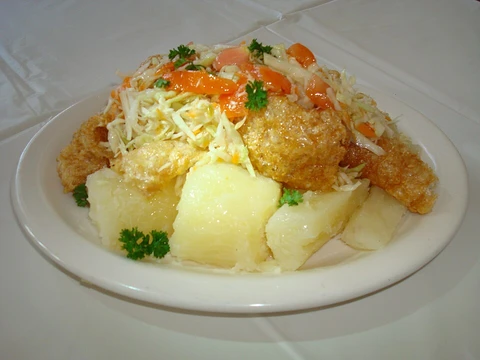
Tamale
A steamed corn dough dish wrapped in husk or leaves.

A tamale is a traditional Mesoamerican dish consisting of masa—a dough made from nixtamalized corn—that is steamed inside a wrapping of corn husk or banana leaves. The wrapper can be thrown away before eating or used as a plate. Fillings vary widely and can include meats, cheeses, fruits, vegetables, herbs, chilies, or any other preparation to taste; both the filling and the cooking liquid may be seasoned.
The English word "tamale" comes from the Spanish *tamal* (plural *tamales*), which itself derives from the Nahuatl *tamalli*. English speakers formed "tamale" as a back-formation from *tamales*, applying English pluralization rules and mistakenly treating the *-e-* as part of the word stem rather than the plural suffix *-es*.
Tamales originated in Mesoamerica, with the earliest known evidence dating to the Preclassic period (around 1000–500 BC). Their preparation likely spread from indigenous Mesoamerican cultures to the rest of the Americas. Archaeologists Karl Taube, William Saturno, and David Stuart suggest tamales may date from around 100 BC, based on pictorial references found in the Mural of San Bartolo in Petén, Guatemala. The Aztec, Maya, Olmec, and Toltec civilizations all used tamales as portable food for hunting trips, long-distance travel, and feeding their armies. Tamales were also considered sacred, seen as food of the gods. Because these peoples regarded corn as central to their cultural identity, tamales played a major role in their rituals and festivals.
**Mesoamerica**
**Aztec** The Florentine Codex, written by Reverend Bernardino de Sahagún, extensively documents the different forms of tamales eaten and sold in Aztec markets. In Book X, he describes how Aztec tamales used a variety of corn for their flour base and were cooked in earth ovens or *olla*, heated by steam from dried cane grown specifically for cooking tamales. Fillings included meat (turkey, fish, frog, axolotl, gopher), fruit, beans, squash seeds, turkey eggs, or no filling at all. Savory tamales were seasoned with chilies or seeds, while sweet ones used honey. Tamales also held great religious and spiritual importance in Aztec culture. Before a wedding, Aztec women customarily stayed up for two to three days cooking tamales (Codex, Book IX).
Quick Facts
- Country
- El Salvador, Guatemala, and Mexico
- Region
- Mesoamerica
- Course
- Main course
- Main Ingredient
- Corn (maize) masa, banana leaves, corn husks
- Variations
- Corunda, guajolota, uchepos, zacahuil
- Similar Dish
- Humitas, pamonha, hallaca
Facts from the source article.
Lore & Background
Tamales originated in Mesoamerica, with the earliest known evidence dating to the Preclassic period (around 1000–500 BC). According to archaeologists Karl Taube, William Saturno, and David Stuart, tamales may date from around 100 BC, based on pictorial references in the Mural of San Bartolo in Petén, Guatemala. The Aztec and Maya civilizations, as well as the Olmec and Toltec before them, used tamales as easily portable food for hunting trips, traveling large distances, and nourishing their armies. Tamales were also considered sacred, as they were seen as the food of the gods.
Reader's Guide
Tamales hold deep cultural and historical significance across Mesoamerica and beyond. The Aztec, Maya, Olmecs, and Toltecs considered corn a central part of their cultural identity, so tamales played a large part in rituals and festivals. In Aztec culture, tamales were documented in the Florentine Codex, with fillings including turkey, fish, frog, axolotl, gopher, fruit, bean, squash seed, and turkey egg, seasoned with chilis or honey. The Aztec feast of Atamalcualiztli involved eating tamales without seasoning every eight years. Among the Classic Maya, tamales appear in ceramic ware and the Fenton vase shows unwrapped tamales offered as penance. The pan-Mayan term 'wa' refers to a basic maize product that can mean either tortillas or tamales, suggesting tamales predate tortillas. Today, tamales are central to holidays and celebrations in countries like Guatemala, El Salvador, Costa Rica, Panama, and Nicaragua, with regional varieties such as nacatamal, chuchito, and paches.
More in Nicaraguan cuisine 1-24
Spotted an error? Know more?
Reader corrections go straight into our review queue. Suggest an edit · How this site is sourced