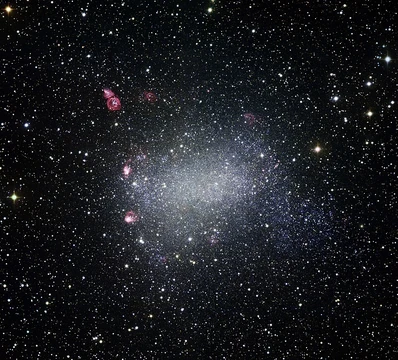
NGC 2359
Emission nebula in Canis Major, also called Thor's Helmet.

NGC 2359 is an emission nebula in the constellation Canis Major, also known as Thor's Helmet. It is notable for its complex bubble shape and curved bow-shock structure, which are thought to result from interactions with a nearby large molecular cloud. The nebula is approximately 3,670 parsecs (11.96 thousand light years) away and spans about 30 light-years in size.
Quick Facts
- Epoch
- J2000
- Ra
- 07 · 18 · 30
- Dec
- -13 · 13.8
- Dist Ly
- 11960 ly
- Constellation
- Canis Major
- Notes
- HII (ionized) region
- Names
- GUM 4, LBN 227.66-00.09, SH 2-298, GRS 227.80 -00.20, LBN 1041, RCW 5
Facts from the source article.
Lore & Background
The nebula has an overall bubble shape with complex filamentary structures. It contains several hundred solar masses of ionised material, plus several thousand more of unionised gas. Most of this material is interstellar gas swept up by winds from the central star, though some material appears enriched with fusion products and likely comes directly from the star. The expansion rate of different portions of the nebula varies from 10 km/s to at least 30 km/s, leading to age estimates between 78,500 and 236,000 years.
The central star is WR7, a Wolf-Rayet star that is extremely hot and thought to be in a brief pre-supernova stage of evolution. The nebula is similar in nature to the Bubble Nebula, but interactions with a nearby large molecular cloud are thought to have contributed to its more complex shape and curved bow-shock structure. It has been studied at radio and x-ray wavelengths, but it remains unclear whether the nebula was produced during the class O main sequence stage, as a red supergiant, luminous blue variable, or mainly as a Wolf-Rayet star.
NGC 2361 is a bright knot of nebulosity on one edge of the central ring of NGC 2359.
Reader's Guide
NGC 2359 is significant as a nearby example of a Wolf-Rayet star interacting with its environment, producing a complex bubble nebula. Its study at radio and x-ray wavelengths has provided insights into the evolution of massive stars, though the exact stage at which the nebula formed remains uncertain. The nebula's curved bow-shock structure and filamentary details make it a valuable object for understanding how stellar winds shape interstellar material. Its age estimates, derived from varying expansion rates, offer constraints on the timescales of pre-supernova evolution. The presence of enriched material from the central star highlights the role of Wolf-Rayet stars in seeding the interstellar medium with fusion products. As a prominent emission nebula in Canis Major, it serves as a key target for studying the late stages of massive star life cycles.
Did You Know?
- NGC 2359 is also known as Thor's Helmet.
- The central star is the Wolf-Rayet star WR7, thought to be in a brief pre-supernova stage.
- The nebula is approximately 30 light-years in size and 11.96 thousand light-years away.
- It is also catalogued as Sharpless 2-298 and Gum 4.
More in NGC Objects, Part 3 1-24
Spotted an error? Know more?
Reader corrections go straight into our review queue. Suggest an edit · How this site is sourced