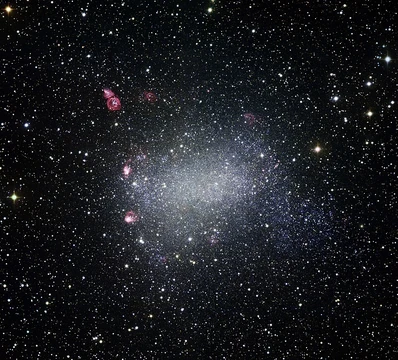
NGC 1744
Barred spiral galaxy with asymmetric arms and active star formation.

NGC 1744 is a barred spiral galaxy located in the constellation Lepus, approximately 30 million light years from Earth. It spans about 75,000 light years across and was discovered by John Herschel on November 20, 1835. The galaxy is notable for its asymmetric spiral arms, numerous star-forming regions, and a nuclear star cluster.
Quick Facts
- Epoch
- J2000
- Ra
- 04 · 59 · 57.736
- Dec
- -26 · 01 · 18.91
- Dist Ly
- 32.6 ± 5.3 Mly (10.0 ± 1.6 Mpc)
- Z
- 0.002472 ± 0.000002
- H Radial V
- 741 ± 1 km/s
- Appmag V
- 11.1
- Constellation Name
- Lepus
Facts from the source article.
Lore & Background
NGC 1744 exhibits a narrow bright bar with many knots, measuring 1.3 by 0.3 arcminutes. Its spiral arm pattern is asymmetric: the north and west arms host many HII regions, while the short southeastern arm contains a single giant HII region. Star-forming regions are also visible along a faint, diffuse arm running from north of the bar southwards. The galaxy is seen at an inclination of 70°.
In ultraviolet light, the galaxy appears similar, with open arms and star-forming regions. Hydrogen line emission is diffuse, showing no discernible spiral pattern except for some clumps at the locations of large star-forming regions, and appears undisturbed. The total hydrogen mass is estimated, with no hydrogen emission outside the plane of the disk. The galaxy has a steep metallicity gradient, likely caused by the bar and enhanced star formation there. The total star formation rate is estimated to be 0.15 solar masses per year. At its nucleus lies a nuclear star cluster 3.3 arcseconds across.
NGC 1744 forms a non-interacting pair with ESO 486-G021, located 58 arcminutes away, corresponding to a projected distance of about 200 kpc (650,000 light years). It has been considered a member of the LGG 127 Group, which also includes NGC 1792 and NGC 1808.
Reader's Guide
NGC 1744 is significant as a nearby barred spiral galaxy that provides a clear example of how a bar can influence star formation and metallicity gradients. Its asymmetric spiral arms and numerous HII regions make it a valuable target for studying star formation processes in a relatively undisturbed environment. The galaxy's steep metallicity gradient, attributed to the presence of the bar, offers insights into the chemical evolution of barred galaxies. The presence of a nuclear star cluster adds to its interest for studies of galactic nuclei. As a member of the LGG 127 Group, NGC 1744 contributes to understanding galaxy group dynamics, though it forms only a non-interacting pair with a nearby companion. Its undisturbed hydrogen disk and diffuse emission suggest a relatively quiescent evolutionary history, contrasting with more active starburst galaxies. The galaxy's discovery by John Herschel in 1835 places it within the rich catalog of southern sky objects observed during his pioneering surveys.
Frequently Asked Questions
What is NGC 1744?
NGC 1744 is a barred spiral galaxy roughly 30 million light years from Earth, with a central elongated bar of stars from which its spiral arms unfurl. It resides in the southern constellation Lepus.
Where in the sky can I find NGC 1744?
Look toward the small southern constellation Lepus (The Hare), where the galaxy sits as a faint deep-sky smudge. It is best targeted by observers in the southern hemisphere during its seasonal window.
How large is NGC 1744?
The galaxy spans approximately 75,000 light years across, giving it a physical scale comparable to our own Milky Way. That size makes it a rewarding target for long-exposure astrophotography.
Who discovered NGC 1744 and when?
John Herschel recorded the galaxy on November 20, 1835, as part of his prolific southern-sky surveys. His observations fed directly into the New General Catalogue of deep-sky objects.
What makes NGC 1744 visually distinctive?
Its spiral arms are noticeably asymmetric rather than neatly mirrored, and they are threaded with numerous bright star-forming regions. A compact nuclear star cluster anchors the galactic core, adding extra structural detail.
More in NGC Objects, Part 3 1-24
Spotted an error? Know more?
Reader corrections go straight into our review queue. Suggest an edit · How this site is sourced