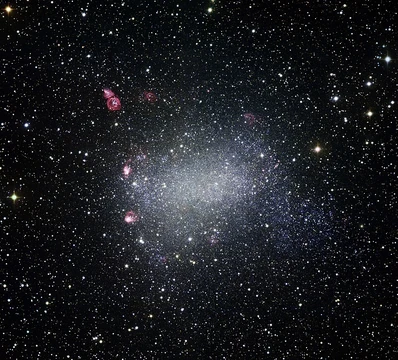
NGC 1614
A barred spiral galaxy with a powerful starburst core.

NGC 1614 is a spiral galaxy in the equatorial constellation of Eridanus. It is notable as a luminous infrared source and one of the most extreme nearby starbursts, undergoing a minor merger that triggers intense star formation.
Quick Facts
- Epoch
- J2000
- Constellation Name
- Eridanus
- Ra
- 04 · 34 · 00.027
- Dec
- −08 · 34 · 44.57
- Z
- 0.015938 · 0.000033
- H Radial V
- 4,778
- Dist Ly
- 64.78 Mpc
- Notes
- Starburst galaxy with an active galactic nucleus
- Names
- 2MASX J04340002-0834445, APG 186, IRAS 04315-0840, Mrk 0617, II Zw 015, PGC 15538
Facts from the source article.
Lore & Background
NGC 1614 was discovered on December 29, 1885 by American astronomer Lewis Swift, who described it as pretty faint, small, round, with a little brighter middle. It was catalogued by Danish-Irish astronomer J. L. E. Dreyer in 1888. Direct photography later revealed conspicuous peculiarities, leading Halton Arp to include it in his 1966 Atlas of Peculiar Galaxies. In 1971, Swiss astronomer Fritz Zwicky described it as a blue post-eruptive galaxy with a compact patchy core, spiral plumes, and a long blue jet to the southwest.
The galaxy has a morphological classification of SB(s)c pec, indicating a barred spiral with loosely wound arms and no ring-like structure around the nucleus. It is bright at the center with two nearly symmetrical inner spiral arms. NGC 1614 is undergoing a minor merger with a gas-rich, low-mass companion located in a tidal tail to the southwest; the main galaxy is 3–5 times more massive. This interaction triggers a burst of star formation, though not an active galactic nucleus. In the core, a 230 pc radius ring formed within the last 5–10 million years from gas inflow, hosting intense starburst activity that masks any weak nuclear emission. The nucleus shows evidence of an older starburst, and the starburst drives an outflow of cold molecular gas with a mass of about 32 million solar masses.
Reader's Guide
NGC 1614 holds significance as a nearby laboratory for studying extreme starbursts triggered by galaxy mergers. Its classification as a luminous infrared source—ranking 55th in the 2003 IRAS Revised Bright Galaxy Sample and the second most luminous galaxy within 75 Mpc—underscores its intense energy output. The minor merger event, with a mass ratio of 3–5:1, provides a clear example of how such interactions funnel gas into the nucleus, forming a compact starburst ring. The galaxy's peculiar morphology, noted by both Arp and Zwicky, and its blue post-eruptive nature highlight its dynamic evolution. The observed outflow of cold molecular gas, totaling 32 million solar masses, offers insight into feedback processes in starburst galaxies. Two supernovae—SN 1996D (Type Ic) and SN 2020cuj (Type II)—have been recorded, adding to its value as a site for transient studies. Its legacy lies in illustrating the connection between mergers, starbursts, and infrared luminosity in the local universe.
Did You Know?
- NGC 1614 was discovered by American astronomer Lewis Swift on December 29, 1885.
- It is the second most luminous galaxy within 75 Mpc in the 2003 IRAS Revised Bright Galaxy Sample.
- The galaxy hosts a 230 pc radius starburst ring that formed within the last 5–10 million years.
- Two supernovae have been observed: SN 1996D (Type Ic) and SN 2020cuj (Type II).
Frequently Asked Questions
What is NGC 1614?
NGC 1614 is a barred spiral galaxy in Eridanus, officially typed as SB(s)c pec. It has gained particular attention for hosting one of the most extreme nearby starbursts, fueled by an ongoing minor merger.
Why is NGC 1614 considered such an intense starburst?
A smaller companion galaxy is currently merging with NGC 1614, and this interaction has kicked off a violent episode of star formation concentrated in the core. The resulting activity makes the galaxy shine exceptionally brightly in infrared wavelengths.
What supernovae have been observed in NGC 1614?
Observers have caught two supernovae in this galaxy: SN 1996D, a Type Ic event peaking at magnitude 18.2, and SN 2020cuj, a Type II explosion reaching magnitude 20. Both are consistent with the high stellar birth rate the merger has produced.
What does the SB(s)c pec classification mean for NGC 1614?
The label tells you it is a barred spiral with moderately open arms and some structural oddities. Those peculiar features are thought to be a direct consequence of the gravitational disturbance caused by the merging companion.
Where in the sky can I find NGC 1614?
It lies in Eridanus, a long constellation that arcs low across the equatorial sky. Because of its near-equatorial position, observers in both the northern and southern hemispheres can track it during the right seasons.
More in NGC Objects, Part 3 1-24
Spotted an error? Know more?
Reader corrections go straight into our review queue. Suggest an edit · How this site is sourced