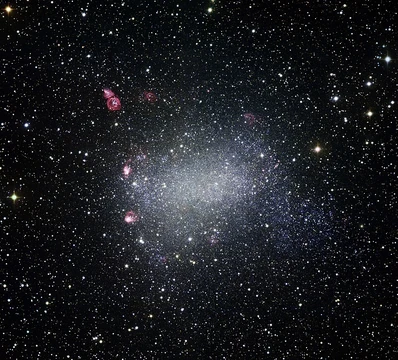
NGC 1559
Barred spiral Seyfert galaxy with strong star formation.

NGC 1559 is a barred spiral galaxy located in the constellation Reticulum. It is notable as a Seyfert galaxy, possessing a quasar-like nucleus with high surface brightness and strong, high-ionisation emission lines, while its host galaxy remains clearly detectable. Originally thought to belong to the Dorado Group, subsequent observations have shown it is not a member of any galaxy group or cluster and has no nearby companions.
Quick Facts
- Epoch
- J2000.0
- Ra
- 04 · 17 · 35.7506
- Dec
- -62 · 47 · 01.316
- Dist Ly
- 14.942 ± 0.669 Mpcned
- Z
- 1304 ± 4 km/s
- Appmag V
- 11
- Constellation Name
- Reticulum
Facts from the source article.
Lore & Background
NGC 1559 was discovered on 6 November 1826 by Scottish astronomer James Dunlop. It is a Seyfert galaxy, meaning its nucleus is exceptionally bright and emits high-ionisation spectral lines, yet the surrounding galaxy is easily visible. Although initially believed to be part of the Dorado Group, later observations determined that NGC 1559 is isolated, belonging to no galaxy group or cluster and lacking any nearby companions.
The galaxy features massive spiral arms and intense star formation. It contains a small bar oriented nearly east–west, spanning 40 arcseconds. Both the bar and the disc are sources of very strong radio emissions. Four supernovae have been observed in NGC 1559: SN 1984J (Type II, mag 13.5), SN 1986L (Type II, mag 13.5), SN 2005df (Type Ia, mag 13.8, which reached magnitude 12.3 and was the brightest supernova of 2005), and SN 2009ib (Type II-P, mag 14.7).
Reader's Guide
NGC 1559 holds significance as a nearby example of a Seyfert galaxy, bridging the characteristics of quasars and normal galaxies. Its strong radio emissions from the bar and disc, combined with massive spiral arms and vigorous star formation, make it a valuable object for studying galactic activity and evolution. The galaxy's isolation—not belonging to any group or cluster—provides a rare opportunity to examine a barred spiral in a relatively undisturbed environment. The four supernovae observed within it, including the exceptionally bright SN 2005df, have contributed to understanding stellar explosions and their diversity. Its legacy lies in its role as a laboratory for both active galactic nuclei and supernova physics, observed over decades by amateur and professional astronomers alike.
Did You Know?
- NGC 1559 was discovered by Scottish astronomer James Dunlop on 6 November 1826.
- It is a Seyfert galaxy with a quasar-like nucleus but a clearly detectable host galaxy.
- Four supernovae have been observed in NGC 1559, including SN 2005df, the brightest supernova of 2005.
Frequently Asked Questions
What is NGC 1559?
It is a barred spiral galaxy located in the southern constellation Reticulum. What distinguishes it is its Seyfert-type active nucleus, which produces quasar-like brightness and intense high-ionisation emission lines while the surrounding spiral structure remains clearly visible.
Who discovered NGC 1559 and when?
Scottish astronomer James Dunlop first catalogued the object on 6 November 1826 during his surveys of the southern sky.
What makes NGC 1559's central engine notable?
Its core behaves like a low-luminosity quasar, generating very high surface brightness and powerful high-ionisation emission lines. Despite that intense activity, the host barred spiral galaxy stays distinctly observable around the nucleus.
How many supernovae have been observed in NGC 1559?
Four supernovae have been recorded in this galaxy, the brightest being SN 2005df, a Type Ia event that peaked at magnitude 12.3.
Is NGC 1559 a member of the Dorado Group?
Early work tentatively placed it in the Dorado Group, but later observations ruled that out. It is now understood to be an isolated barred spiral with no confirmed nearby companions.
More in NGC Objects, Part 3 1-24
Spotted an error? Know more?
Reader corrections go straight into our review queue. Suggest an edit · How this site is sourced