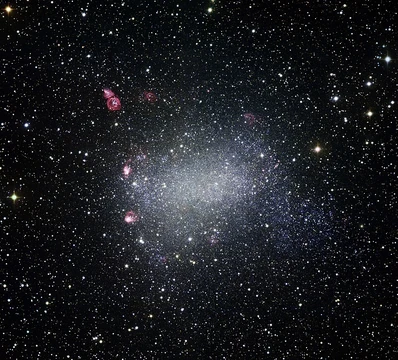
NGC 1784
Barred spiral galaxy with a strong bar and inner ring.

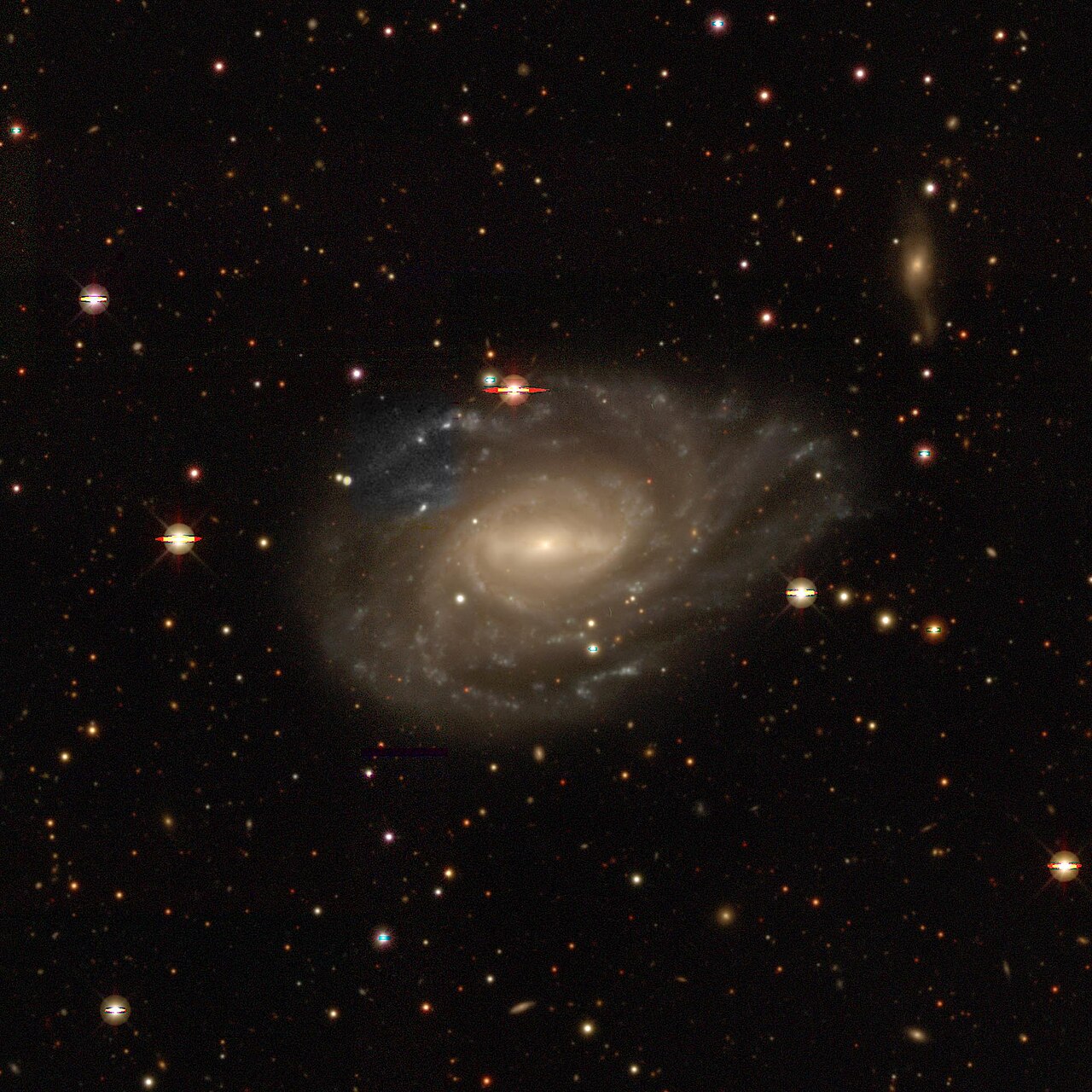
Legacy Surveys / D.Lang (Perimeter Institute) & Meli thev · CC BY-SA 4.0
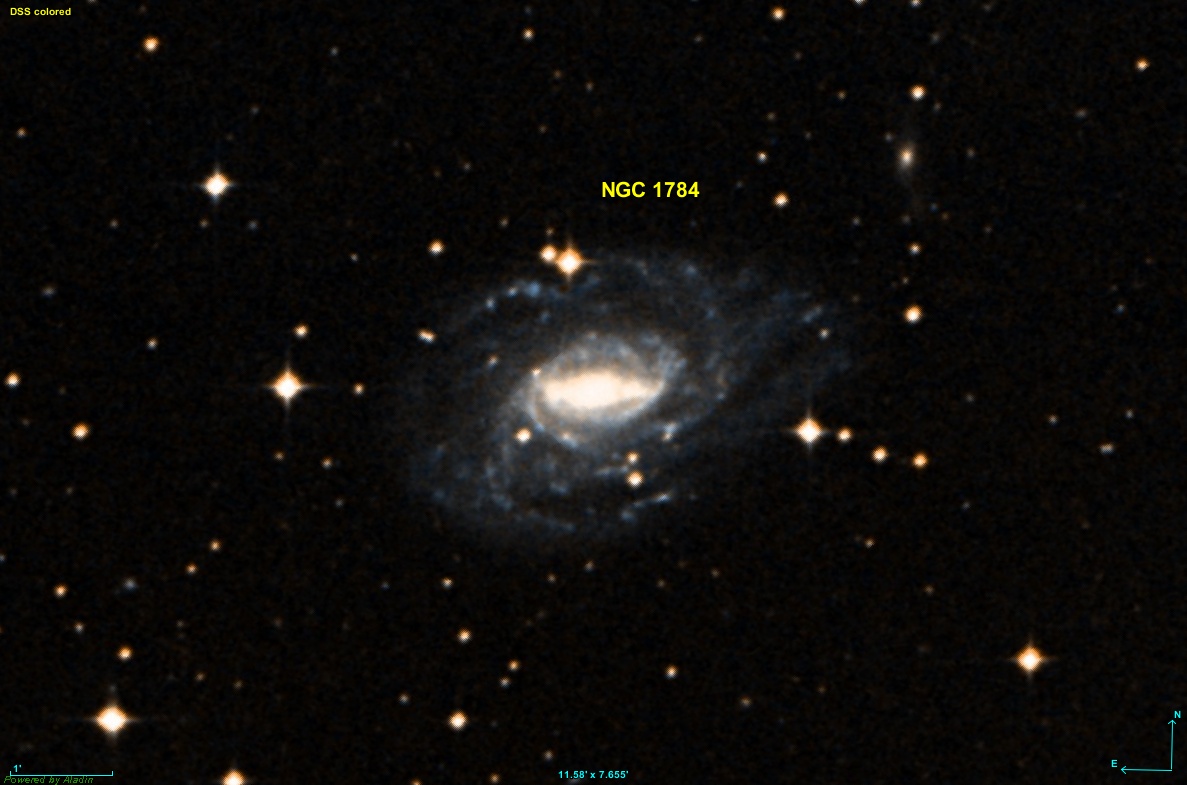
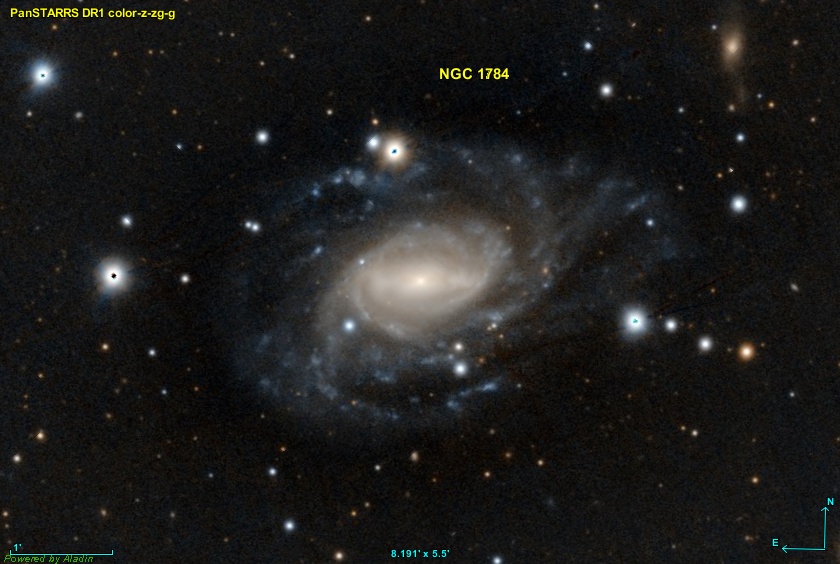
NGC 1784 is a barred spiral galaxy located in the constellation Lepus. It is notable for its strong bar, dust lanes, and a nearly complete inner ring formed by two spiral arms. The galaxy is the foremost member of the NGC 1784 Group.
Quick Facts
- Epoch
- J2000
- Ra
- 05 · 05 · 27.1307
- Dec
- -11 · 52 · 16.766
- Dist Ly
- 79.4 ± 14.5 Mly (24.3 ± 4.4 Mpc)
- Z
- 0.007735 ± 0.000010
- H Radial V
- 2,319 ± 3 km/s
- Appmag V
- 11.7
- Constellation Name
- Lepus
Facts from the source article.
Lore & Background
NGC 1784 was discovered by British astronomer John Herschel on 11 December 1836. The galaxy exhibits a strong bar with dust lanes and patches. Two spiral arms emerge from the ends of the bar and form a nearly complete inner ring. The outer spiral arm consists of low-surface-brightness spiral fragments that complete up to a quarter of a revolution before fading, and these arms contain many knots. Imaging in the hydrogen line reveals a narrow but bright ring, more prominent on the eastern side. The hydrogen appears wrapped, suggesting an interaction with another galaxy. The total hydrogen mass of the galaxy is estimated but not specified in the available data. NGC 1784 is the foremost galaxy of the NGC 1784 Group, which also includes FGC 0523 and HIPASS J0508-13.
Reader's Guide
NGC 1784 is significant as the leading member of its own small group of galaxies, providing a local laboratory for studying galaxy interactions and star formation. Its hydrogen morphology—a bright, narrow ring with wrapped structure—indicates a past or ongoing gravitational encounter, likely with one of its group companions. The galaxy's barred spiral structure, with a nearly complete inner ring and fragmented outer arms, offers insight into the dynamics of bar-driven gas flows and the formation of ring features. The supernova SN 2022xkq, discovered in one of its spiral arms, adds to its legacy. This supernova was initially classified as type I, then reclassified as type Ic, and finally as photometrically transitional and spectroscopically type Ia-91bg-like—an underluminous, fast-declining type more common in older stellar populations. Its unusual red excess and observation by the James Webb Space Telescope in mid-infrared make NGC 1784 a noteworthy site for studying peculiar supernovae and their environments.
Did You Know?
- NGC 1784 was discovered by John Herschel on 11 December 1836.
- The galaxy has a strong bar with dust lanes and patches, and two spiral arms forming a nearly complete inner ring.
- One supernova, SN 2022xkq, was discovered in NGC 1784 on 13 October 2022 and was classified as type Ia-91bg-like.
- The hydrogen in NGC 1784 appears wrapped, indicating an interaction with another galaxy.
Discovery & Classification
NGC 891 was first catalogued by William Herschel on October 6, 1784, when he recorded the faint object in the constellation Andromeda. Over the centuries it has accumulated several evocative nicknames—Caldwell 23, the Silver Sliver Galaxy, and the Outer Limits Galaxy—each reflecting a different facet of how observers and pop culture have encountered it. Situated roughly 30 million light-years from Earth, it presents as an edge-on spiral without a prominent bar, though its nucleus hosts an H II region. Dynamically, the galaxy belongs to a compact cluster sometimes referred to as the NGC 1023 Group, which also includes NGC 925, 949, 959, 1003, 1023, and 1058, along with several UGC members. This grouping places NGC 891 within the broader Local Supercluster, tying it to a web of gravitationally associated systems that stretch far beyond its own disk.
Structure & the Dusty Halo
Viewed from the side, NGC 891 strikingly resembles what our own Milky Way would appear as from an external vantage point; astronomers have noted the visual parallel, especially when comparing it to how the Milky Way looks from the Southern Hemisphere. Both galaxies share comparable luminosity and overall scale. Studies of molecular hydrogen dynamics within the disk have even suggested the probable existence of a central bar structure, despite the galaxy being classified as unbarred. Perhaps the most remarkable feature revealed by high-resolution imaging is a set of unusual filamentary dust patterns that extend well beyond the galactic plane into the halo. Researchers believe these wisps were expelled by supernova blasts, though stellar radiation pressure may also contribute. Beyond the disk itself, the galaxy's outskirts host vast, low-surface-brightness streams looping out to roughly 50 kiloparsecs, while a flat, thick cocoon of stars—spanning up to 15 kiloparsecs vertically and 40 kiloparsecs radially—appears to be the shredded remains of a satellite galaxy in the process of being consumed.
A Favourite of First-Light Ceremonies
For amateur astronomers, NGC 891 is a modest but rewarding target: small and moderate telescopes reveal a faint, elongated streak of light, while larger apertures bring out a delicate dust lane cutting across the disk. Its scientific and aesthetic appeal has made it a natural choice for landmark imaging milestones. In 1999, the Hubble Space Telescope captured an infrared view of the galaxy. Five years later, in 2005, NGC 891 was selected as the first-light image for the Large Binocular Telescope, a testament to its visual appeal and research value. The pattern continued in 2012 when the Lowell Discovery Telescope, equipped with its Large Monolithic Imager, also chose NGC 891 for its inaugural image. The galaxy has also hosted transient events: supernova SN 1986J was spotted on August 21, 1986, reaching an apparent magnitude of 14. These repeated selections underscore how NGC 891 bridges public wonder and serious astrophysical inquiry.
Echoes in Film, Television & Music
NGC 891 has left an imprint on popular culture that extends well beyond the astronomy community. In the closing credits of the classic television series Outer Limits, the galaxy appears alongside familiar deep-sky objects such as M67, the Sombrero, the Pinwheel, NGC 5128, NGC 1300, M81, and the Andromeda Galaxy—a sequence that earned it the informal moniker "the Outer Limits Galaxy." In the world of film, John Carpenter's 1974 science-fiction movie Dark Star features a soundtrack piece titled "When Twilight Falls on NGC 891," a mellow, muzak-style instrumental that evokes the galaxy's serene, sliver-like appearance. Musician Edgar Froese paid tribute in the same year on his debut solo album Aqua, which included a track simply named "NGC 891." Notably, the side of the record carrying that track was a rare commercial release recorded using the artificial head system, adding a layer of technical curiosity to the homage.
Gallery
Frequently Asked Questions
What is NGC 1784?
NGC 1784 is a barred spiral galaxy located in the southern constellation Lepus. It is distinguished by a prominent central bar, well-defined dust lanes, and a nearly closed inner ring traced by two spiral arms.
How far away is NGC 1784 and how big does it appear?
Redshift-independent estimates place it at roughly 80 million light-years, while redshift-based calculations give about 102 million light-years. On the sky its disk spans approximately 100,000 light-years of apparent size.
Who discovered NGC 1784?
John Herschel catalogued the galaxy during his extensive survey of the southern sky in the 19th century. His observations added it to the growing list of deep-sky objects he recorded.
What makes NGC 1784 visually distinctive to observers?
Its strong bar and the near-complete inner ring formed by two spiral arms give it a structure that sets it apart from ordinary spirals. Dark dust lanes threading through the disk add extra contrast, making it a popular target for astrophotographers.
Why is NGC 1784 important within its local group?
It is the foremost member of the NGC 1784 Group, a small collection of galaxies in Lepus. Its size and structural prominence make it the natural anchor around which the group's other members are organized.
More in NGC Objects, Part 3 1-24
Spotted an error? Know more?
Reader corrections go straight into our review queue. Suggest an edit · How this site is sourced