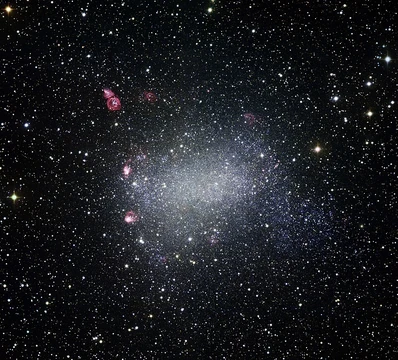
NGC 1600
Elliptical galaxy with one of the largest known supermassive black holes.

NGC 1600 is an elliptical galaxy located in the constellation Eridanus, approximately 149 million light-years from Earth. It is notable for hosting an unusually large supermassive black hole at its center, one of the largest known, despite the galaxy itself being of typical size and situated in an average galaxy group rather than a rich cluster.
Quick Facts
- Epoch
- J2000
- Ra
- 4 · 31 · 39.9
- Dec
- -5 · 05 · 10
- Constellation Name
- Eridanus
- Dist Ly
- 45,770 kpc
- Z
- 0.015614
- H Radial V
- 4681 km/s
- Group Cluster
- group
- Mass Light Ratio
- 10.58
- Appmag V
- 11.93
- Names
- LEDA 15406, PGC 15406
Facts from the source article.
Lore & Background
NGC 1600 is often described as an isolated early-type galaxy, though it is known to have at least 30 fainter satellite galaxies, including NGC 1601 and NGC 1603. The galaxy exhibits boxy isophotes and little rotation. The presence of H-alpha emission indicates possible ongoing star formation, and the galaxy is a known source of X-ray emissions. It is believed that NGC 1600 is the product of a galaxy merger that took place over 4 billion years ago, with the galaxy's age estimated at 4.6 to 8.8 billion years.
The system consisting of NGC 1600 and its surrounding galaxies shares some similarities with fossil galaxy groups but is not exactly the same. It has an unusually high concentration of dark matter, similar to fossil groups, yet its X-ray luminosity is less than the threshold for fossil groups. The galaxy has a diffuse distribution of stars near its center, caused by the influence of its central black hole.
The supermassive black hole at the center of NGC 1600 has a mass of 17 ± 1.5 billion solar masses, making it one of the largest known. At the time of the determination of its size, it was found to be unusual in its location relative to the galaxy population of the region. Previously, extremely large black holes were only found in the hearts of large dense rich clusters, whereas the galaxy group for which NGC 1600 is found is only an average galaxy group and not a rich cluster.
Reader's Guide
NGC 1600's significance lies primarily in its supermassive black hole, which at 17 billion solar masses is one of the largest known. Its discovery in 2016 was unexpected because such massive black holes were previously thought to reside only in the centers of large, dense rich clusters, yet NGC 1600 is located in an average galaxy group. This finding suggests that there may be previously unknown populations of very large black holes, and that current models of black hole growth may be incorrect or incomplete. The galaxy itself is also notable for its boxy isophotes, little rotation, and possible ongoing star formation indicated by H-alpha emission. Its high concentration of dark matter and X-ray emissions further distinguish it, though it does not fully meet the criteria for a fossil group. As a product of a merger over 4 billion years ago, NGC 1600 provides a valuable case study for understanding galaxy evolution and the relationship between galaxies and their central black holes.
Did You Know?
- NGC 1600 hosts a supermassive black hole with a mass of 17 ± 1.5 billion solar masses, one of the largest known.
- Despite being of typical size, its black hole is unusually large and was found in an average galaxy group, not a rich cluster.
Frequently Asked Questions
What is NGC 1600?
NGC 1600 is an elliptical galaxy sitting in the constellation Eridanus, roughly 149 million light-years from our solar system. It presents as a smooth, featureless spheroid of stars with no visible disk or spiral structure.
What's the big deal about NGC 1600's black hole?
The supermassive black hole at its core weighs in at approximately 17 billion solar masses (± 1.5 billion), ranking it among the heaviest known in the universe. What makes it stand out is that this monster anchors a perfectly ordinary-sized galaxy in a modest group, rather than a dense rich cluster.
Where can I spot NGC 1600 in the night sky?
Aim your telescope toward Eridanus, the Water Bearer, in the southern sky. At nearly 150 million light-years out, it is far beyond naked-eye visibility and demands a substantial aperture to coax out its faint elliptical glow.
How old is NGC 1600?
Current estimates place its dominant stellar population between roughly 4.6 and 8.8 billion years old, meaning much of its light was forged during the early galaxy-formation era. It is essentially a living fossil from a time when the universe was still assembling its structure.
Does NGC 1600 have any satellite galaxies?
Yes—astronomers have catalogued at least 30 satellite galaxies orbiting in its vicinity, including the nearby pair NGC 1601 and NGC 1603. This gives it a small but active galactic neighborhood despite residing in only an average-sized group.
More in NGC Objects, Part 3 1-24
Spotted an error? Know more?
Reader corrections go straight into our review queue. Suggest an edit · How this site is sourced