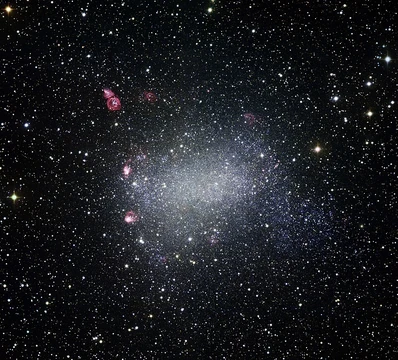
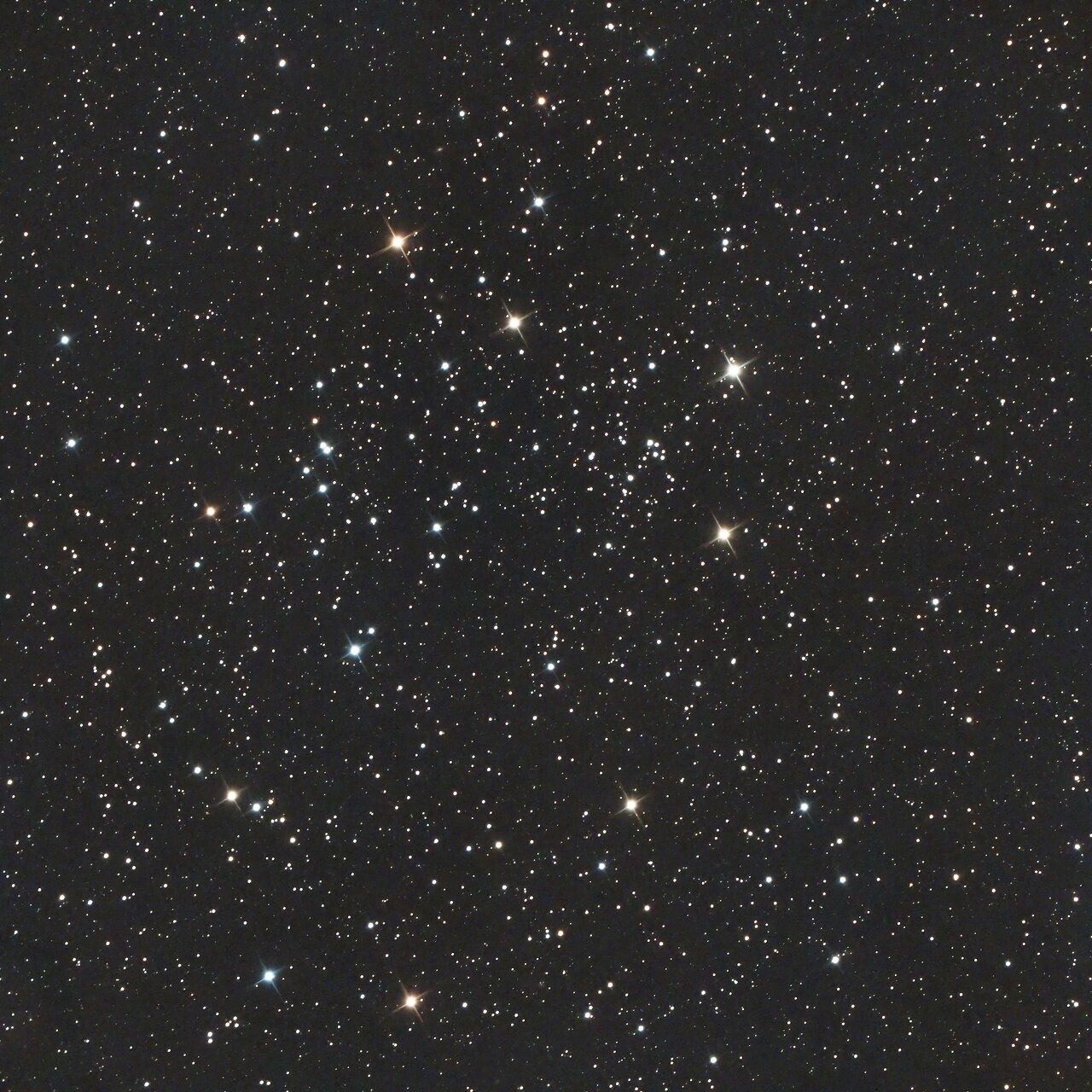
NGC 1746
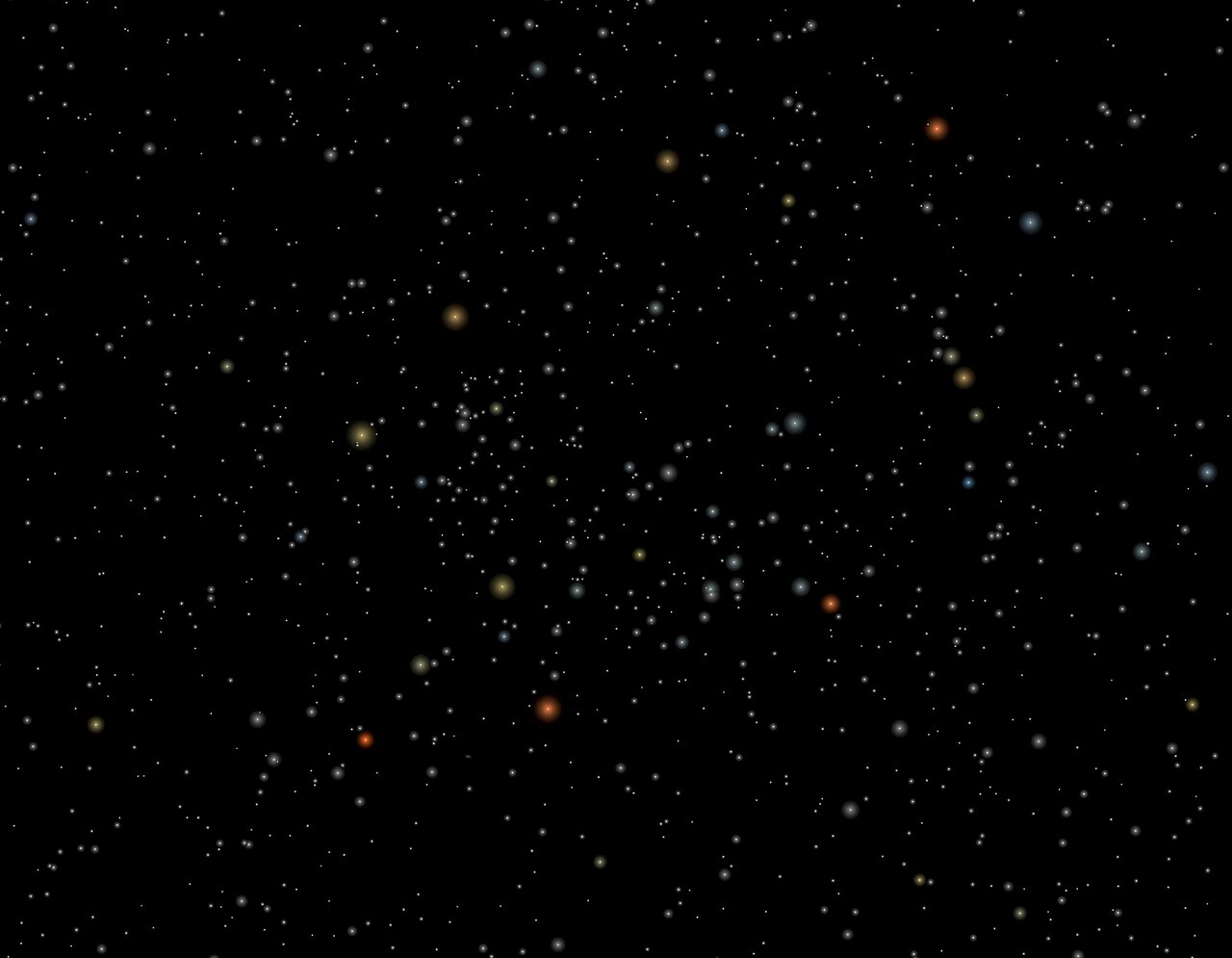
A sparse asterism in Taurus, once thought an open cluster.

Astrophoto Andy · CC0
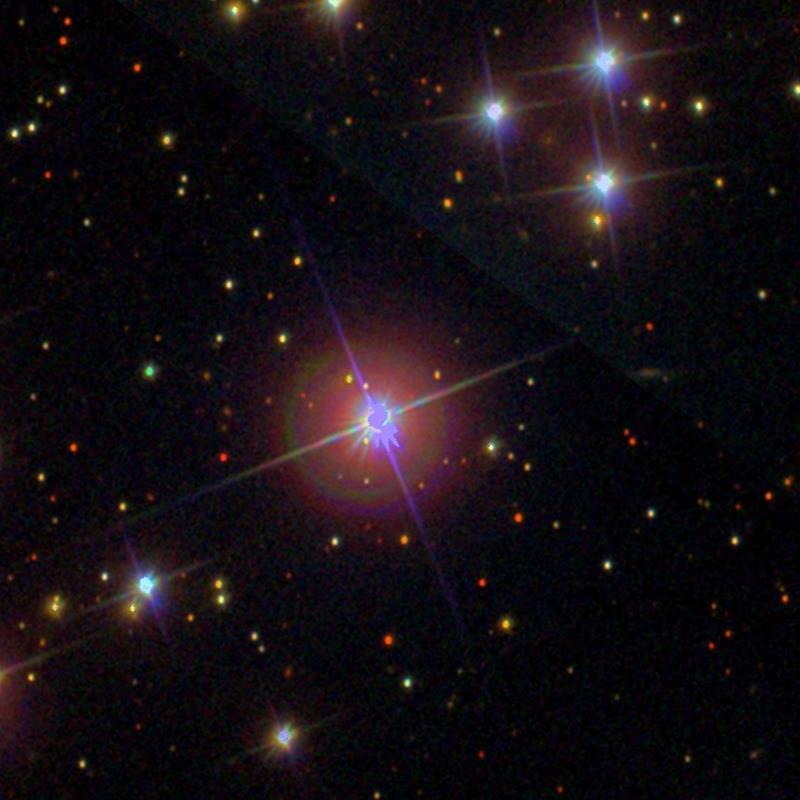
NGC 1746 is an asterism in the constellation Taurus. Originally classified as an open cluster, it has been shown through more recent observations to be a random formation of stars in Earth's sky. It has an apparent magnitude of 6.1 and spans around 40 arcminutes.
Quick Facts
- Constellation
- Taurus
- Ra
- 05 · 03 · 50.0
- Dec
- +23 · 46 · 12
- Epoch
- J2000.0
- Appsize V
- ~40'
- Names
- Cr 57, Mel 28
Facts from the source article.
Lore & Background
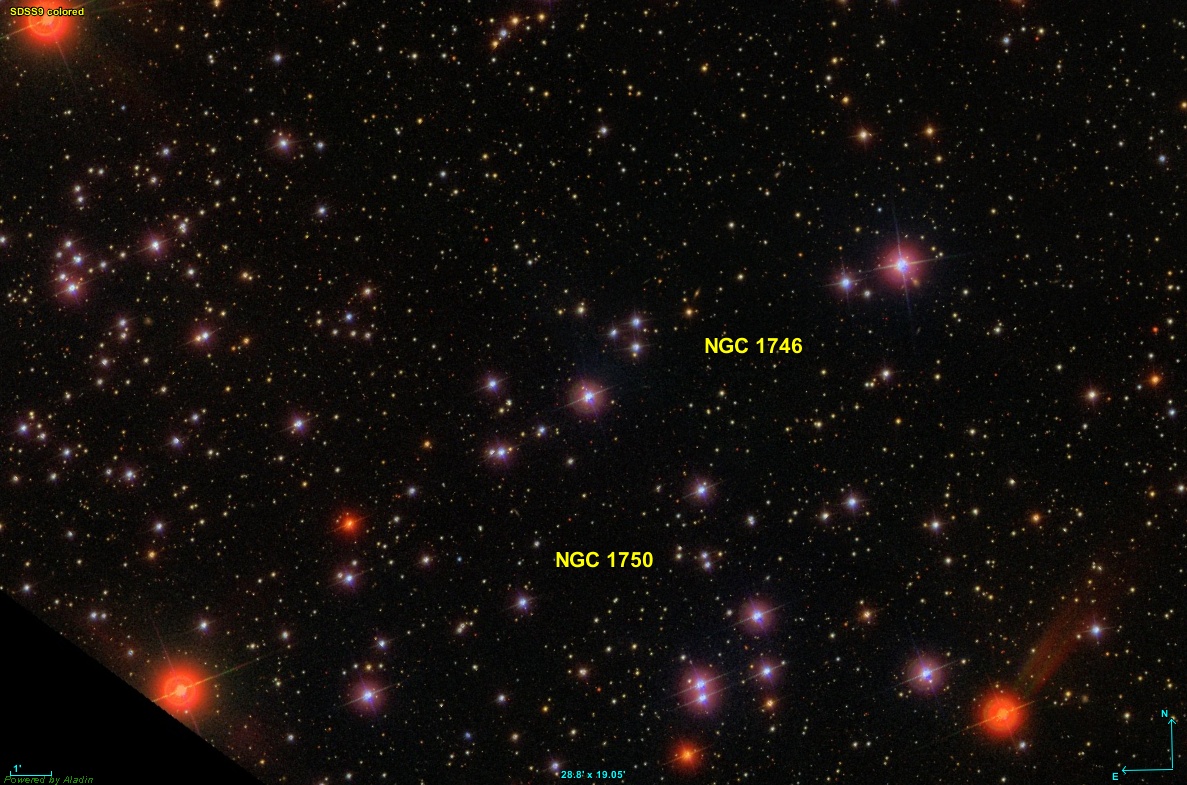
NGC 1746 was described in 1863 by Heinrich Louis d'Arrest and as a result was recorded in the New General Catalogue. It is a sparse, star grouping that spans around 40 arcminutes. The region of the sky also includes NGC 1750 and NGC 1758, which together are known as the Cluster of Clusters or the Taurus Triplet.
NGC 1750 is a true open star cluster spanning 20 arcminutes, with an estimated age of about 200 million years and containing several hundred stars, many still on the main sequence. NGC 1758 is a smaller and denser open cluster, about 12 arcminutes in size, somewhat further away than NGC 1750, with an estimated age of 541 million years; despite its age, there are no confirmed red giant members.
Although these clusters are visually close, detailed analysis of stellar motion and distance indicates that NGC 1750 and NGC 1758 are unrelated clusters, and NGC 1746 is likely a random grouping of stars rather than a true cluster.
Reader's Guide
NGC 1746's significance lies in its reclassification from an open cluster to an asterism, illustrating how improved observational techniques can change the understanding of celestial objects. Its inclusion in the New General Catalogue, based on d'Arrest's 1863 description, marks it as part of the historical record of deep-sky objects. The object is notable for its visual proximity to NGC 1750 and NGC 1758, forming the Taurus Triplet, yet studies of stellar motion and distance show these three groupings are not physically related. NGC 1746 itself is a random alignment of stars along the line of sight, not a gravitationally bound cluster. This distinction underscores the importance of proper motion and parallax data in distinguishing true star clusters from chance alignments. The asterism's apparent magnitude of 6.1 and angular size of 40 arcminutes make it a target for amateur observers, though its sparse nature means it appears as a loose scattering of stars rather than a concentrated group. Its legacy is as a cautionary example in astronomy: what appears to be a cluster may be an optical illusion.
Did You Know?
- It is also known as the Cluster of Clusters or the Taurus Triplet, along with NGC 1750 and NGC 1758.
- NGC 1746 has an apparent magnitude of 6.1 and spans about 40 arcminutes.
- Detailed analysis of stellar motion and distance suggests NGC 1746 is a random grouping of stars, not a true cluster.
Discovery and the Long Road to Resolution
In 1746, the French astronomer Jean-Dominique Maraldi first identified this stellar assembly while he and Jacques Cassini were tracking a comet. For over a decade, the object remained outside the broader astronomical catalog until Charles Messier independently found it in 1760. Messier, however, misidentified the smudge of light as a starless nebula, a classification that would persist until 1783, when William Herschel became the first observer to break the cluster apart into its constituent stars. Today, M2 sits in the constellation Aquarius, roughly five degrees north of the bright star Beta Aquarii. Under pristine dark-sky conditions, a keen observer can just barely make out a faint glow with the unaided eye. A pair of binoculars or a modest telescope immediately reveals that the object is not a single star but an extended, non-stellar smudge. It is only with a larger instrument that the individual members come into view, the brightest of which shines at an apparent magnitude of 12.
A Massive Elder in the Galactic Halo
At a distance of roughly 37,500 light-years, M2 spans an impressive 175 light-years from edge to edge, making it one of the most voluminous globular clusters catalogued to date. Its structure is notably rich, compact, and significantly elliptical rather than perfectly spherical. At approximately 12.5 billion years of age, it ranks among the oldest stellar assemblies bound to the Milky Way. The cluster occupies a position in the galactic halo, specifically in the southern galactic cap, placing it just below the Milky Way's southern pole. Recent research has linked M2 to the Gaia Sausage, a structure hypothesized to be the surviving debris of a dwarf galaxy that merged with the Milky Way in its early history. Gaia satellite data has also revealed an extended tidal stellar stream stretching about 45 degrees across the sky and roughly 300 light-years wide, likely gravitationally associated with M2. This stream may have been perturbed by the gravitational influence of the Large Magellanic Cloud.
Stellar Census and the Oosterhoff Framework
M2 hosts approximately 150,000 stars, among which 21 have been identified as variable. The most luminous members are red and yellow giant stars, and the cluster's overall spectral classification falls at type F4. In the broader taxonomy of globular clusters, M2 is classified as an Oosterhoff type II object. This system, originally devised by Pieter Oosterhoff, divides clusters into two groups based on three key parameters: metallicity, age, and the average pulsation period of RRab Lyrae variable stars. A type II designation typically requires a metallicity below −1.6, an age exceeding 13 billion years, and an average RRab period near 0.64 days. M2's measured metallicity of −1.65 and its 0.64-day pulsation period align neatly with these criteria, placing it squarely within the Oosterhoff Gap—a distinct separation observed between type I and type II clusters when plotted on a metallicity-versus-period diagram.
The Age Paradox and Shifting Consensus
Despite satisfying the metallicity and pulsation-period requirements for an Oosterhoff type II cluster, M2 presents a puzzling inconsistency: its commonly cited age of 12.5 billion years falls short of the 13-billion-year threshold that the classification scheme expects. This is particularly surprising because, in standard stellar evolution models, a cluster's age is largely inferred from its metallicity, so the two values should be mutually consistent. The discrepancy has drawn scholarly attention, with Marín-Franch publishing an analysis offering an explanation for the anomaly. More recently, a study by Botev and colleagues proposed a revised lower age limit of 13.2 billion years for M2, which would bring the cluster back into full agreement with the type II criteria and resolve the apparent contradiction. This ongoing debate underscores how even well-studied objects in the Messier catalog can challenge our assumptions about the relationship between chemical composition, stellar pulsation, and evolutionary timescale in ancient stellar systems.
Gallery
Frequently Asked Questions
What is NGC 1746?
NGC 1746 is a loose grouping of stars located in the constellation Taurus. It was originally catalogued as an open cluster, but newer observations have revealed it is actually just a random line-of-sight alignment of unrelated stars rather than a gravitationally bound group.
How bright and large is NGC 1746 to the naked eye?
It sits at an apparent magnitude of about 6.1, placing it right at the limit of what a dark-sky observer might glimpse. The asterism stretches roughly 40 arcminutes across the sky, which is about 0.7 degrees.
Where in the sky can I find NGC 1746?
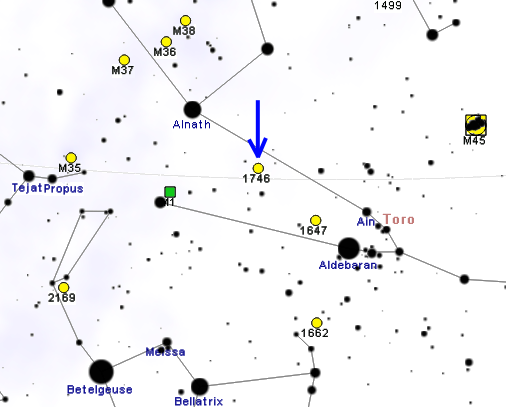
Look toward the constellation Taurus, which is most easily spotted during the winter months in the Northern Hemisphere. It is a faint, sparse smudge of stars rather than a tight, obvious cluster.
Why was NGC 1746 reclassified from a cluster to an asterism?
Early surveys listed it as an open cluster, but follow-up measurements of proper motions and distances showed the stars are not physically associated. They simply happen to line up from our vantage point on Earth, so modern catalogs treat it as a chance asterism.
What other designations does NGC 1746 carry?
Besides its NGC number, it is sometimes referred to as the "Cluster of Clusters" or the "Taurus Triplet" in older star atlases and enthusiast guides. These nicknames reflect its historical confusion with nearby clustered star groups in Taurus.
More in NGC Objects, Part 3 1-24
Spotted an error? Know more?
Reader corrections go straight into our review queue. Suggest an edit · How this site is sourced