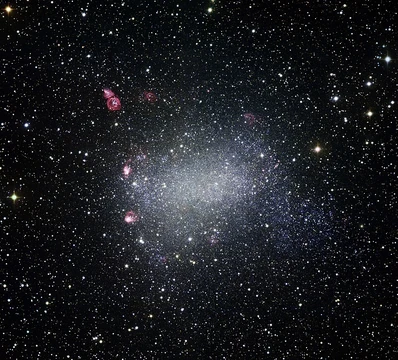
NGC 1792
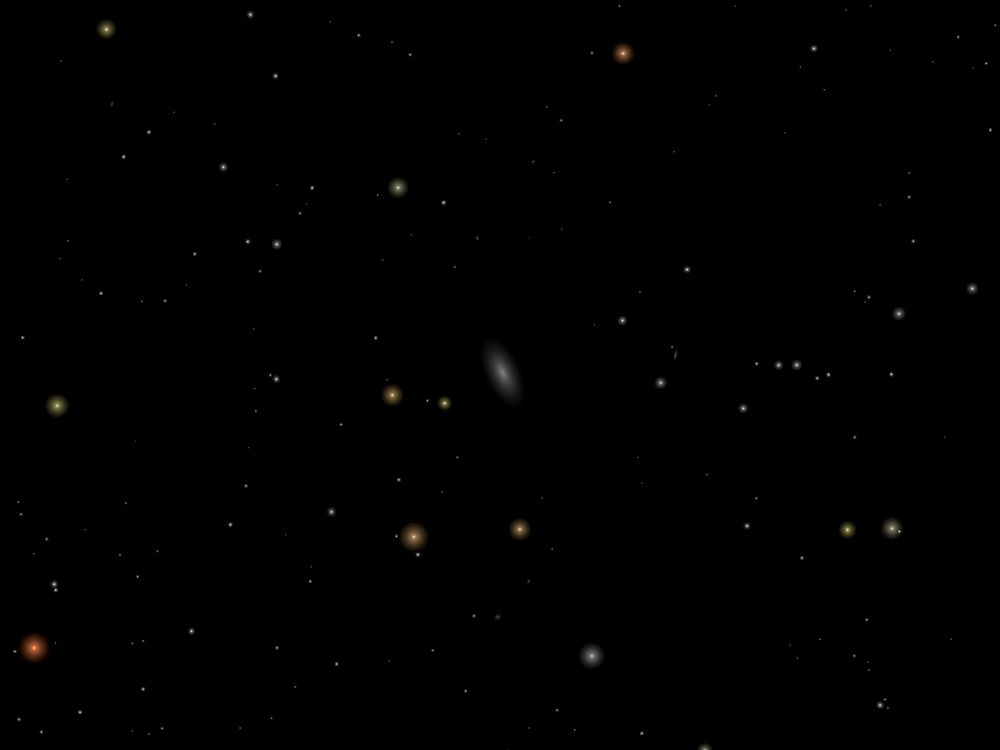
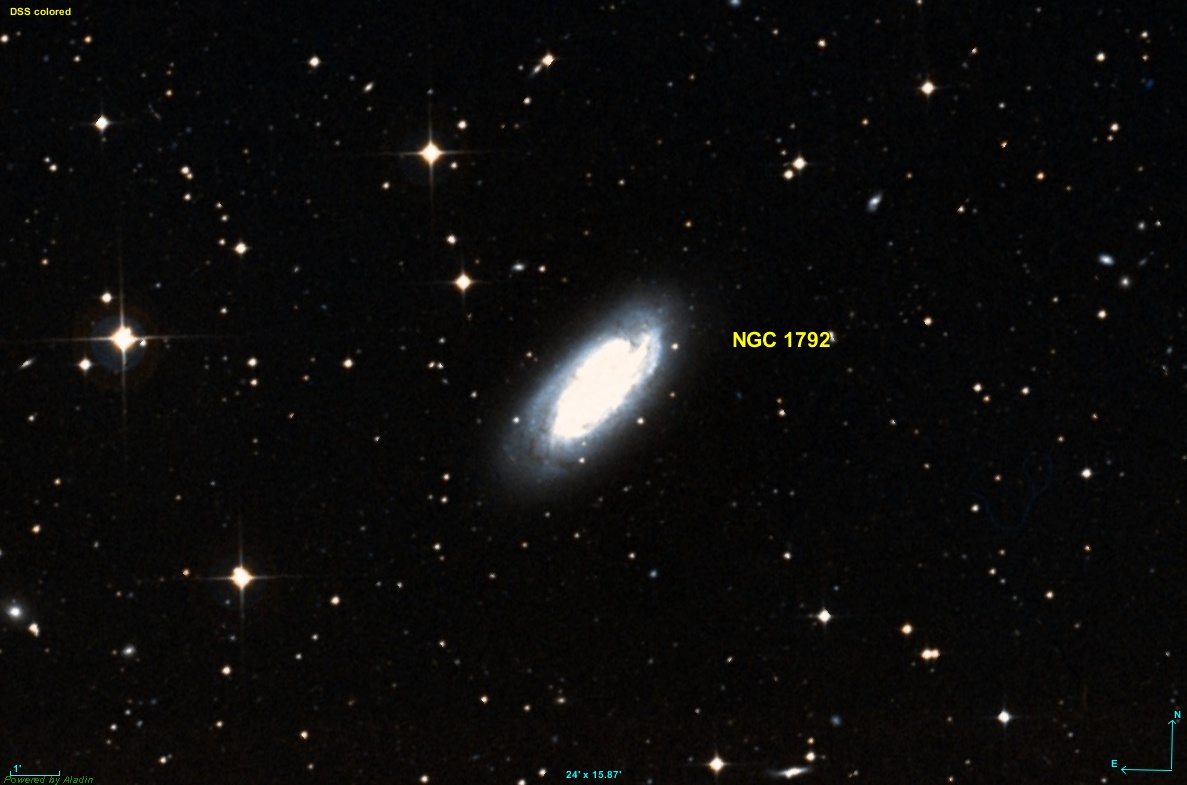
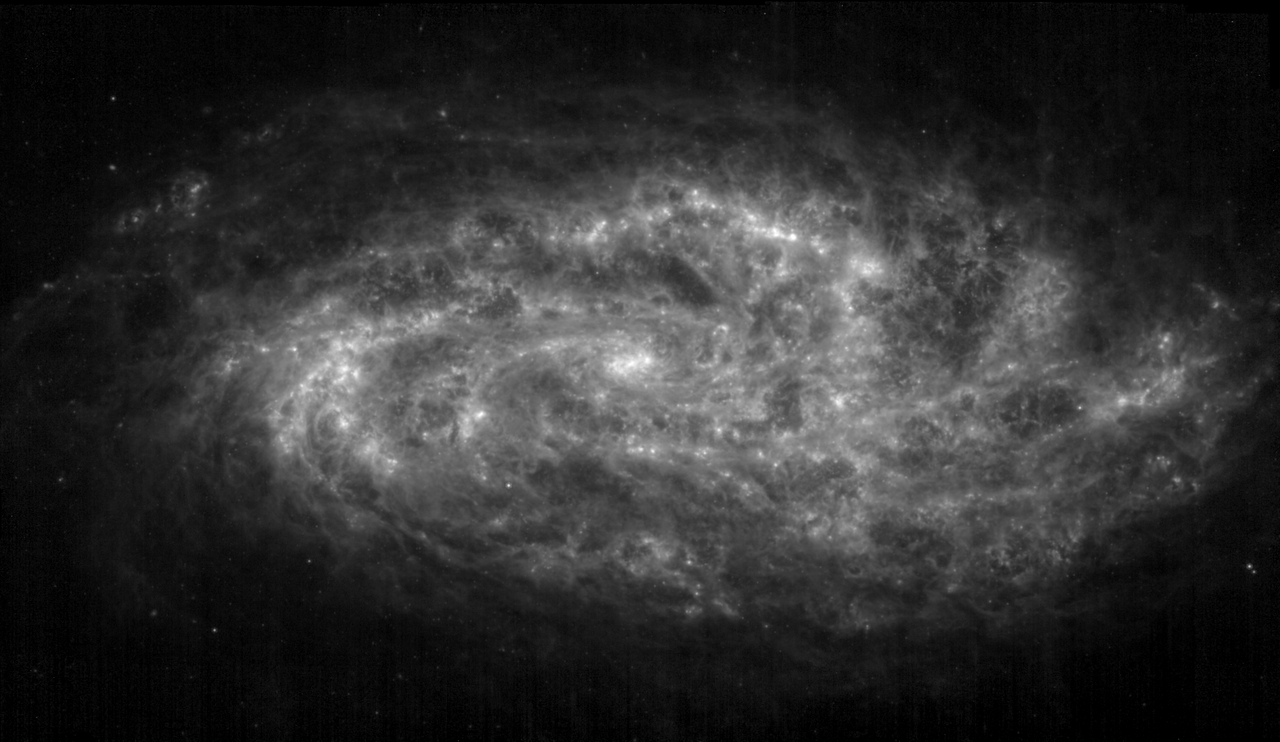
A flocculent spiral galaxy with intense star formation and a possible bar.

ESA/Hubble & NASA, D. Thilker, F. Belfiore, J. Lee and the PHANGS-HST Team · Public domain
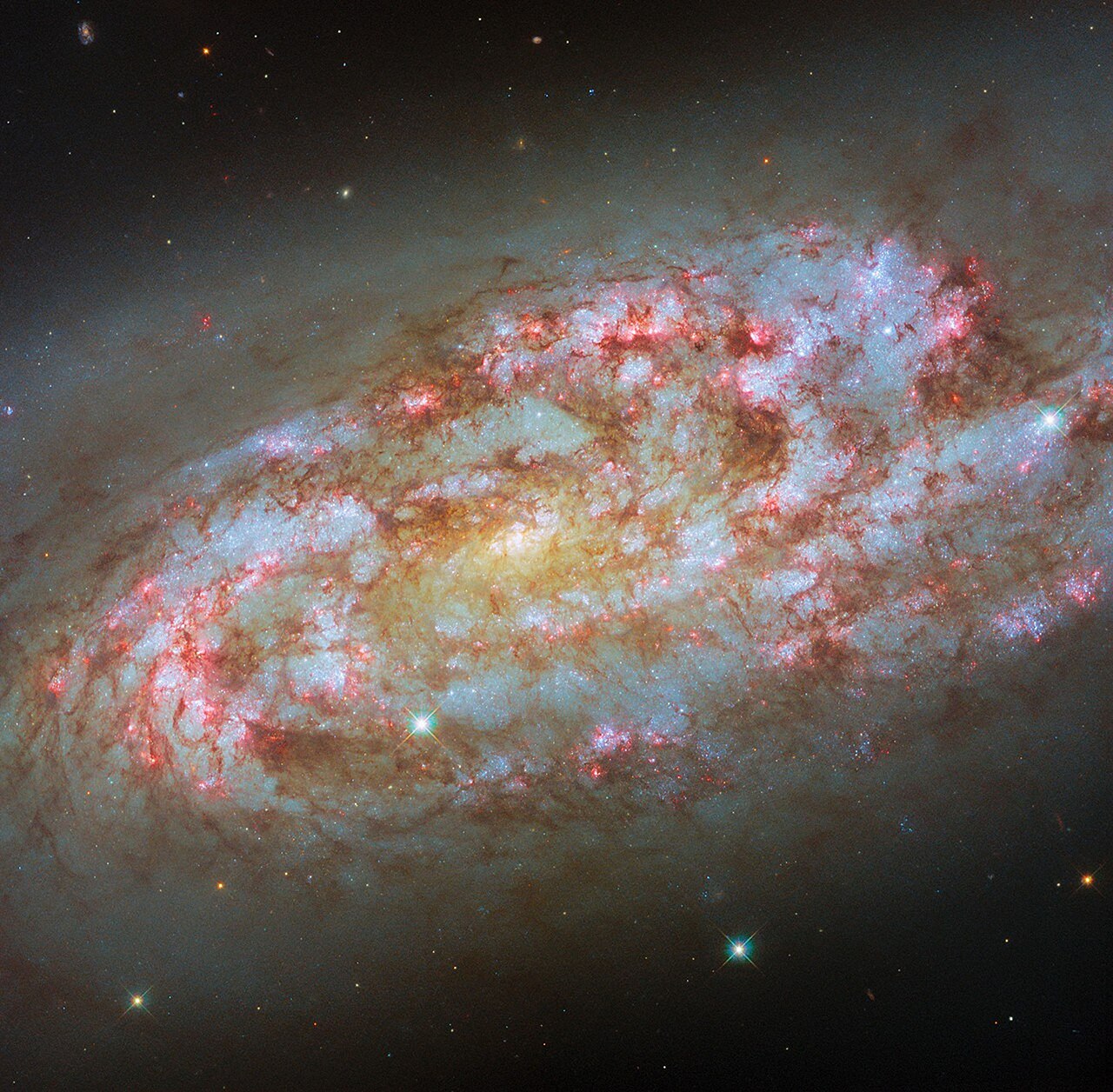
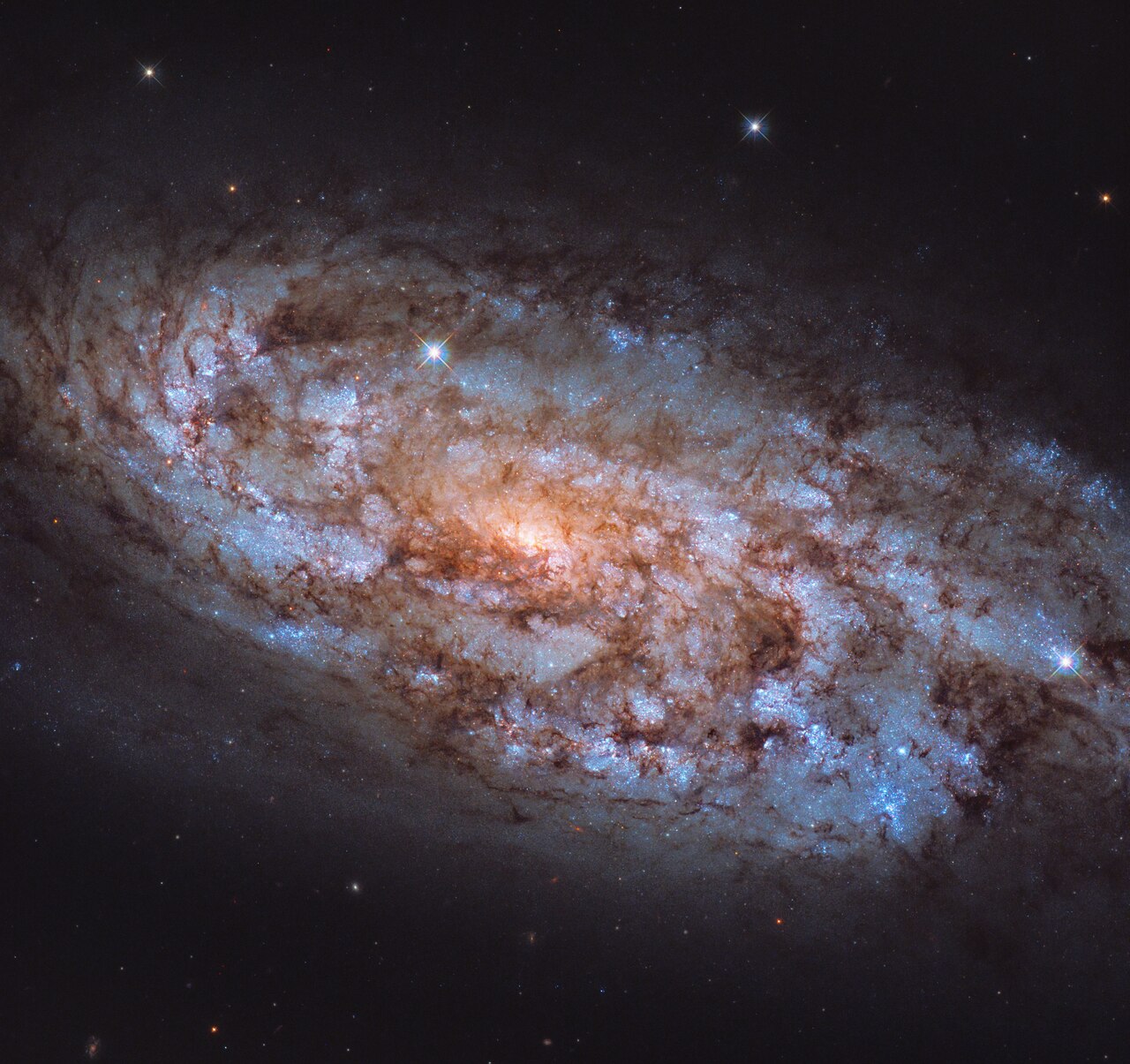
NGC 1792 is a spiral galaxy in the southern constellation Columba, discovered by Scottish astronomer James Dunlop on October 4, 1826. It lies about 36.4 million light-years away and is moving away from the Milky Way at a heliocentric radial velocity of 1,208 km/s. The galaxy is part of the NGC 1808 cluster.
Its classification is debated: in the de Vaucouleurs system it is SA(rs)bc, meaning a spiral without a central bar, moderately wound arms, and an incomplete ring. However, the HyperLEDA database classifies it as SBbc, indicating a barred spiral. The galaxy has a flocculent appearance and lacks a central bulge. Its plane is inclined at 66° to our line of sight, with the major axis aligned at a position angle of 317°.
Star formation is intense along the spiral arms, especially beyond a certain distance from the core, producing many prominent H II regions. A similarly high star formation rate in the nearby NGC 1808 suggests a recent, distant tidal interaction between the two. Radio emission from neutral hydrogen in NGC 1792 shows a pronounced asymmetry, likely from this interaction, though the galaxy appears only slightly disturbed—meaning the encounter mainly affected its outer parts. The star formation rate is estimated at a certain value per year. Soft X-ray emission has been detected, most of which likely comes from X-ray binaries.
Quick Facts
- Epoch
- J2000
- Constellation Name
- Columba
- Ra
- 05 · 05 · 14.454
- Dec
- −37 · 58 · 50.70
- Z
- 0.004059
- H Radial V
- 1,208
- Dist Ly
- 11.17 Mpc
- Group Cluster
- NGC 1808
- Mass Light Ratio
- 3.4
- Appmag V
- 10.18
- Appmag B
- 10.68
Facts from the source article.
Lore & Background
NGC 1792 was discovered by Scottish astronomer James Dunlop on October 4, 1826. It lies at a distance of about 36.4 million light-years and is receding from the Milky Way with a heliocentric radial velocity of 1,208 km/s. The galaxy is a member of the NGC 1808 cluster. Its morphological classification is disputed: in the de Vaucouleurs system it is SA(rs)bc, indicating a spiral galaxy with no central bar, moderately wound arms, and an incomplete ring structure, while the HyperLEDA classification of SBbc suggests it does have a bar. The galaxy has a flocculent appearance with no central bulge. Its plane is inclined at an angle of 66° to the line of sight, with the major axis aligned at a position angle of 317°.
There is a high level of star formation along the spiral arms at distances of more than the galactic core, leading to prominent H II regions. A comparable high level of star formation in the nearby NGC 1808 galaxy may indicate a recent, distant tidal interaction between the two. Radio emission from neutral hydrogen in NGC 1792 shows a pronounced asymmetry, most likely resulting from this interaction. As the galaxy appears only slightly disturbed, the interaction mainly impacted its outer parts. The star formation rate is estimated to be ·yr−1. Soft x-ray emission has been detected, the majority of which may come from X-ray binaries.
Reader's Guide
NGC 1792 is significant as a nearby spiral galaxy exhibiting vigorous star formation, particularly in its outer spiral arms, which host numerous H II regions. Its membership in the NGC 1808 cluster and the possible tidal interaction with NGC 1808 provide context for understanding galaxy interactions and their effects on star formation. The asymmetry in neutral hydrogen radio emission and the slight disturbance of the galaxy's outer parts suggest a recent encounter that did not heavily disrupt the inner structure. The detection of soft x-ray emission, likely from X-ray binaries, adds to its interest as a site of high-energy processes. The morphological ambiguity between a barred and unbarred classification highlights the challenges in classifying galaxies and the importance of different observational methods. Overall, NGC 1792 serves as a case study for star formation triggered by external interactions and for the properties of flocculent spiral galaxies.
Discovery and Celestial Neighborhood
On the night of 10 May 1826, Scottish astronomer James Dunlop turned his attention to the southern sky and logged a new object in the constellation Columba, describing it merely as a "faint nebula." That modest notation would become the first recorded observation of what we now catalogue as NGC 1808. The galaxy sits roughly two degrees south and east of the bright star Gamma Caeli, placing it in a region of the sky accessible from southern-hemisphere observatories. Far from being an isolated wanderer, NGC 1808 belongs to a small family of galaxies known as the NGC 1808 group. This group, in turn, is a constituent of the much larger Dorado Group, a sprawling collection of galaxies in the southern sky. Dunlop's brief description tells us little about the galaxy's true nature, but it marks the beginning of nearly two centuries of increasingly detailed study that would reveal a barred spiral with a rich and complex internal structure.
Morphological Architecture
Modern surveys have assigned NGC 1808 the detailed morphological code (R)SAB(s)a, a string of letters that encodes a great deal about its visual structure. The "SAB" component signals a spiral galaxy possessing a bar of stars and gas around its nucleus, though that bar is only weakly defined. The lowercase "s" tells us there is no ring structure tracing the ends of the bar, while the capital "R" in parentheses indicates the presence of an outer ring. The final "a" classifies the spiral arms as tightly wound, meaning they trace a compact, grand-design pattern rather than loose, open curves. Viewed from Earth, the galaxy is tilted at an inclination of 57 degrees relative to our line of sight, with its long axis oriented at a position angle of 324 degrees. The disk is not a flat, orderly plane: a noticeable warp distorts the geometry of the gas and stellar disk, and the distribution of neutral hydrogen gas and bright H II regions shows a pronounced asymmetry, hinting at past gravitational disturbances.
Nuclear Activity and the Starburst Enigma
At the heart of NGC 1808 lies a region of intense activity that has puzzled and fascinated astronomers. The core harbors a suspected weak active galactic nucleus, surrounded by a circumnuclear ring roughly 280 parsecs from the center. This ring hosts young star clusters and the remnants of supernovae, creating a striking circle of what observers have called "hot spots." For a time, the galaxy was classified as a possible Seyfert, a type of active galaxy powered by a supermassive black hole. However, more recent evidence has shifted the interpretation: the dominant energy source appears to be a vigorous starburst confined to a region about 500 parsecs across the nucleus. A probable outflow of gas streams away from the center toward the north-east, carving prominent dust lanes along its path. Perhaps most intriguingly, the elevated rate of star formation in NGC 1808 and its neighbor NGC 1792 may share a common cause—a recent, distant tidal interaction between the two galaxies that stirred their gas reservoirs and ignited widespread star birth.
A Single Stellar Death: SN 1993af
Among the many galaxies catalogued in the New General Catalogue, NGC 1808 has been the stage for only one confirmed supernova. On 15 November 1993, astronomer Marina Wischnjewsky detected a new point of light in the galaxy and identified it as SN 1993af, a Type Ia supernova reaching a peak apparent magnitude of 17. Its position was measured at 220 arcseconds east and 94 arcseconds north of the galactic nucleus, placing it well within the extended disk. Type Ia supernovae arise from the thermonuclear detonation of a white dwarf, making them valuable standard candles for cosmological distance measurements, though at magnitude 17 this event was far too faint for casual observation and required dedicated telescope time to confirm. The fact that only one such explosion has been recorded in NGC 1808 reflects both the relative rarity of these events in any given galaxy and the limited window of systematic supernova searches over the past few decades. The discovery by Wischnjewsky added a single but important data point to the galaxy's ongoing story of stellar evolution and death.
Gallery
Frequently Asked Questions
What is NGC 1792?
NGC 1792 is a spiral galaxy situated in the southern constellation Columba, roughly 36.4 million light-years from Earth. It belongs to the NGC 1808 galaxy cluster and is receding from the Milky Way at about 1,208 km/s.
Who discovered NGC 1792 and when?
Scottish astronomer James Dunlop first recorded the galaxy on October 4, 1826, during his survey of southern-sky deep-sky objects.
Is NGC 1792 a barred or unbarred spiral?
Astronomers have not reached a consensus: the de Vaucouleurs scheme tags it SA(rs)bc (no bar, a partial ring, moderately wound arms), whereas HyperLEDA lists it as SBbc (barred). The disagreement likely stems from its patchy, flocculent arm structure and a 66-degree inclination that makes the core region difficult to resolve cleanly.
How far away is NGC 1792 and how fast is it receding?
Spectroscopic measurements place it at approximately 36.4 million light-years, with a heliocentric radial velocity of 1,208 km/s, consistent with Hubble-flow recession at that distance.
What makes NGC 1792 interesting to observers and researchers?
Its flocculent arms host vigorous ongoing star formation, and the unresolved bar question makes it a handy benchmark for testing morphological classification schemes. At the same time, its membership in the NGC 1808 cluster offers a natural setting for studying how group environments influence galaxy structure.
More in NGC Objects, Part 3 1-24
Spotted an error? Know more?
Reader corrections go straight into our review queue. Suggest an edit · How this site is sourced