NGC 1692
A lenticular galaxy with a double-lobed radio structure and a companion.

Legacy Surveys / D.Lang (Perimeter Institute) & Meli thev · CC BY-SA 4.0
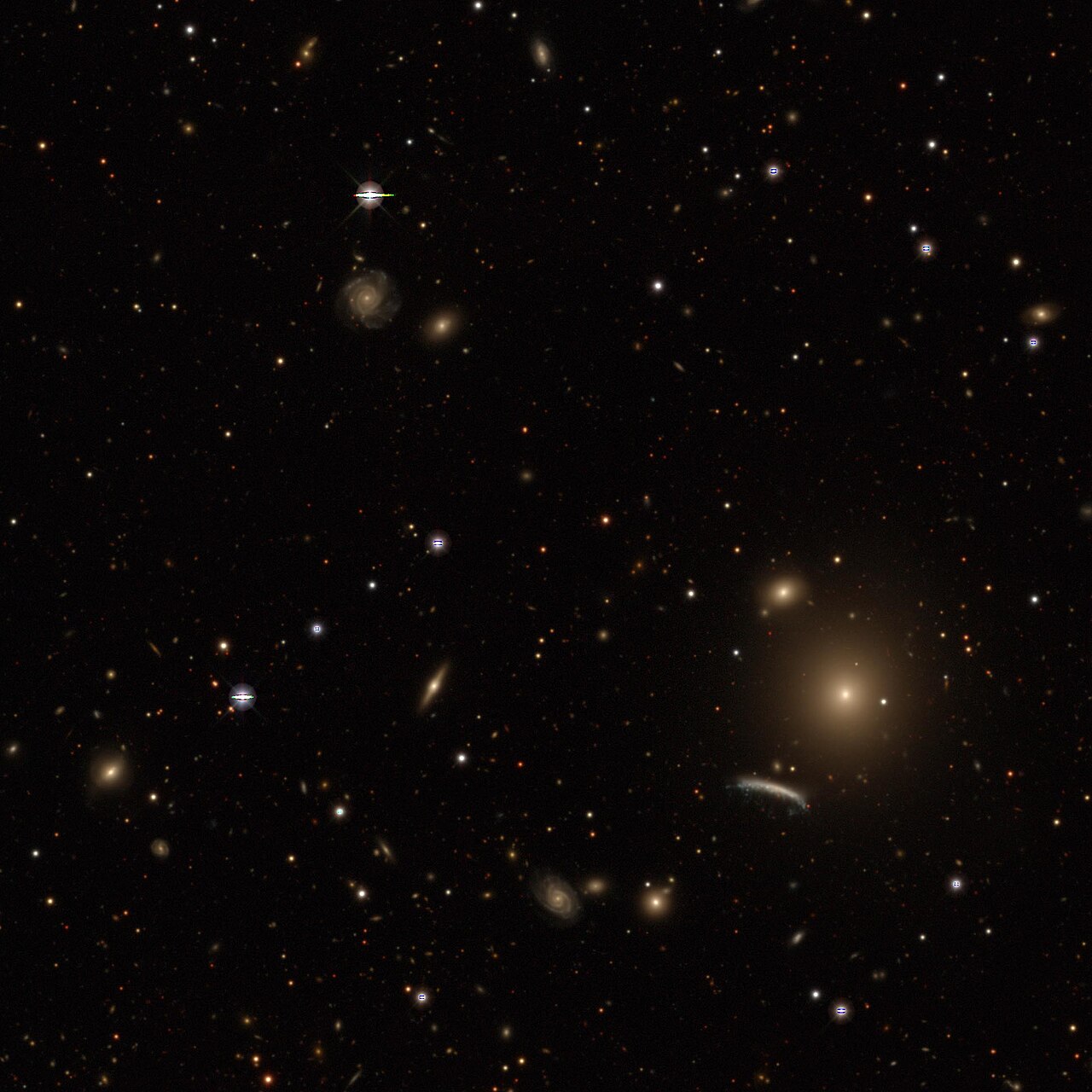
NGC 1692 is a lenticular galaxy located in the constellation of Eridanus, though it appears visually similar to an elliptical galaxy. It is notable as a low-luminosity radio galaxy and a weak-line radio galaxy (WLRG) of Fanaroff-Riley Type I classification, exhibiting a double-lobed radio structure with a jet and hotspot.
Quick Facts
- Epoch
- J2000
- Constellation Name
- Eridanus
- Ra
- 04 · 55 · 23.71
- Dec
- -20 · 34 · 15.87
- Z
- 0.035364
- H Radial V
- 10,602 km/s ± 35
- Dist Ly
- 510 Mly
- Appmag V
- 13.0
- Names
- Cul 0453−0206, ESO 552−G021, G4Jy 0507, PGC 16336, OF −289, MCG 03-13-029, MRSS 552−097500, PAPER J073.83−20.50, RR 095a, VLSS J0455.3−2034
Facts from the source article.
Lore & Background
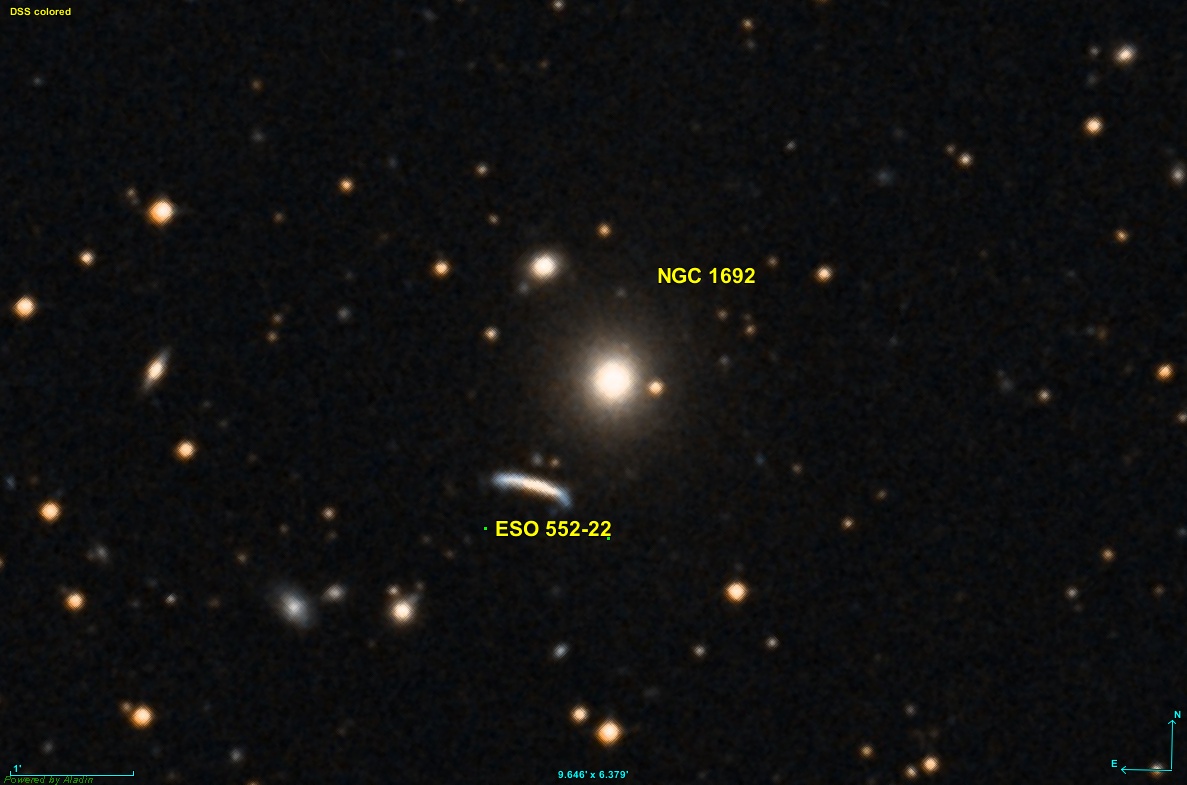
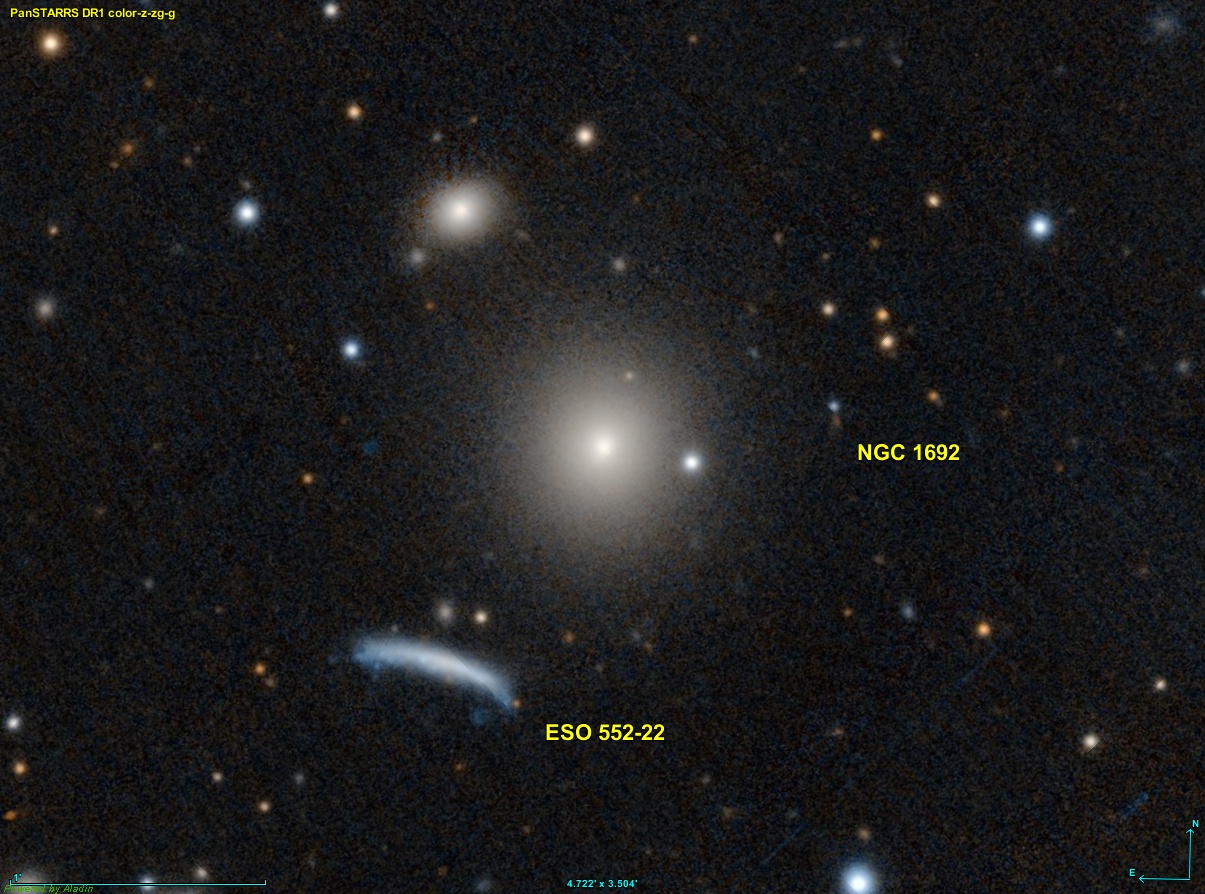
NGC 1692 was discovered by American astronomer Ormond Stone on 11 December 1885. Despite being categorized as a lenticular galaxy by the NASA/IPAC Database, it appears undisturbed and resembles an elliptical galaxy. It has one companion, an edge-on spiral galaxy located to the southeast, which displays a C-shaped appearance. Evidence of excessive ultraviolet emission and traces of young stellar populations have been found, but no emission lines are present in its optical spectrum.
Reader's Guide
NGC 1692 is classified as a low-luminosity radio galaxy and a weak-line radio galaxy (WLRG) of Fanaroff-Riley Type I. Imaging with the Very Large Array (VLA) reveals a double-lobed structure with a radio jet extending toward the northwest, terminating in a hotspot region. In the southern part, no jet is observed; instead, a warm-spot feature lies at the edge of the radio lobe. Earlier imaging from 1993 showed diffuse radio emission surrounding the galaxy but no detectable radio core. The source is compact with a double structure, and the radio emission likely originates from hotspots rather than the core. A study of the host galaxy found flux on the western side just beyond the nucleus, suggesting an asymmetric appearance.
Did You Know?
- NGC 1692 appears like an elliptical galaxy despite being classified as lenticular.
- It has a companion edge-on spiral galaxy with a C-shaped appearance to the southeast.
- The galaxy shows excessive ultraviolet emission and traces of young stellar populations but no optical emission lines.
- Its radio structure includes a double lobe with a northwest jet terminating in a hotspot, while the southern lobe has a warm-spot feature.
Discovery & Basic Classification
NGC 1692 was first identified on December 11, 1885, by American astronomer Ormond Stone, adding another entry to the catalog of deep-sky objects visible from Earth. Situated within the constellation Eridanus, this galaxy carries a dual classification: it is both a lenticular galaxy and a LINER (Low-Ionization Nuclear Emission-line Region) galaxy. Its redshift measurement of 0.035 places it at a Hubble distance of approximately 156 megaparsecs, with an uncertainty of about 11 megaparsecs, translating to roughly 510 million light-years from our vantage point. Despite being formally categorized as lenticular, NASA/IPAC database records note that NGC 1692 visually resembles an elliptical galaxy, presenting an undisturbed, smooth appearance to observers. This discrepancy between its formal morphological type and its apparent shape has made it an interesting case study for astronomers examining the boundaries between galaxy classes.
Stellar Populations & Visual Characteristics
One of the most intriguing aspects of NGC 1692 is the tension between its smooth, elliptical-looking appearance and the evidence of ongoing or recent star formation. Observations reveal excessive ultraviolet emission and traces of young stellar populations, yet the galaxy's optical spectrum lacks the emission lines one might expect from active star-forming regions. This combination suggests that while some younger stars exist within the system, they are not producing the strong ionized gas signatures typically associated with vigorous star formation. Adding to its visual complexity, NGC 1692 possesses a single companion: an edge-on spiral galaxy positioned to its south-east, which presents a distinctive C-shaped profile. The pairing of a seemingly quiescent lenticular host with a younger stellar component and a nearby spiral neighbor creates a rich observational puzzle for researchers studying galaxy evolution and interactions.
Radio Structure & Jet Morphology
Radio observations of NGC 1692 have painted a detailed picture of its low-luminosity radio properties. The galaxy is classified as a weak-line radio galaxy of Fanaroff-Riley Type I, and imaging with the Very Large Array reveals a double-lobed structure. A radio jet extends toward the north-west, terminating in a hotspot region, while the southern counterpart shows no jet but instead displays a warm-spot feature at the edge of its radio lobe. Earlier imaging conducted in 1993 detected diffused radio emission surrounding the galaxy, though no distinct radio core was identified. Additional observations confirm a steep power-law spectral component and indicate that the source is compact with a double structure, with radio emission likely originating from hotspots rather than a central core. This configuration places NGC 1692 among the more understated members of the radio galaxy population, where energy output is modest and the jet morphology is relatively simple compared to powerful Fanaroff-Riley Type II sources.
Asymmetry & Host Galaxy Studies
Detailed study of NGC 1692's host galaxy has uncovered evidence of asymmetry that complicates its otherwise smooth and undisturbed appearance. Researchers have detected flux on the western side of the galaxy, just beyond the nucleus region, suggesting that the system is not as symmetric as its elliptical-like morphology might imply. This localized excess of emission hints at structural irregularities in the outer regions, possibly related to the presence of the young stellar populations identified through ultraviolet observations. The combination of a lenticular classification, a LINER nuclear region, a companion edge-on spiral to the south-east, and this western-side flux paints a picture of a galaxy that, while appearing calm and undisturbed at first glance, harbors subtle complexities. These findings underscore the importance of multi-wavelength and multi-instrument studies in revealing the true nature of seemingly simple deep-sky objects.
Gallery
Frequently Asked Questions
What is NGC 1692 and where can I find it in the sky?
NGC 1692 is a lenticular galaxy that, to the naked eye or small telescope, looks much like an elliptical galaxy. It sits in the constellation Eridanus, one of the larger constellations in the southern sky.
What makes NGC 1692 special compared to other lenticular galaxies?
It is catalogued as a low-luminosity radio galaxy and a weak-line radio galaxy (WLRG) of Fanaroff-Riley Type I, meaning its radio emission is modest and it shows a LINER-type nuclear spectrum. These traits set it apart from the more common quiet lenticulars that lack any significant radio or nuclear activity.
How far away is NGC 1692 from Earth?
Its redshift of 0.035 places it at a Hubble distance of approximately 156 megaparsecs, which works out to roughly 510 million light-years.
What does NGC 1692's radio structure look like?
The galaxy exhibits a double-lobed radio morphology with a central jet that ends in a hotspot, a configuration characteristic of Fanaroff-Riley Type I sources. A companion galaxy is also associated with the system.
Who discovered NGC 1692 and when?
American astronomer Ormond Stone first recorded the object on 11 December 1885 during his systematic survey of southern-sky deep-sky objects. It has since been revisited by radio astronomers studying its jetted structure.
More in NGC Objects, Part 3 1-24
Spotted an error? Know more?
Reader corrections go straight into our review queue. Suggest an edit · How this site is sourced