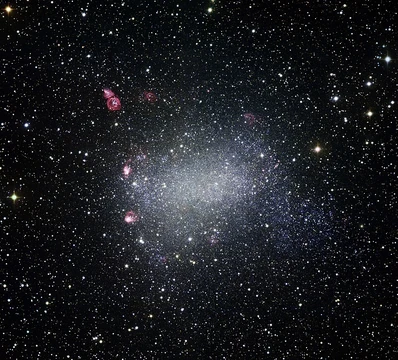
NGC 1808
A barred spiral galaxy with starburst activity and a suspected weak active nucleus.

ESO · CC BY 4.0
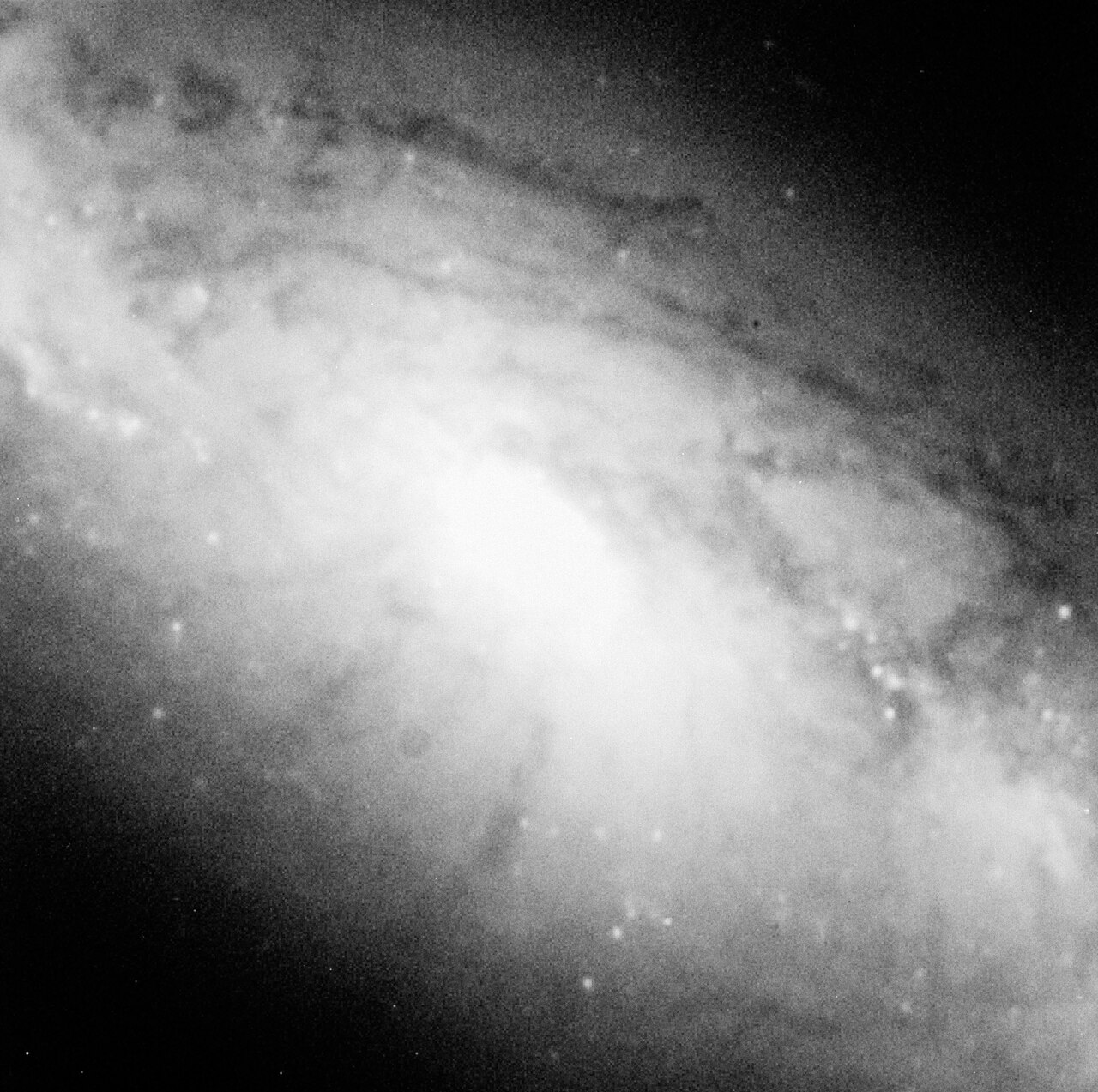
NGC 1808 is a barred spiral galaxy in the southern constellation Columba, located roughly two degrees southeast of Gamma Caeli. Scottish astronomer James Dunlop discovered it on May 10, 1826, noting it as a "faint nebula." This galaxy belongs to the NGC 1808 group, itself a component of the larger Dorado Group.
Its morphological classification is (R)SAB(s)a: a spiral with a weak bar around the nucleus (SAB), no ring around that bar (s), an outer ring (R), and tightly wound spiral arms (a). The galaxy is tilted 57° relative to Earth’s line of sight, with its long axis at a position angle of 324°. The gas-and-star disk is noticeably warped, and the distribution of neutral hydrogen and H II regions is markedly asymmetric.
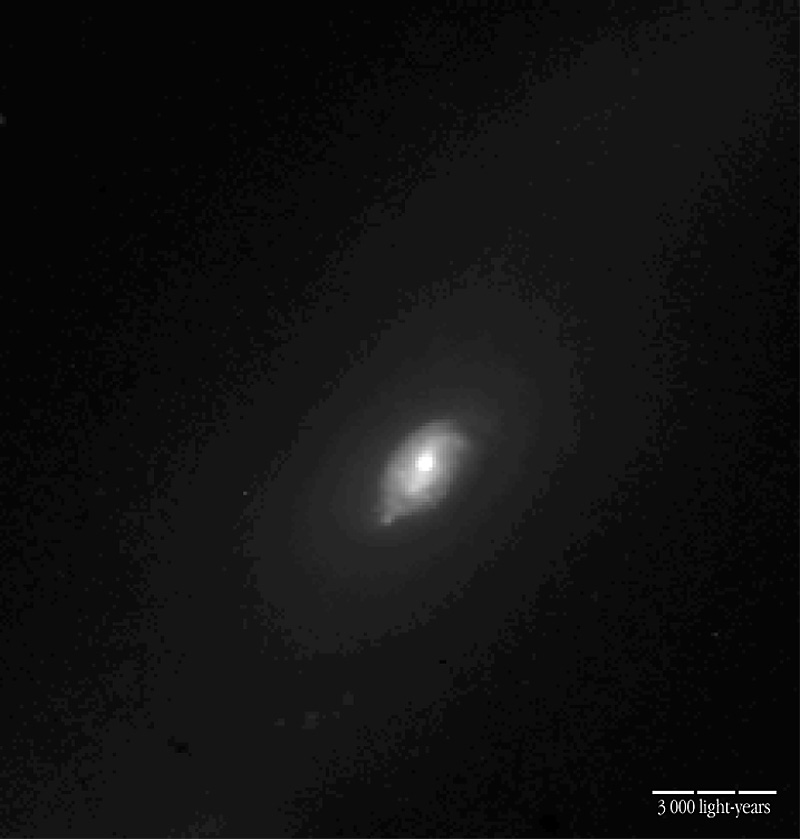
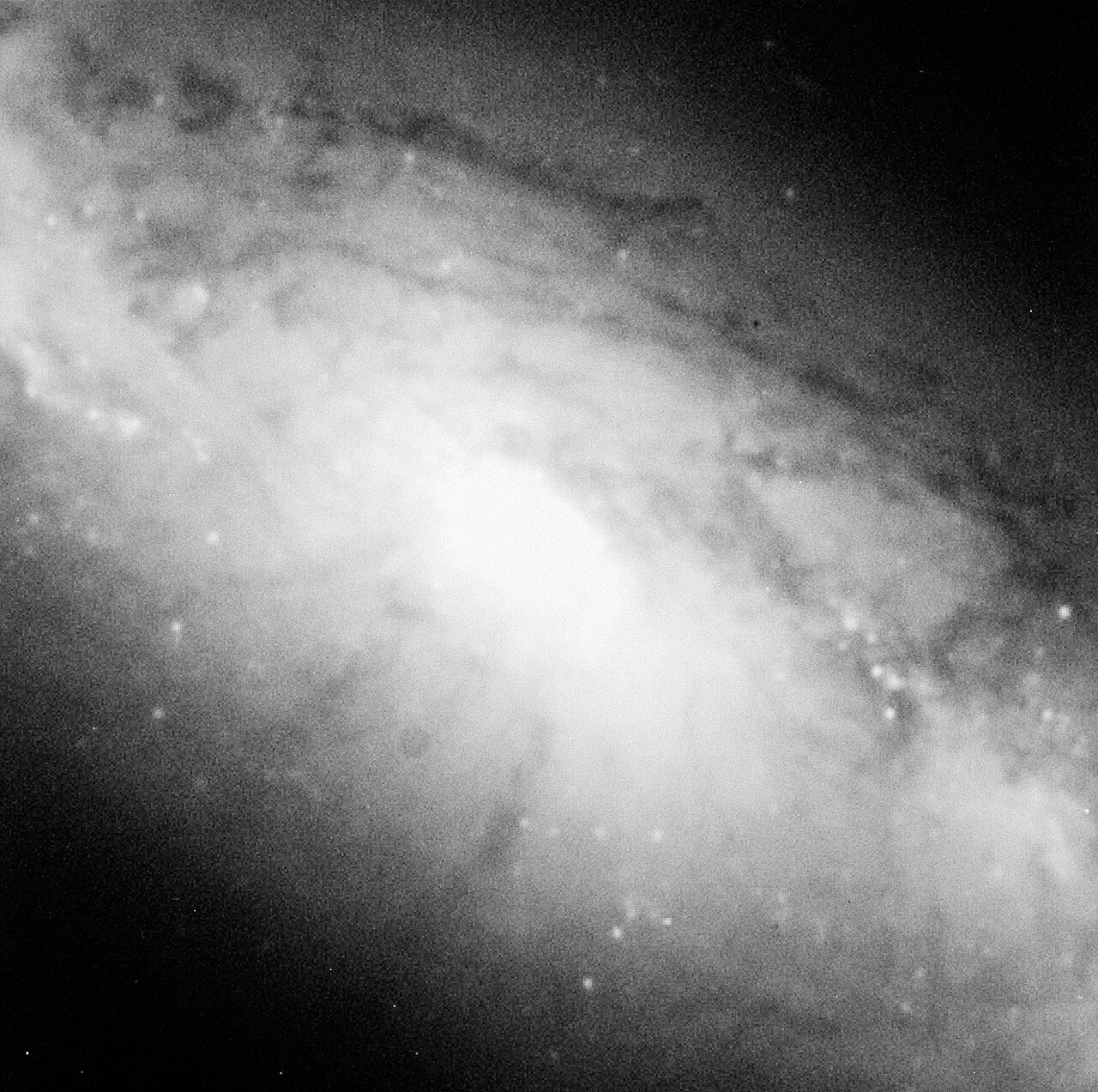
At its core lies a suspected weak active galactic nucleus, surrounded by a circumnuclear ring of star clusters and supernova remnants—forming a ring of peculiar "hot spots." Once thought to be a Seyfert galaxy, evidence now points to starburst activity within a radius around the center. A probable gas outflow streams northeast from the nucleus, carving prominent dust lanes. The intense star formation in NGC 1808 and nearby NGC 1792 suggests a recent, distant tidal interaction between the two.
One supernova has been observed: SN1993af (Type Ia, magnitude 17), discovered by Marina Wischnjewsky on November 15, 1993, located east and north of the galactic nucleus.
Quick Facts
- Epoch
- J2000
- Constellation Name
- Columba
- Ra
- 05 · 07 · 42.331
- Dec
- −37 · 30 · 45.88
- Group Cluster
- Dorado Group
- Dist Ly
- 12.8 ±
- Z
- 0.003339
- Appmag V
- 9.94
- Appmag B
- 10.83
Facts from the source article.
Lore & Background
The morphological classification of NGC 1808 is (R)SAB(s)a, indicating a spiral galaxy with a weak bar around the nucleus, no ring around the bar, an outer ring, and tightly-wound spiral arms. It is inclined by an angle of 57° to the line of sight from Earth, with the long axis oriented at a position angle of 324°. The disk of gas and stars shows a noticeable warp, and there is a pronounced asymmetry in the distribution of neutral hydrogen and H II regions.
The core region contains a suspected weak active galactic nucleus plus a circumnuclear ring containing star clusters and supernova remnants at a distance from the center, forming a ring of peculiar 'hot spots'. It was formerly identified as a possible Seyfert galaxy, but evidence now points to starburst activity in a radius around the center. A probable outflow of gas is directed to the northeast from the nucleus, forming prominent dust lanes. The high level of star formation in this galaxy and the nearby NGC 1792 may indicate a recent, distant tidal interaction between the two.
One supernova has been observed in NGC 1808: SN1993af (Type Ia, magnitude 17) was discovered by Marina Wischnjewsky on 15 November 1993 at east and north of the galactic nucleus.
Reader's Guide
NGC 1808 is notable for its complex central region, which hosts a suspected weak active galactic nucleus and a circumnuclear ring of star clusters and supernova remnants. The galaxy was once considered a possible Seyfert galaxy, but current evidence favors starburst activity within a radius around the center. A probable outflow of gas to the northeast creates prominent dust lanes, and the disk exhibits a warp and asymmetry in neutral hydrogen and H II regions. The high star formation rates in NGC 1808 and the neighboring NGC 1792 suggest a possible distant tidal interaction between them. The galaxy is a member of the NGC 1808 group, part of the larger Dorado Group. Its discovery by James Dunlop in 1826 as a 'faint nebula' belies its dynamic nature, and the observation of SN1993af adds to its astronomical significance.
Did You Know?
- NGC 1808 was discovered on 10 May 1826 by Scottish astronomer James Dunlop.
- One supernova, SN1993af (Type Ia, magnitude 17), was observed in NGC 1808 in 1993.
- The disk of NGC 1808 shows a noticeable warp and asymmetry in neutral hydrogen and H II regions.
Discovery & Galactic Neighborhood
NGC 1808 first entered the astronomical record on 10 May 1826, when Scottish astronomer James Dunlop noted it as a "faint nebula" while surveying the southern sky. It sits in the constellation Columba, roughly two degrees south and east of Gamma Caeli, placing it in a region of the sky that has long attracted observers of southern deep-sky objects. Beyond its individual identity, the galaxy belongs to the NGC 1808 group, a smaller cluster of galaxies that itself is embedded within the broader Dorado Group. This nested membership situates NGC 1808 within a larger web of gravitationally associated systems in the southern celestial hemisphere, giving it a place in the local cosmic neighborhood rather than isolating it as a lone wanderer. Its discovery by Dunlop, a relatively early figure in southern-hemisphere astronomy, also marks it as one of the objects catalogued during the formative decades of systematic galaxy surveys in the nineteenth century.
Morphology & Structural Peculiarities
The formal morphological code (R)SAB(s)a encodes a wealth of structural detail. The "SAB" signals a spiral galaxy with a weak bar threading through its nucleus, while the "(s)" confirms the absence of a ring encircling that bar. An outer ring, denoted by "R," girdles the broader disk, and the trailing "a" tells us the spiral arms are tightly wound rather than loosely flung. From Earth, the galaxy presents at a 57-degree inclination to our line of sight, with its long axis oriented at a position angle of 324 degrees. Observers also note a visible warp in the plane of gas and stars, and a striking asymmetry in how neutral hydrogen and ionized H II regions are distributed across the disk. These structural quirks—warped geometry, lopsided gas distribution, and the interplay of bar, ring, and tightly coiled arms—make NGC 1808 a rich case study for understanding how spiral galaxies evolve and how their internal architecture can deviate from idealized symmetry.
Nuclear Activity & the Starburst Question
At its heart, NGC 1808 hosts a suspected weak active galactic nucleus, though its energetic character has been debated. A circumnuclear ring, situated roughly 280 parsecs from the center, holds star clusters and supernova remnants that together form a band of peculiarly bright "hot spots." For a time the galaxy was catalogued as a possible Seyfert, but more recent evidence has shifted the interpretation toward vigorous starburst activity concentrated within a radius of about 500 parsecs around the nucleus. A probable outflow of gas streams toward the north-east from the central region, carving out prominent dust lanes along its path. The intense level of ongoing star formation in NGC 1808, and in the nearby galaxy NGC 1792, has led researchers to speculate that a distant tidal encounter between the two systems may have triggered or amplified this burst of stellar birth. Whether the nucleus is truly active or simply a byproduct of the starburst remains a point of ongoing investigation.
The 1993 Supernova
Among the relatively few supernovae recorded in NGC 1808, SN 1993af stands as the sole confirmed event. Classified as a Type Ia, it reached an apparent magnitude of 17, placing it firmly in the realm of faint, small-telescope or research-instrument observations. Marina Wischnjewsky made the discovery on 15 November 1993, locating the transient at a position 220 arcseconds east and 94 arcseconds north of the galactic nucleus. The Type Ia designation indicates a thermonuclear explosion of a white dwarf, a process that does not depend on the galaxy's ongoing star-formation rate and thus provides a relatively clean probe of the galaxy's stellar population. The event's modest brightness and its offset from the center reflect the general geometry of NGC 1808's disk as seen from Earth. As the only supernova yet catalogued in this barred spiral, SN 1993af remains a valuable data point for understanding the distribution of evolved stellar systems within the galaxy and for calibrating distance estimates to the Dorado Group.
Gallery
Frequently Asked Questions
What is NGC 1808?
NGC 1808 is a barred spiral galaxy sitting in the southern constellation Columba, about two degrees southeast of Gamma Caeli. It is a member of the NGC 1808 group, which itself is part of the larger Dorado Group.
Who discovered NGC 1808 and when?
Scottish astronomer James Dunlop first spotted the object on May 10, 1826, recording it in his notes as a faint nebula. It was subsequently entered into the New General Catalogue under the number 1808.
What is NGC 1808's morphological type?
It carries the classification (R)SAB(s)a, indicating a weak central bar, the absence of an inner ring, the presence of an outer ring, and tightly wound spiral arms. The galaxy is inclined roughly 57 degrees to our line of sight, with its long axis at a position angle of 324 degrees.
Where in the sky can I find NGC 1808?
Its coordinates place it in Columba at a right ascension of 05h 05m 59.4s and a declination of −37° 34′ 08″. Using Gamma Caeli as a bright anchor star and moving about two degrees toward the southeast is a practical way to zero in on the galaxy.
What makes NGC 1808 interesting to astronomers?
The galaxy shows signs of starburst activity, meaning regions where new stars are forming at an elevated rate, and it also harbors a suspected weak active galactic nucleus. These two features together make it a useful case study for understanding how galactic cores and star-forming regions interact.
More in NGC Objects, Part 3 1-24
Spotted an error? Know more?
Reader corrections go straight into our review queue. Suggest an edit · How this site is sourced