NGC 1554
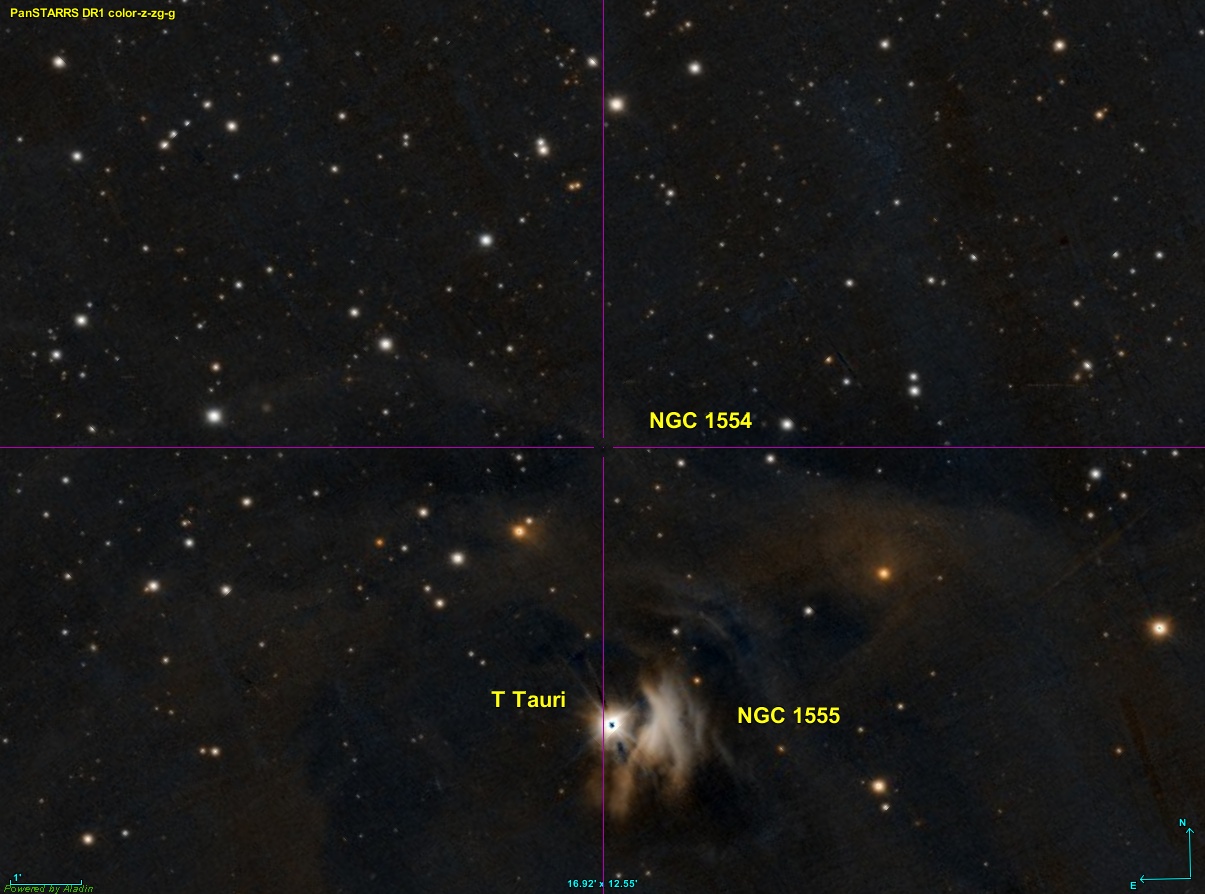
A lost nebula of uncertain identity near Hind's Variable Nebula.

Wolfmanwolf45 · CC BY-SA 4.0
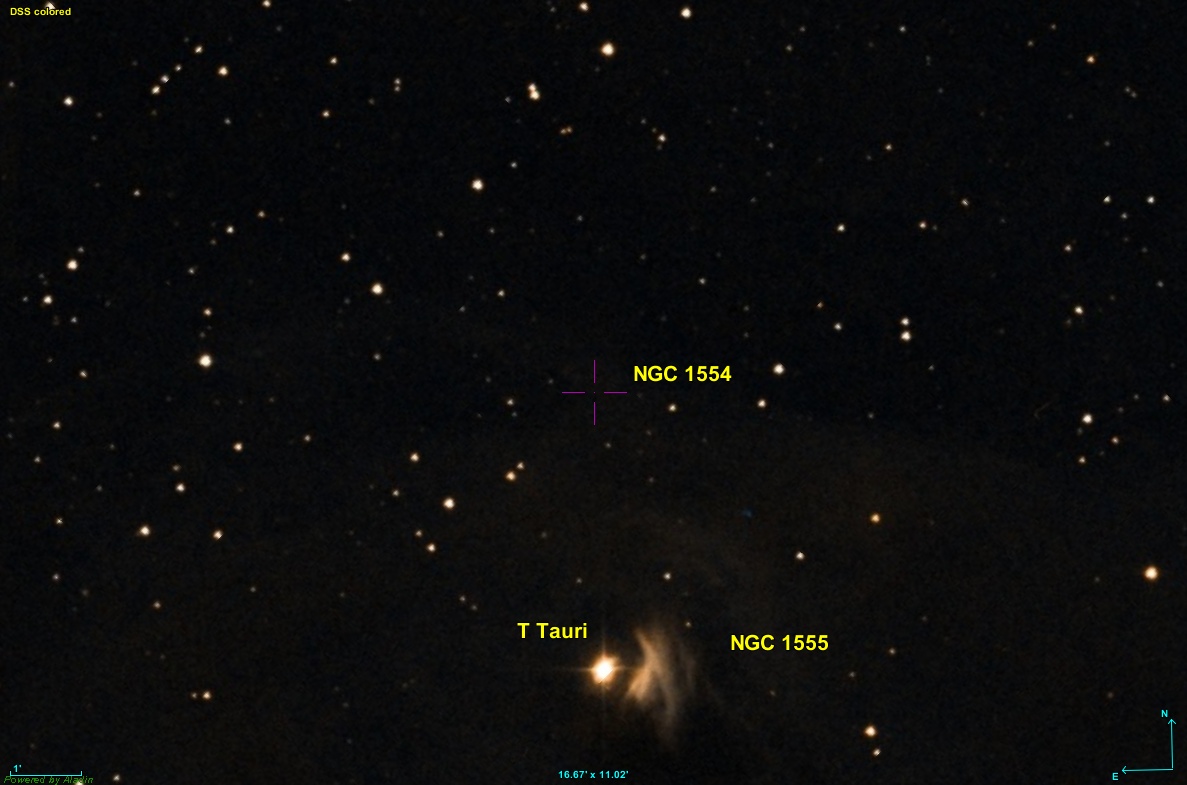
NGC 1554, also known as Struve's Lost Nebula, is an entry in the New General Catalogue of Nebulae. Its identification is uncertain, and no nebula is observed at its recorded coordinates.
- Catalog
- NGC 1554
- Common name
- Struve's Lost Nebula
- Discoverer
- Otto Wilhelm von Struve
- Confirmer
- Heinrich Louis d'Arrest
- Epoch
- J2000
- Ngc description
- magnificent or otherwise interesting object, variable, small, round, nucleus north of a star of the 13th magnitude
Lore & Background
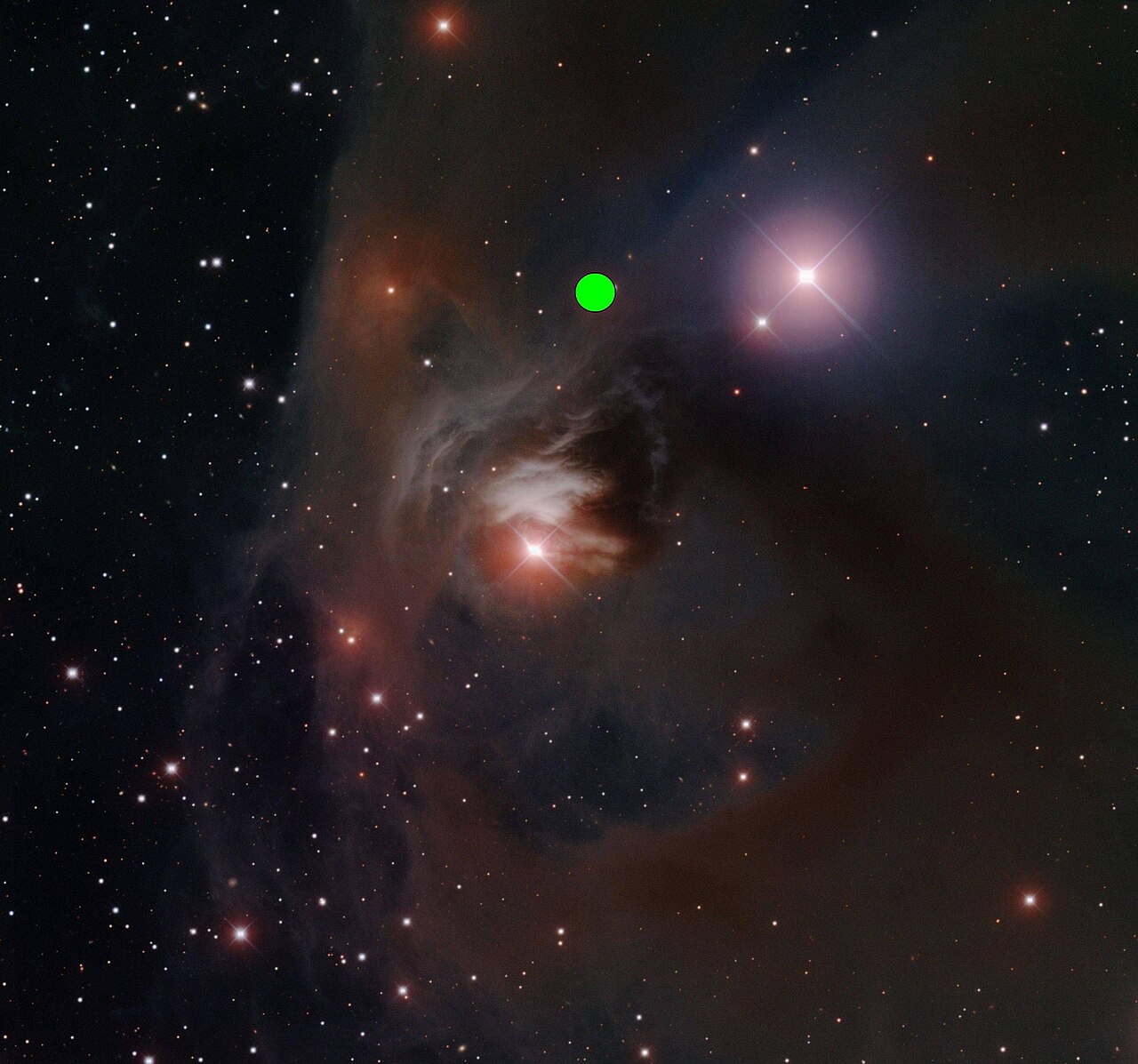
NGC 1554 was discovered by the German-Russian astronomer Otto Wilhelm von Struve and confirmed by Heinrich Louis d'Arrest. Dreyer's New General Catalogue describes it as a magnificent or otherwise interesting object, variable, small, round, with a nucleus north of a star of the 13th magnitude. The nebula's identification is uncertain; many sources think it is related to NGC 1555, Hind's Variable Nebula. At NGC 1554's coordinates (epoch J2000), there is no nebula. However, a 14th magnitude star lies 4' west-southwest of T Tauri, raising the possibility that the nebula Struve discovered surrounded a variable star that only flares up occasionally, perhaps on a centuries-long cycle. Alternatively, it may have been an error caused by a pair of faint stars.
Reader's Guide
NGC 1554, Struve's Lost Nebula, holds significance as a historical astronomical puzzle. Its uncertain status—whether it was a real but transient nebula or a misidentification—illustrates the challenges of 19th-century deep-sky observation. The possibility that it surrounds a variable star that flares on a centuries-long cycle keeps it a subject of interest for variable star and nebula research. In popular culture, the nebula appears in the 2014 video game Elite: Dangerous as a small planetary nebula near the Pleiades cluster, approximately 300 light years from Earth. The game depicts it with no star, making it physically unreachable due to game mechanics, likely an error in the game's astrometrics. A Struve's Lost Sector also exists in the game, but due to a map error, the nebula is not within that sector. This fictional treatment underscores the nebula's enigmatic reputation.
Did You Know?
- NGC 1554 is also called Struve's Lost Nebula.
- At its J2000 coordinates, no nebula is present, only a 14th magnitude star 4' west-southwest of T Tauri.
- In the game Elite: Dangerous, the nebula has no star and cannot be reached due to a game mechanics error.
Spiral Architecture and Warped Geometry
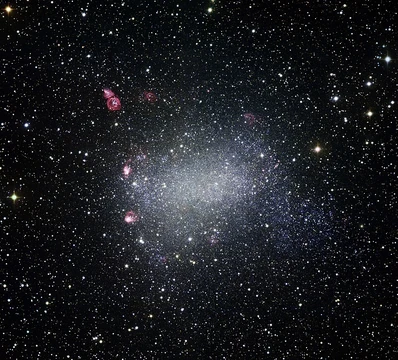
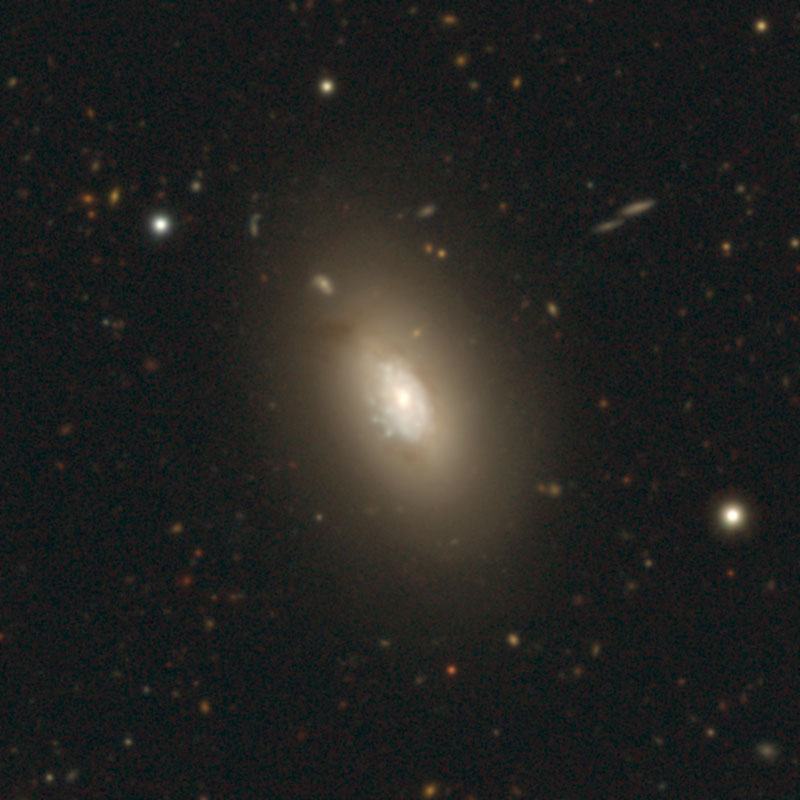
NGC 134 is a barred spiral galaxy whose overall structure draws a natural comparison to our own Milky Way. Its spiral arms are loosely wound around a luminous, bar-shaped core, a configuration that earns it a Hubble classification of Sbc. What makes this galaxy particularly striking from an observational standpoint is its warped disc. Rather than presenting as a flat plane when seen edge-on, the disc bends and tilts, giving the galaxy a distinctly non-planar silhouette. Adding to this unusual geometry is a visible trail of gas being stripped away from the upper edge of the disc. Together, the warp and the escaping gas trail point toward a possible gravitational encounter with a neighboring galaxy, though no definitive evidence has yet confirmed such an interaction. The combination of a loosely bound arm structure, a prominent central bar, and this warped, partially stripped disc makes NGC 134 a compelling case study in how galactic morphology can record the history of dynamical disturbances.
Star-Forming Regions and Dust Obscuration
Imaging of NGC 134 with the Very Large Telescope reveals a galaxy rich in active star formation. Scattered along the spiral arms are numerous regions of ionized hydrogen, the telltale signature of young, hot stars illuminating surrounding gas. In the VLT photograph these regions glow a vivid red, standing out against the broader galactic structure and marking the sites where new stellar populations are being born. Interspersed among these bright zones are extensive dark lanes of interstellar dust. These dusty corridors absorb and block the starlight behind them, preventing a full view of the galaxy's interior and giving the disc a mottled, layered appearance. The interplay between the glowing hydrogen regions and the obscuring dust lanes creates a complex visual tapestry that highlights the ongoing cycle of star birth and the material that both fuels and conceals it. The abundance of these ionized regions along the arms underscores that NGC 134 remains an actively evolving system, continually converting its gas reservoirs into new stars despite the obscuring effects of its own dust content.
Discovery Credits and the Giant Squid Nickname
The catalog entry for NGC 134 is most commonly credited to Sir John Herschel, who observed the galaxy from the Cape of Good Hope. However, the attribution is not entirely straightforward. Herschel himself acknowledged that the object might correspond to the 590th entry in a list compiled by James Dunlop, published in 1828, a full six years before Herschel's own observations of the region. This overlap in discovery timing raises questions about who truly first recorded the galaxy, and the credit remains somewhat shared in the historical record. Beyond its formal catalog designation, NGC 134 has also been proposed for a more evocative popular name. O'Meara suggested calling it the Giant Squid Galaxy, a nickname that presumably draws on the galaxy's visual appearance, perhaps the trailing gas and warped disc resembling tentacles extending from a central body. Such naming traditions help make distant galaxies more memorable and accessible to the public, bridging the gap between technical classification and imaginative recognition.
Galactic Neighborhood and the 2009 Supernova
Located approximately 60 million light years from Earth in the constellation Sculptor, NGC 134 is not an isolated object. It belongs to a small galaxy group designated LGG 7, which also includes NGC 115, NGC 131, IC 1554, NGC 148, IC 1555, and ESO 410-18. This grouping places NGC 134 within a local cosmic neighborhood where gravitational interactions between members may influence their evolution over time. The galaxy's own warped disc and stripped gas trail may be connected to such interactions, though a specific partner has not been identified. In terms of transient events, NGC 134 has hosted one recorded supernova: SN 2009gj, a Type IIb explosion reaching an apparent magnitude of 15.9. It was discovered on 20 June 2009 by Stuart Parker, an amateur astronomer based in New Zealand. The fact that a non-professional observer identified this event speaks to the accessibility of such discoveries and adds a notable chapter to the galaxy's observational history.
Gallery
Frequently Asked Questions
What is NGC 1554?
NGC 1554 is a catalogue entry in the New General Catalogue of Nebulae, commonly nicknamed Struve's Lost Nebula. It is listed as a small, round, variable object, but no nebula can actually be found at its recorded J2000 coordinates today.
Who discovered NGC 1554 and who confirmed it?
Otto Wilhelm von Struve is credited with the original discovery, and Heinrich Louis d'Arrest later confirmed the entry. Both were 19th-century German astronomers working in the Bessel-era observatory tradition.
Why is NGC 1554 called a 'lost nebula'?
The designation is uncertain because modern observers cannot locate any nebula at the published position, making its true identity a matter of speculation. It sits in the same general region as Hind's Variable Nebula, which complicates any attempt to match Struve's original notes to a real object.
What did Struve write in his NGC description of 1554?
He called it a magnificent or otherwise interesting object, noted it as variable and small with a round shape, and placed a nucleus just north of a 13th-magnitude star. Those brief observational notes are all that remain to anchor the entry.
Is NGC 1554 related to Hind's Variable Nebula?
It is catalogued in the vicinity of Hind's Variable Nebula, but the two are not confirmed to be the same object. The proximity is one reason the identity of 1554 remains unresolved among deep-sky researchers.
More in NGC Objects, Part 3 1-24
Spotted an error? Know more?
Reader corrections go straight into our review queue. Suggest an edit · How this site is sourced