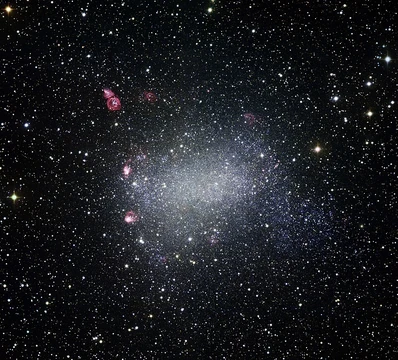
NGC 1527
Lenticular galaxy in Horologium with a possible active nucleus.

NGC 1527 is a lenticular galaxy located in the constellation Horologium. It is notable for having a possible active galactic nucleus, indicating a compact central region that emits significant energy across the electromagnetic spectrum beyond what stars produce. The galaxy is a member of the galaxy group HDC 257, which contains at least 14 galaxies.
Quick Facts
- Epoch
- J2000
- Constellation Name
- Horologium
- Ra
- 04 · 08 · 24.1044ned
- Dec
- -47 · 53 · 48.811ned
- Z
- 0.004043 · 0.0000570ned
- Dist Ly
- 17.130 ± 1.111 Mpcned
- Group Cluster
- [CHM2007] HDC 257
- Appmag V
- 11.74ned
Facts from the source article.
Lore & Background
NGC 1527 was discovered by Scottish astronomer James Dunlop on 28 September 1826. It is a lenticular galaxy, a type that exhibits properties intermediate between elliptical and spiral galaxies. The galaxy has a possible active galactic nucleus, meaning its central region emits energy that cannot be attributed solely to stellar processes. It belongs to the galaxy group HDC 257, which includes at least 14 galaxies such as NGC 1433, NGC 1483, NGC 1487, NGC 1493, NGC 1510, and NGC 1512, among others. One supernova has been observed in NGC 1527: SN 2008ge, a Type Iax event discovered by the CHilean Automatic Supernova sEarch (CHASE) on 8 October 2008. It reached magnitude 12.2, making it the brightest supernova of 2008. Initially classified as Type Ia, later analysis concluded it was Type Iax.
Reader's Guide
NGC 1527 holds significance as a lenticular galaxy with a possible active galactic nucleus, offering insight into the energetic processes at galactic centers. Its membership in the HDC 257 group places it within a rich environment of interacting and neighboring galaxies, contributing to studies of galaxy formation and evolution. The supernova SN 2008ge, initially mistaken for a Type Ia but later reclassified as Type Iax, highlights the importance of careful spectral analysis in supernova classification. As the brightest supernova of 2008, it drew attention to NGC 1527 and provided data on a relatively rare supernova subtype. The galaxy's distance measurements, both from Hubble flow and non-redshift methods, are consistent within uncertainties, supporting its use as a calibrator for extragalactic distance scales. Its discovery by James Dunlop in 1826 adds historical depth to its astronomical record.
Did You Know?
- NGC 1527 has a possible active galactic nucleus.
- Supernova SN 2008ge, initially classified as Type Ia, was later reclassified as Type Iax.
Frequently Asked Questions
What is NGC 1527?
NGC 1527 is a lenticular galaxy residing in the constellation Horologium. It lies roughly 17 megaparsecs from us, placing it in the relatively nearby universe.
Who discovered NGC 1527 and when?
James Dunlop first recorded this galaxy on September 28, 1826, adding it to his catalogue of southern-sky objects.
What makes NGC 1527's core special?
Astronomers suspect it harbors an active galactic nucleus, a compact central engine that radiates energy well beyond what its stellar population alone can account for. This makes it a point of interest for studying nuclear activity in lenticular systems.
How far is NGC 1527 from Earth?
Redshift-based measurements put it at about 17.37 ± 1.27 megaparsecs, while independent non-redshift estimates yield a mean of 17.13 ± 1.11 megaparsecs.
What galaxy group is NGC 1527 part of?
It belongs to the HDC 257 group, a gravitationally associated collection containing at least 14 galaxies.
More in NGC Objects, Part 3 1-24
Spotted an error? Know more?
Reader corrections go straight into our review queue. Suggest an edit · How this site is sourced