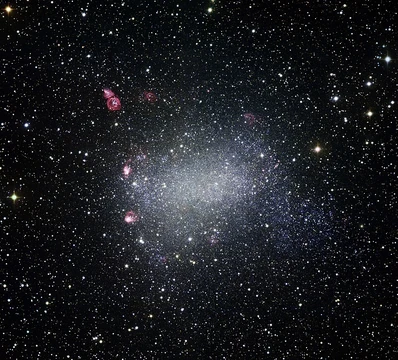
NGC 2336
A large barred spiral galaxy with multiple arms and active nucleus.

NGC 2336 is a barred spiral galaxy in the constellation Camelopardalis, discovered by Wilhelm Tempel in 1876. It lies roughly 100 million light-years away and, given its apparent size, spans about 200,000 light-years across.
The galaxy has a small optical bar surrounded by a ring-like structure with a radius of about 34 arcseconds (equivalent to 5.3 kiloparsecs at its distance). From this ring, at least eight spiral arms extend, filled with numerous HII regions. Within the larger arms, 28 HII regions have been identified that may contain young massive star clusters; for two of them, nebular emission makes up most of the light. Three of these HII areas are estimated to be between 100 and 300 million years old and range from 300 to 600 parsecs in size, possibly forming star complexes that could coexist with younger ones. The most massive HII region, labeled number 13, has a mass estimated at a certain value and spans 810 parsecs across. Ultraviolet observations have revealed 78 star-forming regions, with two located between the spiral arms and six on the galaxy’s ring; their sizes are comparable to NGC 604, one of the largest nebulae in the Local Group. Star formation is most intense in the inner parts of the arms and at the ring.
In the nuclear region, scattered dust lanes that don’t follow a spiral pattern have been observed. No radio-wave, HI, or H-alpha emission has been detected from the nucleus. The nucleus itself is small, with an apparent diameter of 5 arcseconds, while the bulge is large, with a radius of 17 arcseconds. At the center lies a supermassive black hole with an estimated mass of 30 million solar masses, based on Ks-band bulge luminosity. NGC 2336 also hosts an active Type II Seyfert nucleus, discovered by the Ultraviolet Imaging Telescope (UVIT).
One supernova has been observed in this galaxy: SN 1987L, a Type Ia event with a magnitude of 14.2. It was discovered visually on 16 August 1987 by American amateur astronomer James Dana Patchick, using a home-built 17.5-inch Dobsonian reflecting telescope as part of the SUNSEARCH team effort started by Steve H. Lucas. Spectroscopy performed by the William Herschel Telescope on 20–21 October 1987 confirmed it as a Type Ia supernova that had reached its maximum roughly 100 days earlier.
NGC 2336 is the leading galaxy of a small group called the NGC 2336 group.
Quick Facts
- Epoch
- J2000
- Ra
- 07 · 27 · 03.7437
- Dec
- +80 · 10 · 42.212
- Dist Ly
- 90.7 ± 28 Mly (27.8 ± 8.6 Mpc)
- Z
- 0.007352 +/- 0.000003
- H Radial V
- 2204 ± 1 km/s
- Appmag V
- 10.3
- Constellation Name
- Camelopardalis
- Notes
- Hosts AGN: Type II Seyfert Galaxy
Facts from the source article.
Lore & Background
NGC 2336 is a barred spiral galaxy featuring a small optical bar. At least eight spiral arms, with numerous HII regions, emanate from a ring-like structure around the bar. This ring has a radius of approximately 34 arcseconds, corresponding to 5.3 kpc at the galaxy's distance. In the large arms, 28 HII regions have been observed that may host young massive star clusters; for two of them, nebular emission comprises most of the flux. Three of these HII areas have ages calculated to be 100 to 300 million years and sizes between 300 and 600 parsecs, and it is suggested they are star complexes that may coexist with younger ones. The most massive HII region, number 13, has a mass estimated to be and is 810 pc across. Observations in the ultraviolet showed 78 star-forming regions, with two between the spiral arms and six at the galaxy ring; their size is comparable to NGC 604, one of the largest nebulae in the Local Group. Star formation is more intense in the inner parts of the arms and at the ring.
Scattered dust lanes that do not fit into a spiral structure have been observed in the nuclear region. No emission has been detected in radiowaves, and HI and Hα imaging of the nucleus show no emission. The nucleus is small, with an apparent diameter of 5 arcseconds, while the bulge is large, with a radius of 17 arcseconds. At the center lies a supermassive black hole whose mass is estimated to be 30 million solar masses based on Ks bulge luminosity. NGC 2336 also hosts an active Type II Seyfert galactic nucleus, discovered by the Ultraviolet Imaging Telescope (UVIT).
One supernova has been observed in NGC 2336: SN1987L (Type Ia, magnitude 14.2), discovered by American amateur astronomer James Dana Patchick on 16 August 1987 using a home-built 17.5-inch Dobsonian reflecting telescope. The supernova was found as part of a team effort known as 'SUNSEARCH', started by Steve H. Lucas. Spectrography performed by the William Herschel Telescope on 20–21 October 1987 concluded it was a Type Ia supernova with its maximum approximately 100 days before. NGC 2336 is the foremost galaxy of a small group known as the NGC 2336 group and forms a non-interacting pair with IC 467, which lies 20 arcminutes away.
Reader's Guide
NGC 2336 stands out as a large barred spiral galaxy with a complex structure of at least eight spiral arms and a prominent ring around its bar. Its numerous HII regions, including 28 in the large arms and 78 star-forming regions detected in ultraviolet, indicate ongoing star formation, particularly intense in the inner arms and ring. The presence of a supermassive black hole of 30 million solar masses and an active Type II Seyfert nucleus highlights its energetic core. The galaxy's discovery by Wilhelm Tempel in 1876 and the visual discovery of supernova SN1987L by amateur astronomer James Dana Patchick underscore its place in both professional and amateur astronomy. As the leading member of the NGC 2336 group, it provides a context for studying galaxy interactions and star formation in a non-interacting pair with IC 467. The detailed observations of its HII regions, including ages and sizes, contribute to understanding star complex evolution. The lack of radio and HI/Hα emission from its nucleus, despite its active nucleus, presents an interesting contrast. Overall, NGC 2336 serves as a valuable object for studying barred spiral structure, star formation processes, and active galactic nuclei.
Did You Know?
- NGC 2336 spans about 200,000 light years across, roughly twice the diameter of the Milky Way.
- The galaxy has at least eight spiral arms emanating from a ring-like structure around its bar.
- The central supermassive black hole has an estimated mass of 30 million solar masses.
More in NGC Objects, Part 3 1-24
Spotted an error? Know more?
Reader corrections go straight into our review queue. Suggest an edit · How this site is sourced