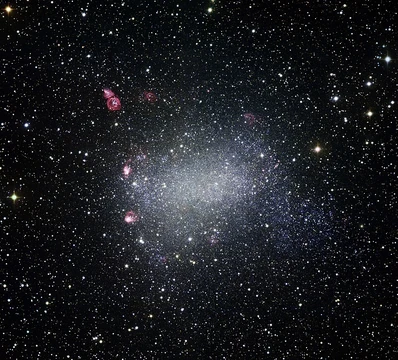
NGC 2325
Elliptical radio galaxy with an active galactic nucleus.

NGC 2325 is an elliptical galaxy found in the constellation Canis Major. It belongs to a group called [CHM2007] HDC 421, which includes at least eight other galaxies, among them IC 456, ESO 427-22, MCG-05-17-006, MCG-05-17-004, and MCG-05-17-008. This galaxy is classified as a radio galaxy, meaning it possesses enormous regions of radio emission that stretch far beyond its visible parts. Additionally, NGC 2325 contains an active galactic nucleus—a compact central zone that radiates strongly across the entire electromagnetic spectrum, with the energy output clearly not coming from stars alone. One supernova, SN 2010ih, was observed here. It was a Type Ia event, first spotted on 29 September 2010 by the CHilean Automatic Supernova sEarch (CHASE) at magnitude 13.3. A prediscovery image from 16 September showed it at magnitude 12.8, making it the brightest supernova recorded in 2010. Measurements of the galaxy’s distance vary: its velocity relative to the cosmic microwave background gives a Hubble distance of 34.76 ± 2.48 Mpc, while 16 non-redshift measurements yield a closer mean distance of 22.850 ± 1.209 Mpc. John Herschel, a British astronomer, discovered NGC 2325 on 1 February 1837.
Quick Facts
- Epoch
- J2000
- Constellation Name
- Canis Major
- Ra
- 07 · 02 · 40.4030ned
- Dec
- -28 · 41 · 50.048ned
- Z
- 0.007288 · 0.0000730ned
- Dist Ly
- 22.850 ± 1.209 Mpcned
- Group Cluster
- [CHM2007] HDC 421
- Appmag V
- 12.38ned
Facts from the source article.
Lore & Background
NGC 2325 was discovered by British astronomer John Herschel on 1 February 1837. Its velocity with respect to the cosmic microwave background corresponds to a Hubble distance of 34.76 ± 2.48 Mpc, but 16 non-redshift measurements give a much closer mean distance of 22.850 ± 1.209 Mpc, leaving its true distance uncertain. The galaxy is a member of a galaxy group designated [CHM2007] HDC 421, which contains at least eight galaxies including IC 456, ESO 427-22, MCG-05-17-006, MCG-05-17-004, and MCG-05-17-008. One supernova has been observed in NGC 2325: SN 2010ih, a Type Ia supernova discovered by The Chilean Automatic Supernova sEarch (CHASE) on 29 September 2010. A prediscovery image taken on 16 September showed it at magnitude 12.8, making it the brightest supernova of 2010.
Reader's Guide
NGC 2325 holds significance as a radio galaxy, meaning it possesses giant regions of radio emission that extend far beyond its visible structure, a characteristic that makes it a subject of interest for studies of galaxy evolution and active galactic nuclei. Its active galactic nucleus indicates a compact central region emitting energy across the electromagnetic spectrum, not produced by stars, which points to the presence of a supermassive black hole. The galaxy's membership in the group [CHM2007] HDC 421 places it within a larger cosmic structure, providing context for understanding galaxy interactions and group dynamics. The discovery of SN 2010ih, the brightest supernova of 2010, adds to its legacy as a site of transient astronomical events. The discrepancy between its Hubble distance and closer non-redshift measurements underscores ongoing challenges in measuring extragalactic distances, highlighting NGC 2325 as an object that continues to refine our understanding of cosmic scales.
Did You Know?
- NGC 2325 is an elliptical galaxy in the constellation Canis Major.
- It was discovered by John Herschel on 1 February 1837.
- SN 2010ih, a Type Ia supernova in NGC 2325, was the brightest supernova of 2010.
- The galaxy is a member of the group [CHM2007] HDC 421, which contains at least eight galaxies.
More in NGC Objects, Part 3 1-24
Spotted an error? Know more?
Reader corrections go straight into our review queue. Suggest an edit · How this site is sourced