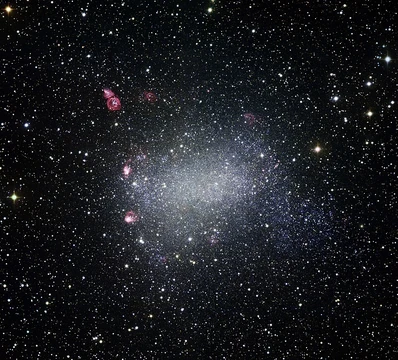
NGC 2300
Lenticular galaxy possibly hosting the largest radio lobes of any GRG.

NGC 2300 is a lenticular galaxy located in the constellation Cepheus. It is possibly the nearest known giant radio galaxy, with radio lobes spanning about 3.5 million light-years and an apparent size of 132 arcminutes—the largest such angular extent of any giant radio galaxy. The source of these radio lobes is not firmly established; they could be linked to NGC 2276, though that is improbable given NGC 2276 is a spiral galaxy.
The galaxy's velocity relative to the cosmic microwave background is 1876 ± 7 km/s, implying a Hubble distance of 27.67 ± 1.94 megaparsecs. However, eleven measurements not based on redshift yield a distance of 40.464 ± 6.668 megaparsecs. Discovered in 1871 by French astronomer Alphonse Borrelly using an 18 cm telescope, NGC 2300 is listed in the SIMBAD database as an Active Galaxy Nucleus Candidate, meaning its center contains a compact region emitting substantial energy across the electromagnetic spectrum, with characteristics indicating the luminosity does not come from stars.
Together with NGC 2276, it forms the 114th entry in Halton Arp's Atlas of Peculiar Galaxies. One supernova has been observed in NGC 2300: SN2024uai, a type Ia-91bg-like event with a magnitude of 16.58.
Quick Facts
- Epoch
- J2000
- Constellation Name
- Cepheus
- Ra
- 07 · 32 · 20.5
- Dec
- +85 · 42 · 31.9
- Z
- 0.00641
- H Radial V
- 1,917 km/s
- Dist Ly
- 27.67 ± 1.94 Mpc
- Group Cluster
- Arp 114
- Appmag V
- 10.76
- Absmag V
- −22.0
Facts from the source article.
Reader's Guide
NGC 2300 is notable as a possible host of the largest radio lobes of any giant radio galaxy, spanning roughly 3.5 million light years with an apparent size of 132 arcmin. Its status as the closest discovered GRG remains uncertain because the radio lobes' host has not been definitively identified; while NGC 2276 is a candidate, its spiral morphology makes it an unlikely host. The galaxy's classification as an Active Galaxy Nucleus Candidate adds to its astrophysical interest, suggesting a central engine that outshines its stellar population. One supernova, SN2024uai (type Ia-91bg-like, magnitude 16.58), has been observed in NGC 2300. Its inclusion in Arp's Atlas of Peculiar Galaxies alongside NGC 2276 highlights its role in studies of interacting or disturbed systems.
Did You Know?
- NGC 2300 may be the closest discovered giant radio galaxy.
- Its radio lobes have an apparent size of 132 arcmin, the largest of any giant radio galaxy.
- The galaxy is an Active Galaxy Nucleus Candidate according to the SIMBAD database.
- One supernova, SN2024uai, has been observed in NGC 2300.
More in NGC Objects, Part 3 1-24
Spotted an error? Know more?
Reader corrections go straight into our review queue. Suggest an edit · How this site is sourced