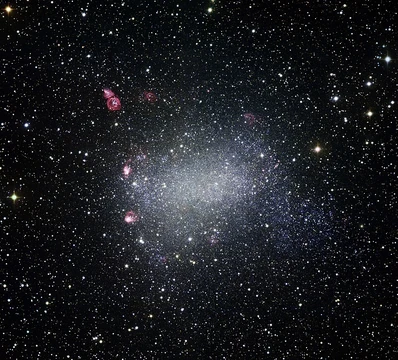
NGC 2280
A large, undisturbed spiral galaxy in Canis Major.

NGC 2280 is a spiral galaxy located in the constellation Canis Major, approximately 75 million light years from Earth. It spans about 135,000 light years across and is notable for its undisturbed spiral pattern and a supermassive black hole at its nucleus.
Quick Facts
- Epoch
- J2000
- Ra
- 06 · 44 · 49.0984
- Dec
- -27 · 38 · 18.405
- Dist Ly
- 74.6 ± 16 Mly (22.9 ± 5.0 Mpc)
- Z
- 0.006334 +/- 0.000010
- H Radial V
- 1899 ± 3 km/s
- Appmag V
- 10.5
- Constellation Name
- Canis Major
Facts from the source article.
Lore & Background
NGC 2280 was discovered by John Herschel on February 1, 1835. It has a small bright nucleus, with spiral arms that are narrow and of high surface brightness in the inner disk, becoming broader and lower in surface brightness in the outer disk, where more knots appear. The east arm can be traced through about 540°, while the west arm fades after about 360°. The galaxy's spiral pattern is undisturbed, with regular flow and no evidence of a bar or oval distortion. At its nucleus lies a supermassive black hole with an estimated mass between 4 and 15 million solar masses, derived from the galaxy's pitch angle.
One supernova has been observed in NGC 2280: SN 2001fz, a type II supernova discovered by the Beijing Astronomical Observatory Supernova Survey on November 15, 2001, with a peak magnitude of 17.4. The galaxy belongs to the NGC 2280 galaxy group (LGG 138), which includes the possibly merging lenticular galaxies NGC 2292 and NGC 2293, as well as NGC 2295, ESO 490−G010, and ESO 490−G045. The group was identified in 1993 by Garcia et al. using redshift data. Although smaller galaxies near NGC 2280 could be companions based on redshift, there are no significant indications of recent interactions or tidal distortions such as warps. Gerard de Vaucouleurs had placed NGC 2280 in a different group with NGC 2139, NGC 2207, NGC 2217, and NGC 2223.
Reader's Guide
NGC 2280 is significant as a relatively nearby, large spiral galaxy that exhibits a classic undisturbed spiral structure, making it a valuable object for studying the dynamics of spiral arms and galactic morphology. Its lack of a bar or oval distortion and regular flow pattern provide a clear example of a pure spiral galaxy. The presence of a supermassive black hole at its nucleus, with mass estimated via pitch angle measurements, contributes to understanding the relationship between black hole mass and galactic structure. The galaxy is also notable as the namesake of the NGC 2280 group, a collection of galaxies identified through redshift surveys, though it shows no signs of recent tidal interactions with its neighbors. The single observed supernova, SN 2001fz, adds to the record of stellar explosions in this system. Its legacy lies in serving as a benchmark for studies of undisturbed spiral galaxies and as a member of a well-defined galaxy group.
Did You Know?
- The galaxy's supermassive black hole mass is estimated between 4 and 15 million solar masses.
- Only one supernova, SN 2001fz, has been observed in NGC 2280.
- The east spiral arm of NGC 2280 can be traced through about 540°.
More in NGC Objects, Part 3 1-24
Spotted an error? Know more?
Reader corrections go straight into our review queue. Suggest an edit · How this site is sourced