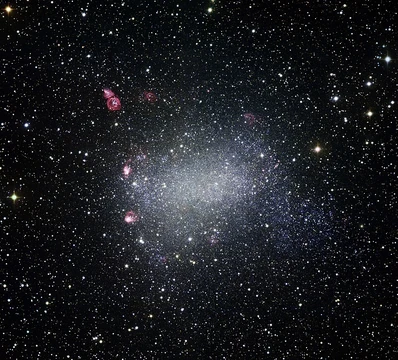
NGC 2276
A disturbed spiral galaxy with a black hole and supernova history.

NGC 2276 is an intermediate spiral galaxy located in the constellation Cepheus, approximately 120 million light-years from Earth. It is notable for its asymmetrical appearance, likely caused by gravitational interactions with its neighbor, the elliptical galaxy NGC 2300, and for hosting an intermediate-mass black hole in one of its starburst spiral arms.
Quick Facts
- Epoch
- J2000
- Ra
- 07 · 27 · 13.9755
- Dec
- +85 · 45 · 15.877
- Dist Ly
- 120 Mly (36.8 Mpc)
- Z
- 0.008062
- Appmag V
- 11.8
- Constellation Name
- Cepheus
Facts from the source article.
Lore & Background
NGC 2276 was discovered by Friedrich August Theodor Winnecke on 26 June 1876. Its asymmetrical shape is thought to result from gravitational interactions with the neighboring elliptical galaxy NGC 2300, and the galaxy is moving at an orbital velocity of about 968 km/s relative to the NGC 2300 group. A long tail of interstellar medium, roughly 300,000 light-years long, trails behind NGC 2276, formed by ram pressure stripping.
The galaxy exhibits an enhanced rate of star formation, possibly triggered by a collision with a dwarf galaxy or by gravitational compression of gas and dust from its neighbor. One of its starburst spiral arms contains an intermediate-mass black hole designated NGC 2276-3c, with a mass of 50,000 times that of the Sun. This black hole has produced two jets: a large-scale radio jet about 2,000 light-years long and an inner jet about 6 light-years long.
NGC 2276 is listed twice in the Atlas of Peculiar Galaxies: as Arp 25 (spiral galaxies with one heavy arm) and, together with NGC 2300, as Arp 114 (elliptical galaxies close to and perturbing spiral galaxies). Six supernovae have been observed in NGC 2276, including SN 1962Q, SN 1968V, SN 1968W, SN 1993X, SN 2005dl, and SN 2016gfy.
Reader's Guide
NGC 2276 holds significance as a well-studied example of a galaxy undergoing gravitational perturbation and ram pressure stripping. Its asymmetrical structure and long tail of interstellar medium provide insights into the dynamics of galaxy interactions and the effects of ram pressure in dense environments. The presence of an intermediate-mass black hole, NGC 2276-3c, with its dual radio jets, offers a rare opportunity to study black hole activity at a scale between stellar-mass and supermassive black holes. The galaxy's enhanced star formation rate, possibly triggered by a dwarf galaxy collision or gravitational compression, makes it a valuable laboratory for understanding starburst processes. Its inclusion in the Atlas of Peculiar Galaxies under two separate entries (Arp 25 and Arp 114) highlights its distinctive morphology and its interaction with NGC 2300. The six recorded supernovae, mostly Type II, contribute to the study of core-collapse supernova rates and progenitor systems in starburst environments. NGC 2276 remains a key object for research on galaxy evolution, black hole formation, and the interplay between galaxies in groups.
Did You Know?
- NGC 2276 has an asymmetrical appearance likely caused by gravitational interactions with its neighbor, NGC 2300.
- It contains an intermediate-mass black hole named NGC 2276-3c with 50,000 times the mass of the Sun.
- A long tail of interstellar medium about 300,000 light-years long trails the galaxy due to ram pressure stripping.
More in NGC Objects, Part 3 1-24
Spotted an error? Know more?
Reader corrections go straight into our review queue. Suggest an edit · How this site is sourced